The last time we really heard from the Satyricon camp in a big way, it was some bleak news that had nothing to do with black metal, black n’ roll, or however you might describe their post 2002 musical output. Frontman and guitarist Satyr (Sigurd Wongraven) announced on Instagram on October 5th, 2015 that upon being rushed to the hospital after feeling extremely ill, doctors found a brain tumor that while Satyr described as “most likely” benign, still managed to rattle myself and I’m sure many others who read the statement. I remember we discussed it on the MSRcast around then, and then everyone just kinda held their breath to see what would happen. I began following Satyr’s Instagram feed because of that post, and was encouraged to see his upbeat, positive nature in regards to his new found condition and how he seemed to just be forging ahead with life in general. He has one of the most intriguing Instagram feeds of any metal musician out there, particularly in the black metal realm where the majority of the big names are fairly reclusive when it comes to social media (understandably). Satyr’s feed is startlingly candid, featuring photos of his family life, his kids, a lot of his work in relation to his wine making (hosting wine tasting dinners in super fancy Norwegian restaurants… seriously), artistic pictures of some incredible looking meals, and generally devoid of most of the grim and brutal things you’d normally associate with the guy who penned Nemesis Divina. He replies to comments frequently, and has been open with his current medical status, which is thankfully fine, though he says he’ll have to be on alert for any signs of that changing.
What he took away from that intensely frightening personal experience was a sense of urgency, about life in general but also about his art. It was reflected in his statement in the press release for the album,
“Approaching this release, what I always kept in mind is that either this is the beginning of something new or it’s gonna be my last record. If this is going to be the last, then it needs to be something special. If there are more records, then I’d better make sure that this is so different from the last one that it feels like a new beginning. I think it’s really, really dark, very spiritual and filled with confidence and energy.”
– Satyr
I don’t usually quote from press releases in my album reviews, but this one is pertinent to fully understanding where Satyr is coming from as a songwriter on Deep Calleth Upon Deep. And of course before delving into this album, we should talk about where we all stand as fans or critics of the two major divisions of Satyricon’s career. Personally I love it all, but I came in at the end of their classic black metal era, that run from Dark Medieval Times through The Shadowthrone and their masterpiece Nemesis Divina. Their modern era, which arguably started with 1999’s Rebel Extravaganza (some would say 2002’s Volcano) has its share of detractors, particularly when singles like “Fuel For Hatred” and “K.I.N.G.” moved into a far more simplified musical direction, with shorter and more to the point songwriting built around catchy riffs and hooky choruses. But the band’s success increased throughout this latter era, and they released some of their best work as well —- to my ears anyway. I do understand some folks longing for a band like Satyricon to release something in their classic style again, with their Norwegian-ness and inherent second wave pedigree. But I’d argue that Satyricon have forged a sonic identity unique to themselves in their pursuit of a simpler, more direct songwriting approach. Its not new anymore, they’ve been in this milieu for just under two decades now, and they’ve released a handful of albums in its vein, but its unmistakably Satyricon’s.
On their previous album, the self-titled Satyricon in 2013, I wrote that the band was attempting to try something new and fresh, to shake off the black n’ roll tag they had been shackled with, describing its sound as “…the sound of black metal’s moods, tones, and temperament, but purposefully stripped of its surface aggression.” It was an intriguing shake up of their sound, one that was regarded with dismay by quite a large part of their audience, even the ones that had gotten on board during the Now, Diabolical and The Age of Nero eras. What I hope for those of you who were thrown off by that last album’s strange sonic deconstruction of the band’s black metal sound is that you’ve had enough time to digest it properly and appreciate some of its more abstract aspects. I emphasize this because even though four long years separate it and Deep Calleth Upon Deep, and even though this album is truly the beginning of something new for the band, they’ve continued that album’s exploration of a more muted sound (slightly less this time), as well as carrying over a penchant for atmospherics that they gained from that experience. In many ways Deep Calleth is a kaleidoscope of an album, its various turns featuring glimpses of the full spectrum of their career, from classicist black metal grandeur to grim, punchy black n’ roll, set to a backdrop of haunting atmospheric touches that often transcend mere keyboard studio trickery. Now I know what you’re thinking… Pigeon, you’re telling me this is the start of a new, fresh Satyricon yet you’re telling me they’re continuing the sound of their last album, which I loathed? Yes, and that’s seemingly a contradiction, but this is a band talented enough to make it work.
 I’m going to go out on a limb here, and say this is the best Satyricon album start to finish since Nemesis Divina. its just absolutely captivated me and held me in thrall since I first started listening to it weeks ago. To say its shocked me is an understatement, because although I always expect to enjoy most of a new Satyricon album (being a fan of the band), what I’m hearing on this album is the sound of a songwriter delivering his most inspired, most meaningful material —- perhaps ever. These songs are filled with imagery recalling nature, particularly in its wild, untamed, and primitive state, and the effect is spellbinding. There’s a spirituality to Deep Calleth Upon Deep that has eluded previous Satyricon albums. This comes through in the lyrics straightaway, as on the album opener “Midnight Serpent”, where Satyr barks in that inimitable grimness, “From soul to soul—I speak to you / God of no gods—I’m slave of none / I pledge to fight—your cause is mine”. The song lays out the underlying theme of the album, which Satyr remarked in that same press release I quoted before that the album was thematically about the essence of appreciating art itself. The very title of the album is in reference to this, that the creator digs deep within to create, and if the listener wants to truly appreciate that art, they have to dig deep within themselves as well. That may sound sanctimonious to some, but to me its the very root of what it takes to be a metal fan. And Satyr is writing with an eye towards his mortality as well, which adds gravitas and urgency to his spoken word lyric later in the song, “Face of morbidity / spotted through the keyhole / Unlocked by the persecuted / who wants nothing but the sunlit meadows”. When he barks a few bars later, “Let another song reverberate”, you know he means it like nothing else.
Its the first salvo in a barrage of excellent, inspired songs, the next being the uptempo “Blood Cracks Open The Ground”, where we get to hear our first example of how the sound from their previous album has carried over yet not dominated on these new songs. The band employs space between instruments, wide and airy as production technique to work as a counterbalance to the song’s heavy riffing and rumbling, thunderous percussion. I know that this particular approach to production and mixing must aggravate those who are used to Satyricon’s dense, crushing wall of sound that adorned albums like Now, Diabolical but I do feel it has a purpose. The guitars here are highly melodic, full of twisting, spiraling patterns that are center stage, not running into slabs of brutal rhythm guitars and having to fight for space in the mix. The result is an unorthodox way to perceive black metal, as not a furious assault on your ears, but a focused, concentrated effort —- and you’ll know what I mean at the 3:20 mark, where Satyr hones in over a particularly ominous chord progression with “Ravens flee / Pitch black”, the combination of the two resulting in a truly unsettling but addictive moment. The production (more precisely, the mixing) on this song and indeed throughout the album is best characterized as warm, open, and spacious. Instruments are given room to breath individually, even down to the basslines, and I think that’s on purpose. Nothing is able to hide under blankets of riffs in Satyricon’s new sonic world.
Those aforementioned sonic attributes are central to the triumph of “To Your Brethren In The Dark”, a slow-dance tempo meditation built on open chord sequences that ascend and descend like that skeleton you always knew was walking up and down your staircase at night when you were a kid (oh is that just me??). This is normally the kind of song that should irritate me, a slow moving dirge when I really want the album to be kicking off into high gear around track number three, but I’ve loved this upon first listen. I can’t explain why, but there’s something immensely satisfying about its construction —- the lead guitar motif that first appears at 1:26 is so beautifully wrought and evocative in itself that I want to grab hold of it like a corgi puppy. The patient rhythmic structure at work here is a coordinated effort between those open chord figures and Satyr’s most reigned in, yet still tension-filled vocal performance. His lyrics here are spectacular, perhaps his best ever amidst a career full of praise-worthy work, this time writing them with an eye towards poetic structure and rhythmic meter and the symmetry of it all. My favorite stanza is in the middle, “October sky, October leafs / and the silence, of nightfall / pass the torch to your brethren in the dark”, that last line serving as the song’s echoing refrain, a beautiful image that can sit at the center of the album’s thematic core. What an incredible song.
I’ll refrain from going on at length about every single song because I know I’ll be writing about this album again, but the rest of the record is just as spectacular. The early lead single was the title track, and it hits even harder within context of the album, being one of the most slyly hooky songs of the year. The background vocals by tenor Hakon Kornstad add an extra dimension to the soundscape here, as well as on “The Ghost of Rome” —- his contributions sounding more like the grief stricken wailing of some old-world woman at a funeral pyre. And I have a specific fondness for some of the riffs in specific passages of “Burial Rite”, particularly around the 3:27 mark when things get monstrously heavy after a section that was almost loose enough to be called jazz, a wild juxtaposition. Songs like “Dissonant” and “Black Wings and Withering Gloom” are fierce and fiery enough to prevent this album from leaning towards the slower end of the spectrum. Its a far more aggressive affair overall than Satyricon, despite continuing for the most part in that album’s sonic palette production/mix wise. That might be a stumbling block for some, but its worth trying to push past. It sounds borderline trite to say this, but Satyr’s brush with mortality has seemingly given him a focus that we’ve never heard from him. These songs have a clarity about them lyrically and musically, with a sense of vitality that is palpable. In a year where black metal has been unusually quiet, Deep Calleth Upon Deep is a cannon shot from the Norwegian wilderness that its old veterans still have the mastery of this dark art.
 Strange things are afoot in the music world right now, because as of this writing, Steven Wilson’s much anticipated new album To The Bone is sitting at the number one spot in the UK Official Albums Mid-Week chart (its since debuted at #3, the release of this review was delayed by Hurricane Harvey stressing me out). It was seen as a deserved triumph when his 2015 masterpiece Hand. Cannot. Erase. seemed to finally bang loudly on the mainstream’s doors by debuting at #13 in the UK, a high water mark for his career (solo, Porcupine Tree, otherwise). But even the most optimistic among us had to suspect that it would be as good as it gets, and his next releases would hover just slightly below that mark. But no, To The Bone and its prog-fan enraging single “Permanating” seem to be readying to —- as former Houston Oiler’s coach Bum Phillips once said —- “kick that sumbitch in” entirely. His closest competition is the Game of Thrones appearing goofball Ed Sheeran, the pop equivalent to a glass of warm milk before bedtime, and audible proof enough that Wilson’s right about the unambitious, flaccid state of modern pop music. And yes, this is very much the most overtly pop album Wilson’s recorded since 2004’s Blackfield debut, or more accurately due to similarity in tones, since 1999’s Lightbulb Sun by Porcupine Tree. Wilson’s fans come in a spectrum, from those who relish his most far out prog adventures to those who are more attuned to his ability to demonstrate masterful song craft and the odd musical or vocal hook. To The Bone functions if anything as a ready barometer to see where you fall on that spectrum.
 First, the majority of the controversy surrounds one of the album’s advance singles, a bright, bubbly piano jaunt named “Permanating” (love that word creation!) that owes more to The Carpenters and ABBA than to Genesis and Yes. It is indeed the most positive, uplifting song Wilson has ever penned, the close second being “The Rest Will Flow” from Lightbulb Sun, and its notable for that reason alone. Nevermind that its got a hook and easy appeal that could see it fit alongside ol’ Ed, Coldplay, and Mumford & Sons on BBC2 Radio. This isn’t Wilson’s first brush with the idea of radio success either, as many of you will remember that “Shallow” from Deadwing actually landed on the Mainstream Rock chart here in the States back in ’05. And for all the hoopla around “Permanating”, it hasn’t actually landed on any UK singles charts yet, so maybe all the noise surrounding it will be all for naught. Now I know what you’re thinking, that the most poppy Wilson penned pop number would logically be my favorite, and while I do enjoy “Permanating” overall, its actually not my pick for the best pop tune he’s written, nor is it my favorite tune on this album. His best pop tune? Debatable —- but right now my mind went to a battle between “Hand Cannot Erase” (the title track for that album) and a classic gem like “Trains”. The best song on To The Bone? Well… let’s not get ahead of ourselves here, we still need to talk about the album as a whole.
 Awhile back in August of 2014, I wrote a
  The resulting Indie-Go-Go crowdfunding campaign ran all of this past March. Instead of offering the usual run of merch n’ perks that most bands put up in exchange for donations, the only donation option was for “The Forest Package”, which was essentially the band’s new album The Forest Seasons, its instrumental twin plus a remastered version of Time I (and its instrumental version), as well as the remaster of the debut album along with the Live at Tuska 2013 live album. When this news went out I actually thought that it was a smart move, to just simply offer the die hard Wintersun fan a pre-order of the new album (essentially) plus a host of other Wintersun music that you could get a tidy amount for per person. It wouldn’t appeal to a casual fan like myself, and as a result I suspect many of us scoffed at the band’s overall stated goal of 750,000 Euros (a goal to be reached in chunks —- this being the first of three crowdfunding campaigns), but the band has gotten the last laugh as they netted € 428,310 in just March alone, more than halfway towards their goal. Kudos to them, seriously. I’m not against crowdfunding in metal, I think that its a valid way to go if a band can pull it off. With Mäenpää, the frustration was that he had started clamoring for a crowdfunding attempt after making his fans wait a decade, not to forget the numerous delays and social media posts that grated on everyone’s patience. Its a testament to the man’s music that so many didn’t hold that against him in March.
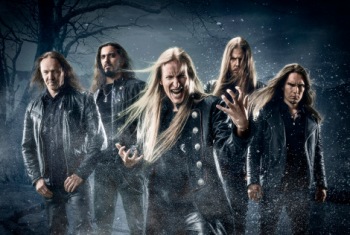 Riding such a high from the sounds of spring and summer, its a bit of a bummer that I couldn’t find as much enthusiasm for “Eternal Darkness (Autumn)”, and “Loneliness (Winter)”. You’d figure with the band’s name being Wintersun that these would be home runs, and while they’re not bad by any stretch of the imagination, they don’t inspire the same awe and grandeur of their more flowery siblings. With autumn we get the band’s most blistering attack ever, its furious black metal assault nearly running the gamut of the track’s fourteen minute run time. There are breaks here and there, the song being broken up into “parts”, transitioned by more breathable musical interludes. This piece instantly reminded me of fellow Finns Insomnium and their Winter’s Gate album, both in tonality and sheer aggression —- great for depicting the brutality of winter, which is what made Insomnium’s album so convincing, but I’m not so sure it was the wisest choice for the autumn sequence. The suite’s second half is so reminiscent of Dimmu Borgir riff sequences (complete with Tim Burton-esque orchestrations and Shagrath-like vocals) that I wonder if they weren’t a direct inspiration. Its a trying piece, one that is unforgiving in its attack and devoid of the Wintersun melodicism we all came for, and I just don’t think it succeeds on any level.
 Our lovable crazy Germans from the little town of Fulda are celebrating twenty-five years of rockin’, and in keeping with how these things are usually marked, we’re getting a career retrospective that spans two discs, as well as a third that’s a DVD with a few music videos and footage of a concert from 2004. I wouldn’t normally review these types of releases, because really, what is there to review apart from song selection? But as I did with Blind Guardian and their
  If you’re wondering what the heck I’m referring to with that last sentence, basically in my
  Iced Earth – Incorruptible:
 When the initial preview track “Seven Headed Whore” was first released, I was a bit taken aback by what I believe I described as its modern day Slayer vibe. Now after having sat with it for a few months and hearing it in the context of the album, particularly as a change of pace after those aforementioned preceding semi-ballads, it holds up a little better. It actually feels like a spiritual cousin to “Violate” from Dark Saga, which also wasn’t my favorite track on that album but helped to inject some welcome variation in a largely mid-tempo album. I’ve read some criticism online of its overtly political lyrical theme, and Schaffer’s had his share of critics and derision when he discusses his views on, well, everything in interviews. All that aside, I’ve always found Schaffer to be one of the most interesting, thoughtful, and engaging interview subjects in metal (his half-hour interview on the bonus disc of Horror Show is a classic). I consider myself a patriotic American citizen, no more or less than others, and it was with Iced Earth that I first heard metal that spoke to that (thinking of classics like “Ghost of Freedom” off Horror Show, and “1776” from Something Wicked). Schaffer’s music was the motivating factor in getting me reading about the civil war for the first time and understanding its historical importance. He’s a valuable voice in metal, regardless of whether you agree or disagree with what he’s said.
 Vintersorg – Till fjälls, del II:
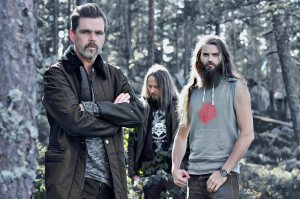 I know I rail against that kind of stuff hard, but it wasn’t an attitude I came to easily. For years I gave a lot of those bands leeway and a ton of patience, but where they ended up is so far from what I loved about folk-metal in the first place. In the liner notes of the awesome 2000 release Cosmic Genesis, Vintersorg thanked Carl Sagan, and delivered the still shiver inducing lyrics “In heaven I am a wild ox / On Earth I am a lion… The Scientist of darkness / Older than the constellations…” (on “The Enigmatic Spirit”). In summary, it was so much more elevated, thoughtful, and yes, spiritual than the bizarre, troll cosplaying, beer drinking singalongs that the bulk of the genre degenerated into after Finntroll released their “Trollhammaren” single in 2004. I feel this return to that older spirit when listening to Till Fjalls del II, even more than I did in spare, momentary glimpses on his past three “elements” albums where he did slowly incorporate more of his old folk stylings. Those albums, particularly Solens Rotter and Orkan found Vintersorg trying to regain his footing in songwriting in a less convoluted, progressive structure. They were still infused with the avant-garde quality of Visions From the Spiral Generator and The Focusing Blur, and as a result were at times murky and difficult.