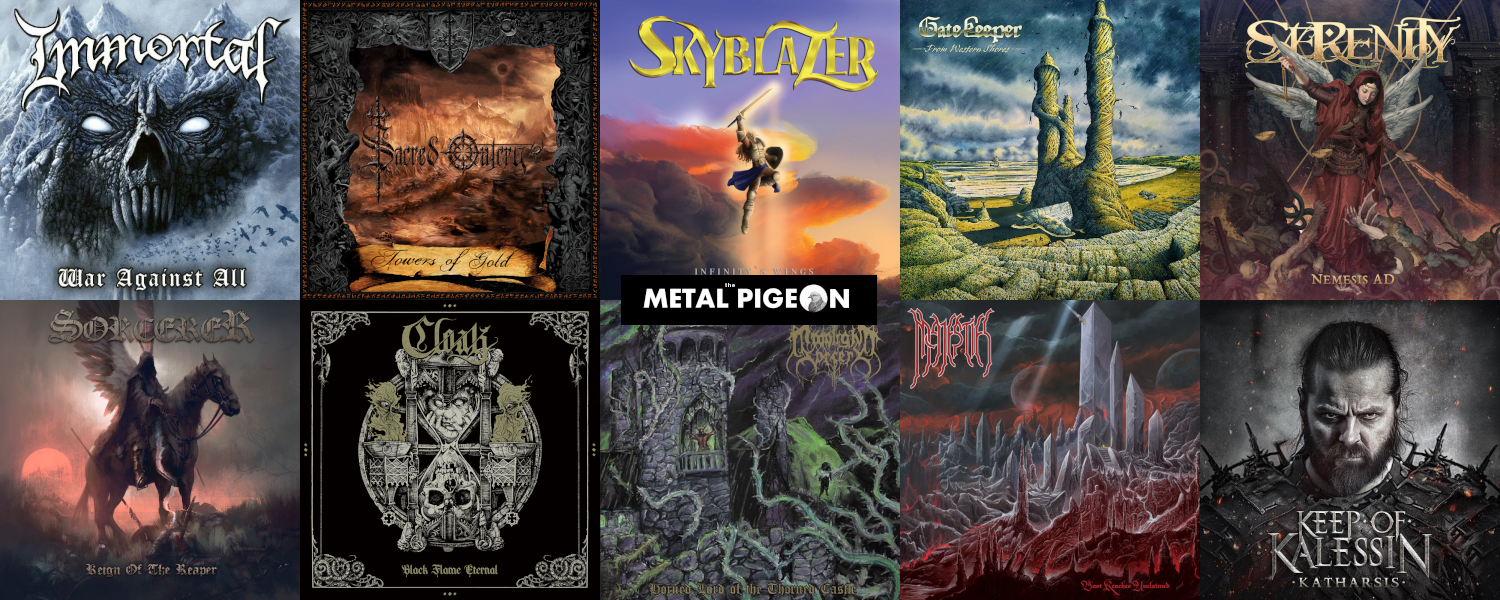
I can’t begin to describe just how relieved and happy I am to present the best albums of 2025 list, because damn was this a challenge to put together. Easily the hardest list I’ve had to winnow down in all the years of doing The Metal Pigeon, I had twenty one shortlisted nominees and it took me weeks of listening, relistening, and making notes (that I couldn’t make heads or tails of when reading back later) just to narrow them down to ten. I spent another week or so tooling around with the top ten list order several times, just to make this even more difficult for myself. At one point, I was flipping coins to decide who to put at the number ten spot just because I couldn’t decide and felt guilty — thankfully, I ceased this madness and decided to put in the actual work of relistening to the albums in question back to back and having them compete against each other to decide who would make it. Yes I realize I have a problem. And the thing is, I didn’t see this coming, because these lists over the past few years have come together relatively easily in comparison, but for whatever reason 2025 had a slew of great albums that when it came down to it were very hard to rank amongst each other, with the exception of perhaps the top three on this list. I’ll keep this short and sweet, only to mention a reminder to check out the Best Songs list if you haven’t yet, subscribe to the MSRcast wherever you listen to podcasts, and to thank anyone and everyone who came to this blog and read something I wrote. I’m always amazed and grateful that people do so. Hope everyone has a great new year!
10.Avantasia – Here Be Dragons
I know what you’re thinking, big surprise, an Avantasia album lands on The Metal Pigeon’s year end list, but hear me out for a sec — even I’m surprised that Here Be Dragons landed in the top ten. Up until I started reviewing this year’s releases in preparation to assemble nominees for this list, I didn’t think this album was a serious contender for most of this past year. When the album first came out in early spring, I expressed quite a bit of criticism towards it, and much of that still stands in my opinion as I write this. Roy Khan was squandered as a guest vocalist on “Everybody’s Here Until the End”, Geoff Tate’s guest spot on the title track was underwhelming, causing me to wonder if his role in the cast of guest vocalists is really necessary anymore, and I longed for this album to hit harder and heavier than it did (largely due to the intentionally rounded 80s prog influenced production approach). There were two songs here that were solo sung Tobias Sammet tunes in “Creepshow” and “Unleash the Kraken”, thus calling into question their presence on an Avantasia album where the whole schtick is supposed to be guest vocalists on every track. But for all its frustrations, this was also a collection of seriously brilliant songwriting, some of Sammet’s best in years actually. He conjured up magic for Bob Catley once again in “Bring On the Night”, delivered a Best Songs listee in the awesome rocker “The Witch”, delivered a convincingly heavy Priest-ian turn in the aforementioned “Unleash the Kraken” (shades of Edguy’s “Nailed to the Wheel” on that one), and crafted one of those trademark magical, epic choruses in the title track that just made it an undeniably awesome song. This entire album was in my Spotify generated Your Top Songs of 2025 playlist, and that fact snuck up on me, that this album stuck with me throughout the year despite my most critical eye on it. Easily his best effort since Ghostlights, Sammet’s talent as a songwriter is the high tide that raises all ships, even if they’re leaky.
Its probably not a surprise to see this one here given how much we were raving about Novembers Doom’s twelfth album Major Arcana a couple months back on the MSRcast, and even here on the blog; but this was clearly a shoe-in for this list, the question was where it would land. Don’t think that because its back here at the nine spot that my affection for it has lessened, because it did not — however there is a likelihood that I played this so much in September and October that I burned myself out on it and it fell back a touch when I went back to review all the nominees. The unfortunate quirk about having to cobble together these lists is that you have to defend against recency bias and not forget about older records, but also consider how often you kept coming back to an album throughout the year, and if you go hard on listening to an album when it comes out and overplay it, that latter facet may begin to suffer. There’s also the reality that Novembers Doom do not make bad albums. They consistently make very good to great albums, and that kinda works against them sometimes because no one will be surprised to learn that Major Arcana is the most satisfyingly heavy record on this list, just hitting you repeatedly with sledgehammer riffs and a thunderous rhythm section. The best songs listee title track should be proof enough of this, but that wasn’t the only song that could’ve made that list, consider the empowering “Ravenous” and its teeth gritting circular riff progression. Vocalist Paul Kuhr is a titanic force throughout, and his ability to blend together harsh and clean vocals as a result of some mystifying physiological freak of nature ability is a singular talent, there’s no one else quite like him in the extreme metal space. Consider this one of the band’s truly great albums, a top three for me alongside Hamartia and ThePale Haunt Departure. The execution here was perfect, the thematic framework of the songs representing the major arcana cards in a tarot deck was truly inspired, and this band seemingly has no bottom to their well of creativity.
Sailing under the radar of most this year was this potent debut by new gothic doomsters Opia, its members hailing from Spain, the UK and elsewhere. Reminding me at times of Draconian’s lush melancholic melodies, and often of Swallow the Sun’s brutal heaviness during the more violent moments, Opia weave these influences into their own sonic brew of patient tempos and carefully painted atmospheres. Their greatest strength is in these modulating, gradual builds that interject washes of color into their nominally charcoal grey palette, as on “Man Proposes, God Disposes” (what a title!). It contains my favorite moment on the album just before the three minute mark where it seems like sunrays are slowly illuminating some unknown pit of darkness. That Swallow the Sun vibe really hits during “On Death’s Door Part I”, not only for vocalist Tereza Rohelova’s Mikko Kotamäki-ian screaming harsh vocal tone, but for guitarist and main songwriter Phoenix Griffiths’ penchant for crafting riff progressions that are sneaky earworms, operating as microhooks to counterbalance the permeating atmosphere they layer on via Jorge Afonso Rodríguez’s artful keyboard arrangements. This balancing act flourishes on “Days Gone By”, where Griffiths cuts loose with some sharp edged riffs that get close to outright heavy metal despite carefully navigating through the somber atmosphere. On “The Eye”, Rohelova’s clean vocals are rich and clear, carrying with her performance a feeling of introspection that reminds me of some of Martina Astner’s vocals on Therion’s Vovin album. I think that my immersion into old gothic metal over the past year and a half really put me in the headspace to be receptive to Opia, because their music requires patience for sure, and I don’t always have that in great supply. I had been keeping my ears open for interesting goth metal or even gothic tinged metal, and Opia has a take on the genre that certainly is a crossover to a more extreme interpretation of it as opposed to say Sentenced and Charon, but like their fellow gothic doomsters in Messa, they are redefining the boundaries of the genre in subtle but important ways.
7.Saor – Amidst the Ruins
Scotland’s Andy Marshall returned this year with yet another album of spiritually powerful, epic folk metal in Amidst the Ruins. Even that description fails in adequately describing the kind of all encompassing musical journey that Saor takes you on as you sit back and let this album wash over you. Like its best albums list making predecessor Origins three years ago, this albums most unforgettable moments are not necessarily its heaviest, but more its elegant sweeps into blissful melodic transcendence. Whether intentionally or not, Marshall managed to combine Origins bagpipe draped, cinematic epic grandeur with the grounded, earthen toned warmth of 2019’s Forgotten Paths. This merging of these two approaches is heard straight away on the opening title track, where a juxtaposition of the beautifully melancholic sweep of violin, viola, and cello artfully play counterpoint to the tumultuous violent metallic sequences layered underneath. Marshall’s magic talent lies in being able to bring together these apparently dichotomous elements, sounds, and moods together in perfect harmony, rather than separating things out into heavier and softer passages. The ending minutes of this song were one of my favorite bits of ear candy this year, that beautiful melody line echoed on lead guitar and Ella Zlotos’ beautiful low whistle playing. And while it narrowly missed landing on the best songs list, album closer “Rebirth” is in the running for my favorite Saor composition ever, its blending of blackened folk metal with some progressive song structuring captivating me for its fourteen minute run (tellingly, it does not feel that long). Its coda, with Zlotos adding her gorgeous, sonorous vocals to the mix is one of those aforementioned transcendent moments, reminding me of shades of Enigma, and leaving you with an emotional ripple of peace, calm, and serenity, a very strange thing for even a folk metal record to achieve, let alone a metal record. But Saor are proving time and time again that they are not a typical folk metal band.
6.Ancient Bards – Artifex
It’s a credit to the talents of keyboardist/main songwriter Danielle Mazza and the incredibly talented Sara Squadrani that not even a six year gap since their last release, Origine – The Black Crystal Sword Saga Part 2, could derail what has been a picture of consistency in quality if not quantity. Picking up where they left off on the last album, Ancient Bards sound is indeed more cinematic and expansive than their earlier days where you could decipher out influences such as Rhapsody of Fire, Luca Turilli, Derdian, and Vision Divine. Those days of virtuosic guitar driven power metal have been slowly scaled back over the years into a more symphonic metal driven style that reminds one more of Epica and perhaps even Dark Moor’s mid-career transition post Alfred Romero joining the band. This album had a relatively quiet release reflecting perhaps the change in the band’s status as a touring outfit to a more stationary, studio based project, with little fanfare leading up to it (after years of speculative silence) and little press done to promote it save a few revealing Mazza interviews where he hints that more albums are to come (fist pump). This is a dazzling, adventurous, and emotional listening experience, from the Nightwish-ian dramatic pulse of “My Prima Nox”, through Squadrani’s passionately sung paean to devotion in the glorious ballad “Unending”, to the stately aura of “Minsters of Light”. The virtuosity is still a part of the band’s dynamic (bassist Martino Garattoni’s work is stellar in particular, he also of Ne Obliviscaris), with guitarists Claudio Pietronik and Simone Bertozzi spinning off Luca Turilli approved blasts of neoclassical shred, particularly on the soaringly epic single “Soulbound Symphony”. The bards may not travel the adventurous roads as often as they used to, but they’re still telling fine tales.
I don’t think I had as much fun and pure joy listening to any album in 2025 the way I did with Manegarm’s Edsvuren. This is not the Swedish folk metal trio’s first time on the best albums list, landing on it with their previous two albums in 2019 and 2022, and they manage the hat trick here, a run that I’m not sure any band has accomplished in the history of me writing this blog. There’s something about Manegarm’s approach over the past half decade plus that has set it apart from even their older, more blisteringly black metal tinged albums that I enjoyed back in the day. Modern Manegarm is the sound of a band that knows who they are sound wise, never tries to be anything other than that, and yet finds a way to broaden their sound within that framework in a way that sounds natural, welcoming even. My favorite byproduct of the band’s experimenting in this way has been all the beautifully recorded and produced acoustic Swedish folk music that weaves its way in and out of this album, both on the heavier songs as a dynamic change of pace, and on its own as standalone balladry. They’ve employed a cast of excellent singers to contribute to these more lush, beautiful moments, one of whom over the past two albums has been vocalist Erik Grawsiö’s own daughter Lea, and Ellinor Videfors who has been a frequent contributor over the past four albums. The latter’s performance on “Rodhins hav” alongside Erik Grawsiö is a magical duet, a piece of music I figured had to be a traditional Scandinavian folksong, but no, its a Manegarm original, that’s just how good these guys are. Yet lets not ignore the metal in folk metal, because Manegarm continues their incorporation of straight ahead heavy metal songwriting into their mix, scaling back on extremity a bit to allow their music to breathe more. The instrument separation that occurs as a result allows masterpieces such as “En nidings dåd” to have swelling, monumental emotional build ups with epic payoffs. There is a case to be made that Manegarm is crafting the best music of their career right now, as well as some of the finest folk metal ever recorded.
Every year there seems to be an out of left field album that sidewinders its way onto this list, and this year Italy’s gothic doom quartet Messa were the culprit. Their strange and mysterious album The Spin is not a debut, its actually their fourth full length release since 2016, but it’s likely the album that most of us were introduced to the band with, and for good reason. Standing out from the field of bands in both the gothic and doom subgenres, Messa’s take on these styles is inspired and fresh, using elements of one to highlight the other via clever juxtaposition. The charcoal grey doom riffs that permeate “Fire on the Roof” stand in sharp contrast to singer Sara Bianchin’s eerie, goth drenched vocal melodies that ring of Cocteau Twin’s Elizabeth Fraser and even Siouxsie Sioux. Bianchin turns in incredible performances throughout the album, such as on the gorgeous “Immolation” where she borrows some of Kate Bush’s light etherealness to weave together melodies that are hypnotic and meditative. There are parts of this album that dabble in musical styles such as jazz and country (check the opening bars of “Reveal”), and those kinds of disparate elements usually will throw me completely of course while listening to most albums (I’ve had trouble with Ihsahn’s albums that do this for example), but they didn’t phase me at all throughout listening to The Spin. Why? Because from the opening minutes of “Void Meridian”, Messa get you to drop your guard, the song itself already unconventional and enticing, and my mind immediately went to Oh, this is different but good different, and you sit back and let the album wash over you instead of demanding something from it. I remember hearing this very shortly after its release and taking note of it as something to maybe discuss on the podcast as a charming breath of fresh air, but long before we recorded that episode I was binging it full time. It stuck with me throughout the rest of the year and it was among the first albums from the nominee pool that I was certain belonged on this list.
The Gothenburg legends that form the ranks of The Halo Effect crafted something in their sophomore album that lived up to the hope that many of us had for this band when they first came together a few years ago. That means an album that is permeated with the sonic characteristics that call to mind that incredible but all too brief era in the mid-to-late 90s when the melodeath explosion left incredible releases littered all across our collective laps. The Gothenburg scene was in retrospect a small circle of musicians who grew up knowing each other, lived near each other, and some have even been in the same band with one another before. So it wasn’t a complete shock that Mikael Stanne of Dark Tranquility fame, ex-In Flames’ classic line-up members Peter Iwers, Daniel Svensson, and Jesper Stromblad, and ex-In Flames and ex-Gardenian member Niclas Engelin (an equally incredible band who is tragically overlooked) would want to play music together. What is a shock is that after a debut album where they seemed uncertain of what this band was supposed to sound like, they managed to lock onto a musical identity on March of the Unheard that is hard coded with classic Gothenburg melodeath DNA, yet still sounds of the moment, a reflection of modern melodic death metal. This album crackled with intensity and a familiar warmth, in songs such as the uber hooky “Our Channel To The Darkness” with its Stromblad-ian trademark acoustic guitarwork decorating the intro to a phenomenal lead figure serving as the hook during the chorus. That detail of the guitar melodies driving the songwriting instead of vocal melodies, connects these songs to the subgenre’s foundations, as on “March of the Unheard” where the expressive lead guitar coda acts as the exuberant payoff after a turbulent buildup. When the band switches gears to let Stanne steer things with his richly melodic clean singing, as on “Between Directions”, they utilize lead guitar melodies as part of an informal string section along with the cello and violin to serve as a counterpoint to his vocal lines. I was excited two years ago when the young Minneapolis upstarts in Majesties released Vast Reaches Unclaimed, a purposeful throwback to the late 90s melodeath sound, but I’m even more excited by March of the Unheard, because it feels like a wormhole connecting us to the past, bridging two eras of melodeath together.
2.Helloween – Giants & Monsters
Confident, assured, muscular, and joyfully playful at times, Helloween’s second album with the post Hansen/Kiske lineup is a gloriously vivid celebration of what makes this band so phenomenal in every aspect. Those of you with sharper memories might realize that I’m ranking this higher on this list than its self-titled predecessor was ranked on my 2021 list, and truth be told, I think I can confidently say that I think this is a better album front to finish. Is part of that due to its shorter run time? I do think that yes, things felt a little more tightened up this time around with its relatively short fifty minute run time (Helloween was by comparison an hour and thirteen minutes!), but it goes beyond album length — this is a collection of incredible songs, and while lacking something as jaw dropping as “Skyfall”, this feels like a more cohesive album overall. It begins with the charmingly Scorpions tinged “Giants on the Run”, with its flurry of tempo shifts reflecting its multiple personalities, its one of the best openers in Helloween history. Michael Wekiath’s “Savior of the World” is classic Helloween, the kind of high speed, off-kilter rocker that the Keepers were built on, and it feels like a sibling to Hansen’s own “We Can Be Gods”. The layered piano runs that underscore the chorus resound with pomp and grandiosity and also a sly wackiness that is in keeping with Helloween’s career long commitment to keeping their tongues firmly in cheek. When they do get somber, as on the epic power balladry of “Into the Sun” where Michael Kiske and Andi Deris cojoin their voices together to supreme goosebump inducing effect, the results are magical. I spoke at length about the best songs listee “A Little Is A Little Too Much”, but I’ll chime in to say that even though I played that song an untold number of times this year, it has lost none of its charm in doing so, and the same goes for the entirety of the album. This was an album that wormed into your head the more you played it, and Helloween has earned that kind of attention from me in a way that only a select few bands have.
Like a bolt of lightning in a clear blue sky, Blackbraid’s third album struck with a primal energy unmatched by any other record I heard this year. This album didn’t just live up to the band’s potential hinted and teased out in moments on their first two records, it shattered all expectations completely. I simply did not feel that a black metal album could hit me with this kind of impact both as an emotionally charged experience, but also just as a metal fan wanting to proverbially bang my head. This album succeeds in achieving all of this because the songwriting of vocalist / guitarist / bassist Sgah’gahsowáh focuses on both crafting rich, evocative atmospheres and crafting finely honed metal tracks that are intentionally stripped down of anything unnecessarily complex to maximize headbangability (that’s a word isn’t it?). The former is integral to the album’s success as a complete listening experience, these interludes of acoustic guitars, crackling campfires, and animal sounds working together to create vivid sonic imagery that matches the evocative cover artwork. It gives this album a feeling of place, that rustic North American landscape that existed before highways and byways and gas stations. So much of the lyrical themes on this album are ruminations on the passage of time and the preservation of ancient memories of the way things were, or traditions that struggle to continue. These ideas are given life on the albums four instrumental pieces, each a vital part of this album’s connective tissue.
When the headbanging parts come up, they’re blistering in intensity, raw in their sheer rage and violence, yet delivered with the clarity that made latter day Immortal so damn awesome and compelling. The best song of the year, “Wardrums at Dawn on the Day of my Death” is black metal perfection, a concentrated blast of energy with precision focus. Drummer Neil Schneider’s work throughout the album is stellar, but he absolutely crushes on this song and is a huge part of its success, his frenetic pace feels on the verge of going off the rails but manages to cling on for dear life. The snarling, animalistic intro to “God of Black Blood” shouldn’t work for most bands who would dare to attempt it, but it feels entirely of a place within this album, the perfect set up for the albums most fist pumping, neck hurting riff sequence. I also loved that melody wasn’t eschewed aside for straight ahead riffing, but played a major part in the composition of tunes such as “The Dying Breath of a Sacred Stag” and “Tears of the Dawn”, not only in adding to the memorability of their hooks, but providing a dose of color to what could have been a monotonal experience in lesser hands. I loved every second of this album, and when I listened to it, I did so from start to finish every time, wanting to be pulled into the world it was inhibiting and exploring rather than skipping around for my favorite bits like a greatest hits album. In my initial review, I compared it to great conceptual albums I’ve loved in the past such as Nightfall in Middle Earth and Epica, but truth be told I do skip around on those records quite a bit to bypass interludes. With Blackbraid III, the songs and interludes were skillfully woven together to create a complete listening experience that felt natural and grounded, and yet achieved cinematic grandiosity, a rare duality in itself, and deservedly the album of the year.
I think I look forward to deciding and narrowing down my best songs of the year lists as much if not more so than my albums lists, mainly because the songs list is always a little off balance, a little quirky and perhaps even inexplicable. Sometimes songs will just stick with you no matter how much you’ve tried to shake them due to overconsumption, or you’ll realize that your nominee for best song of the year isn’t necessarily the best representative song on a given album, or better yet, your favorite song off an album will be loathed by many! I nailed all of those categories with this year’s Best Songs, and also as an added bonus I found this incredibly easier to put together than this year’s albums list which is the tightest race I’ve come across in ages for the top spot. Going to keep this preamble shorter than usual, only to add that if covers were allowed on the Best Songs list, The Halo Effect might’ve had two entries here with their renditions of Danzig’s “How the Gods Kill” and Broder Daniel’s “Shoreline”, they were just that damn good. Anyway, the list!
10. Majestica– “Go Higher”(from the album Power Train)
Effortless, classic Europower with the Scandinavian gloss of Stratovarius and the gritty, galloping riffs of Gamma Ray and pre-Hellfire Club Edguy, Majestica outpaced most power metal artists this year with their Power Train album, and in particular, its standout album deep cut “Go Higher”. Seemingly overlooked while most of the general fan attention was directed at the title track and “No Pain, No Gain”, I thought this song should’ve been a single. Maybe its that Tommy Johannsson’s vocals here remind me of Timo Kotipelto circa Visions or Destiny era Strato, replete with a noticeable English as a second language accent thing happening which sounds so fitting and perfect for this style of power metal (the Sonata Arctica call and response backing vocal lines are also a chefs kiss). And lets not bury the lede here, part of this songs awesomeness lies in its lyrical theme, of a version of Back to the Future where our hero ends up in 1995 instead of 1955 (or 2015 for that matter). Johannsson’s gloriously triumphant delivery of the line “Hearing one man’s voice saying loud in the night, “I’m your density. I mean destiny.”” is a contender for lyric of the year. I’d like to think in this song our protagonist somehow got handed a copy of Land of the Free and decided to stick around for the late 90s power metal explosion that was soon to follow. Marty McFly would be proud.
9. Brainstorm – “Garuda (Eater of Snakes)“(from the album Plague of Rats)
Riding high on a late career bloom, Brainstorm are making their second consecutive appearance on the Best Songs list, having landed here in 2021 with the anthemic “Glory Disappears” off Wall of Skulls. That song was classic Andy B. Franck, an arms wide expansive bellow-worthy chorus that his muscular vocal delivered with satisfying aplomb, a reminder of just how incredible (and overlooked) he is within the world of power metal. This time however, Franck takes a bit of a backseat to the machinations of his fellow bandmates, particularly guitarists Torsten Ihlenfeld and Milan Loncaric, who deliver a Teutonic slab of concrete riffs, sounding like equal parts Accept and Kreator and making this more of a band centric effort. Franck’s brilliance shines through however with some clever vocal melody design in the delayed effect he employs on the chorus by waiting a half second before delivering “…Garuda!”. It wasn’t lost on many of us longtime fans that this song was a knowing nod to the band’s past via the inclusion of east Asian melodicism, insinuating that it was a close spiritual cousin to Brainstorm classic “Shivas Tears” from Soul Temptation, making this a headbangin’ full circle moment for everyone.
8. Vintersorg – “Efter Dis Kommer Dimma” (from the album Vattenkrafternas Spel)
Even though Vintersorg’s first album in eight years was highly anticipated by yours truly, I was still turned ecstatic by the flood of nostalgia soaked dopamine this opening salvo filled me with upon first listen. Characterized by the trademark “ooohs” Vintersorg used to dish out like Halloween ear candy during the old Otyg days, this brilliant track brought me back to the comforting warmth of Cosmic Genesis era Vintersorg, just before the progressive metal overwhelmed his sound for the next many years and albums. This wasn’t an unexpected return, after all Vintersorg’s last album in 2017 was the sequel to Till fjälls, which saw him reincorporate more of his folk influences into his modern Vintersorg mix, but “Efter Dis Kommer Dimma” is a return to that sweet spot crossroads of folk melodicism meeting progressive songwriting as only Vintersorg can navigate. This is inarguably the catchiest song the man has written in well over a decade, and yet its still very strange and weird. The keyboard lines deliberately run contrary to the entire thrust of the rest of the song, and often the percussion seems to accelerate just a beat ahead of the riffs in what feels like a purposeful disruption of anything getting close to a standard song structure, but damn it all if that’s not the best hook he’s ever penned in the chorus. The lush layered harmony vocals from Wytch’s Johanna Lundberg are the whipped cream on the espresso in this folk metal doppio con panna.
7. Avantasia – “The Witch“(from the album Here Be Dragons)
This was a happy surprise, not because an Avantasia song made the year end list (it would be a disappointment if one hadn’t), but because the Tobias Sammet songs that usually make and top these kind of lists are the syrupy ballads such as “Alone in Myself”, or the cinematic epics, the pomp and grandiosity of a “Ghost in the Moon” or the breathtaking sweep of a “Restless Heart and Obsidian Skies”. But the best song on Here Be Dragons instead turned out to be its most propulsive rocker, “The Witch”, a Tommy Karevik co-lead vocal empowering this sleek chorus with his smooth yet muscular delivery. It was also a delight to hear him open the song by himself, making a break from the usual method Tobias employs where he’s the first one at bat and the guest follows up (its not a coincidence that “Bring on the Night” with Bob Catley singing vocals out of the gate was another stellar song on the album). The centering of Karevik gives this song a freshness that Avantasia deeply needs more of across its recent albums, and that’s nothing against Tobias himself who turns in his usual excellent performance here, but he plays more of a supporting role, and the result made this song pop upon every listen thru the album.
6. Messa – “At Races“(from the album The Spin)
One of the strangest entries onto any Best Songs list in the history of this blog, Italy’s doomsters Messa gnawed their way into my brain this year with tunes as mystifying and alluring as the fantastic “At Races”. I say they’re doom, but you’d be forgiven for questioning that description if you’re hearing them for the first time via clicking the YouTube link above. Their sound is a blending of so many different elements that its hard to parse them out individually, but one thing I know for certain is that I loved how Sara Bianchin’s vocals make her sound like Elizabeth Fraser’s younger goth sister, her airy, monotoned approach lending her style a detached attitude. She balances this with a little splash of Siouxsie Sioux, her vocal melodies firmly locked onto the tempo when it counts the most, as on the opening verses during the most riff centric sequences. Her bandmates paint with a sonic palette that is deep black and soft purples, at times pulling from these obvious non-metal influences but then keeping things grounded with the rhythmic attack of Dreamtime and Love era The Cult. As I indicated above, this song is by no means representative of the more metallic side of their attack that they unleash on other tracks, but its the track that made me sit up and really take notice that I was listening to something new and fresh.
5. Novembers Doom– “Major Arcana“(from the album Major Arcana)
The opening eponymous track on Novembers Doom blistering new opus Major Arcana, this masterpiece not only features a wide array of brilliant vocal stylings from singer Paul Kuhr, but is also one of the most satisfyingly catchy yet brutal slabs of aggression that any band has delivered this year. The refrain here is way more complex than first listen would suggest, considering that Kuhr switches up his dynamic vocal approach on a dime from line to line from blackened death growls to his characteristic baritone bellow. Often he crosses textures, his growls surfacing underneath his clean vocals, almost distorting them in what results in a convincingly chilling utterance of pure rage. Guitarists Larry Roberts and Vito Marchese lay down the wood with punishingly heavy riffage, particularly during the buildup to the chorus where they collide with drummer Garry Naples’ in a particularly devastating passage, Naples’ percussion throughout this song just a nonstop assault of energetic, creative fills that ratchet up the intensity. This was a statement song for one of the most compelling albums released this year.
4. Månegarm– “En nidings dåd“(from the album Edsvuren)
Manegarm finds itself landing on the best songs list for the second time with the remarkable “En nidings dåd”, one of those transcendent songs that halts your million thoughts a second anxiety brain and forces you to lock in on its bittersweet splendor. Their first time on this list was in 2022 for the gorgeous ballad “En snara av guld”, and though that song shares similarities with this one in it’s anchoring, mournful violin melody, “En nidings dåd” stands in sharp contrast as being one of the heavier and bleaker songs on Edsvuren. The best moment comes at the 2:50 mark when a layered clean vocals usher in a bridge that packs an emotional whollop, with an uncharacteristically hard rock styled guitar solo serving as the exclamation point a minute later, the contrast reminding me of a sunrise over the frigid December Scandinavian wilderness. This song captured my attention during my first pass through this album and although it vied for the title of the best song on the album with the ballad duet “Rodhins hav”, its dynamism and brutal yet beautiful dichotomy has earned its placing as one of the best songs of the year.
3. Helloween – “A Little Is A Little Too Much“(from the album Giants & Monsters)
I was a little surprised at the mixed reactions this single from Helloween’s newest album got upon its initial release, when to my ears anyway, its a classic Andi Deris penned Helloween single in the vein of so many of his songs from his time as the singular frontman of the band. Its uber hooky poppiness is a trademark of so many of his songwriting contributions to the band that I can’t understand why anyone would be caught off guard by that (if that’s the complaint), or was it that the lyrics here are a little too quirky and tongue-in-cheek (hmm…as opposed to other Deris singles such as “Lost In America” or “Are You Metal?” or even going back to the old days of Better Than Raw with “Hey Lord!”…my point exactly). I simply loved this song from first listen, and its still my favorite tune off a really strong album, and it leans into Deris’ strengths as a songwriter, that being a knack for memorable vocal melodies, nifty syllabic word play, and a hard rockin’ strut during the verses that hint of old Pink Cream 69. Easily one of my favorite Helloween songs of the last twenty years, I also loved that the band chose an old school approach to the music video with actual sets, props, and a silly “plot” that felt like it could’ve actually been on MTV back in the day (as opposed to the green screen, performance based, drone shot dreck music vids that get cobbled together in droves in recent years). In this case, a little effort wasn’t too much at all, but exactly what was needed.
2. Ancient Bards – “Unending“(from the album Artifex)
Longtime readers of the blog will already know of my unabashed love for power metal balladry (a primer for those of you who didn’t), and Italy’s Ancient Bards had already earned their place among the genre’s most gifted at this particular craft despite having a relatively short discography. If you’ll recall, their beautiful, dazzling, Disney-esque power ballad “Light” off 2019’s Origine landed at fourth place on that year’s best songs list, and I thought that it was unlikely that the band would ever top that ballad-wise. Stunningly then, they have managed to do just that with the stately, somber toned yet light on it’s feet “Unending”, a song that sees the band marrying the darker mood of “In My Arms” with the shimmering positivity of “Light” into a masterpiece of sweet ache and grateful melancholy. Keyboardist and main songwriter Daniele Mazza has a gift for crafting melodies that unfold with slow, patient subtlety and blossom into something greater than the sum of its parts — the cinematic nature of this song feels natural, inevitable. Of course, its artistry is woven together through Sara Squadrani’s soulful, inimitable vocals, someone who I would gladly listen to singing the phone book. Together her and Mazza are making a legitimate case for being power metal’s best current ballad writing duo, and I hope for our sake they never stop.
1. Blackbraid – “Wardrums at Dawn on the Day of my Death“(from the album Blackbraid III)
As unlikely as it is to believe, this isn’t the first time that a black metal band has topped my best songs list, with Satyricon doing so in 2017 with the brilliant but strange “To Your Brethren In The Dark” — but it is the first time that a song which is so unrepentantly black metal in spirit, sound, and identity has sat upon this particular throne. To deny this song this placement would be to ignore its powerful magnetic pull it had as the album opener for Blackbraid’s astonishing third album (we’re obviously not calling an intro track an “opener” for anyone keen on nitpicking). Unapologetically wasting no time with its quick, stuttering percussion intro and diving right into one of the most teeth gnashing, ripping riffs on the album, the straightforward viciousness of the attack here sounds feral and unnervingly intense. Yet not unrestrained, because this is black metal that while redolent with classic tremolo riffing and all the tropes that come with it, feels sequenced with classic heavy metal in mind. I think of the theatricality of the grand shift at the 1:50 mark, with the announcement of the thundering “drums of war”, the downshift in tempo ushering in a glory claw at the skies cinematic bridge, all followed up with the very Quorthon esque solo at the 4:17 mark. If your experience has been similar to mine, you’ve heard so much black metal in various permutations over the years, and over time it all sounds so much like one another that you feel like you lost the thread of what you love about it. So when a primal, bloody, meat on bone experience like this reminds you of how cathartic this music can be, its like hearing black metal again for the first time.
I have to admit to being slightly taken aback by just how strong the start to this year has been metal-wise. This is because normally, release calendars get off to a slow, lurching start in the first few wintry months of any year, and only really get frenetic around the springtime, which allows us lazier listeners to dilly dally for awhile in the wake of the post year-end best-of list publishing where we listen to a ton of old stuff or nothing at all. I consider myself lucky in that knowing a bunch of friends who are even more intense about their metal listening than I am yields a handful of best of lists worth delving into, which I’ve been doing diligently through most of these first few weeks. And to that point, normally the first article of the year is a mea culpa talking about all the stuff I’ve missed the year prior, but you know what — I can’t afford to that do this time around because there is so much genuinely exciting new stuff coming out that I owe it to myself to sort out my thoughts on all of it here. So here are some scattered thoughts on a plethora of new things and other odds and ends that have been top of mind recently:
Saor – Amidst the Ruins:
Having lapsed on release date awareness recently, I was happily surprised that Andy Marshall was rewarding my late December and early January constant spins of Forgotten Paths and Origins with a new Saor album. Going into this I had only expectations for the quality of the compositions, because there’s a standard that Marshall had set over the entire discography of the project that was largely characterized by thoughtfulness, depth, and a conveying of emotion. That latter dimension has been one that shifts, because I’d imagine that no one could argue against the idea that Origins (a year end listee in 2022) was strikingly more euphoric in tone than its immediate predecessor. Now while opinions are mixed about that change in tone, I personally loved it and wouldn’t have minded if he continued that trajectory. But credit to Marshall, he pivoted away from it a touch on Amidst the Ruins, which is indeed a darker, more earthen toned album in the vein of Forgotten Paths, though with the added spice of some smoky mysticism, as heard in the striking single “The Sylvan Embrace”. But not entirely, because on “Rebirth”, we get some of those clear eyed lead guitars combined with ringing bagpipes and it gives major Origins vibes. In re-listening to the album just now, I feel the takeaway here is that it’s a combination of moods from the past few records, a sort of career summary in a way, and that’s not a bad thing. I do love it, and though it lacks a transcendent moment such in the extended guitar solo of “Aurora”, its likely to stick in the listening rotation throughout the year.
The Halo Effect – March of the Unheard:
I feel like the general consensus about The Halo Effect’s first album has over the past three years gradually caught up to the opinion that I had of it upon its release, that it sounded far too much like Dark Tranquility for its own good. Sure there were elements of Jesper Stromblad’s signature touch on guitars and the songwriting was at times pretty solid, but Mikael Stanne’s position at the vocal helm was that double edged sword of him being a really fantastic screamer with incredible tone, and yet someone who has had years of developing a clean vocal melody style that is unmistakably recognizable. So recognizable in fact that it was hard to shake the Dark Tranquility vibes leaching into The Halo Effect’s music, particularly when it was largely a mix of scream/clean balancing acts within the songs, a trait that characterized so many of the recent albums of his main band. So on the sequel, they seem to have either heard the criticism and are consciously responding to it, or Jesper has seemingly decided to interject more of his signature guitarwork approach to the band’s sound, because there is a convincing aspect to March of the Unheard that is classic Gothenburg melodeath in terms of pure sound. For that reason alone, I enjoy this album a great deal when I’m actively listening to it, because its hitting those same taste buds that were awakened when I first heard classic In Flames and the rest of the Gothenburg ilk. But I will offer this criticism, that after weeks of listening to this consistently, I still have a hard time identifying most of these songs individually, as they all blur together in this modern melodeath mélange, and that’s been my criticism of Dark Tranquility’s newer albums as well. And I hate piling on Mr. Stanne, because I think he’s a great vocalist, but perhaps he needs guiderails for this project, such as a declarative rule on no clean singing, or no vocal melody driven choruses allowed? A little more Majesties’ Vast Reaches Unclaimed and less Atoma or Endtime Signals would really go a long way.
Majestica – Powertrain:
A fun one from a band led by one Tommy Johansson (ex-Sabaton/ReinXeed) who is in his power metal element here. I have a fond regard for anyone proudly flying the flag of classic power metal (the non-meme sort that is), and Tommy loudly declares that pride on an album that is a natural progression from their 2019 debut Above the Sky and sophomore x-mas concept album A Christmas Carol (if we’re counting that as a regular album I suppose). It also doubles as a tribute to power metal in subtle and not so subtle ways, the latter coming in the form of a unabashed salute to fellow Swedes in Hammerfall on “Megatrue”, with lyrics invoking that band’s album and song titles to amusing effect (well, to us power metal nerds), set to a suitably Hammerfall-ian marching song structure. I hear a little nod towards “Full Moon” ala Sonata Arctica on “No Pain, No Gain”, not only in the keyboards, but in the vocal patterning that does have hints of Tony Kakko. I hear Power Quest on “Victorius” with splashes of Stratovarius, and major Heavenly vibes on “Go Higher” — but alas, I trust that the band didn’t want us to only take away comparisons from this album. On “A Story In the Night”, they unleash a beast of a song that is unmistakably cut from the ReinXeed/Majestica songwriting mold, easily their finest tune to date and one to likely land on the songs of the year candidate list at least. Along with fellow Swede Johannes Skyblazer, Tommy has become one of the leading lights in a resurgence of unabashedly Europower oriented power metal, unafraid of being unfashionable and gimmick free. Its refreshing.
Dawn of Solace – Affliction Vortex:
Really impressed with the new Dawn of Solace, this being Tuomas Saukkonen’s other other band (that second ‘other’ is referring to Before the Dawn, who he brought back from the dead last year with a new singer onboard, that dude from The Voice of Finland reality show), and if that name is still not ringing a clear bell in your head, he’s the main man behind Wolfheart. So with this other band of his, it leans towards less aggression, and more of a focus on Finland’s ongoing love affair with melodic doom through a gothic filter. A two man lineup, Saukkonen’s always excellent harshes are paired against Mikko Heikkilä’s clean vocals, who is a bit of an acquired taste admittedly. He reminds me a lot of Tuomas Tuominen who gothic metal fans might remember as the vocalist on the first two The Man-Eating Tree albums and all those Fall of the Leafe records, sharing a similar tone and cadence in their deliveries. This is a moody, patience requiring affair, with songs that aren’t shy about gradual builds, slower tempos (that doom influence), and payoffs that aren’t hook based. It is a demanding listening experience in that regard, but I keep coming back to it for the depth and raw emotion they’ve mined here. I think if you’re a die-hard aggressive Wolfheart fan, this might be a fifty-fifty proposition, but if you like Finnish gothic metal this might be close enough to pique your interest.
The Night Flight Orchestra – Give Us The Moon:
I should also mention the new album from The Night Flight Orchestra, Give Us The Moon, which continues their locked into 1985 stylistic direction that they’d been splashing around in for the past two albums. I will say this, on one hand, there are some really solid songs here, “Like the Beating Of A Heart” is the band’s best single in ages and “Paloma” is a rather creative take on power balladry (deep pulls from Foreigner’s brand of AOR here) — but on the other hand, I feel like the band is treading familiar ground here that was already covered ad nauseum on the two Aeromantic albums that preceded this. There was a point where it seemed like the band was progressing their sound according to the timeline of the 80s, starting off with their debut album reflecting 1980 or 81, and each successive album moving along with the stylistic shifts in sound that actually occurred in that decade. Now I’m not so sure, maybe they just like this particular mid-80s aesthetic so much they’ve decided to nest here, but I do feel like their sound needs a shakeup. My vote would be to inject some late 80s glam/pop metal vibrancy into the mix on the next album, a little Whitesnake or Europe-ian over the top dramatic flair and some more virtuosic guitarwork. I can only hope anyway.
There were a handful of other releases that I’ll briefly comment on, starting with Master Sword’sToying With Time being a really stellar listen, and if you heard the recent episode of the MSRcast, you’ll have heard us realizing during recording that it was the band’s final album, as they broke up immediately after its release, which does dampen the mood a bit. Give it a shot though because its a really unique blend of styles, a raspy, deep toned talented vocalist in Lily Hoy, and The Legend of Zelda as lyrical inspiration (a cousin to Fierce Deity in some ways). Italy’s Labyrinth also returned with their first album in four years, In the Vanishing Echoes of Goodbye, and it’s a solid effort that I enjoyed to a certain extent. I will concede that it didn’t have quite the punch of 2021’s Welcome to the Absurd Circus where they leaned more towards classic melodic power metal. Here I get more a progressive vibe, big on dense riff sequences and less on the soaring melodies leading the way, although Roberto Tiranti does go wild on a couple songs. I guess I’m still on the fence about my overall feelings on this album, and it very well might be a grower that hopefully sticks with me through the year.
Elsewhere, there was obviously the new Dream Theater album Parasomnia with Portnoy back in the fold, and while it was alright, I did find that “Bend the Clock” was the most interesting thing they’ve done in ages, a song genuinely brimming with some emotion and a above average vocal from James Labrie. I love the first minute and a half of that song where its such a Steven Wilson/Porcupine Tree vibe that’s happening, with undertones of nostalgia and melancholy… ahhh, if only more of their stuff could be like this I’d be a fan of this band. I listened out of curiosity and didn’t regret it, but probably will only return to that song alone. And the new Dynazty album Game of Faces came out and damn if I can find anything remarkable about it, which makes me sad actually. I don’t know if its just a me problem or that the band has started to repeat themselves, but this all sounds like stuff I’ve heard before, just less catchy. I like Nils Molin quite a bit as a vocalist for this band (unlike in Amaranthe, my criticism of him there should be well documented by now) so this is a total drag for me, so to curb my sadness I’ll end my comments here.
I can’t say that I enjoyed much of Marko Hietala’s solo album Roses From the Deep, but I applaud him getting back out there after dabbling around the metal scene with some solo guest appearances (including a cracking one with Therion on the first Leviathan album in 2021). This has much more in common with Tarot than Nightwish of course, but its so all over the place stylistically that it fell victim to a classic solo album faux pas of not having a cohesive vision. It was more Balls to Picasso and less The Chemical Wedding so to speak. There’s a new Lacuna Coil album out called Sleepless Empire, and I think its solid for what it is, though its back to their more slick, polished direction as opposed to the surprisingly dark and heavy affair that made 2019’s Black Anima very compelling. Cristina Scabbia still sounds ageless to her credit, and they have a sound that works for them, and there are songs on here such as “In Nomine Patris” and “Never Dawn” that are incredibly strong despite the thick production gloss. I do think getting messier and darker with their sound is the way for them to lean, but maybe that’s not an opinion shared by their fans.
I’m still digging into the new Ebonheart, Arion, Kilmara (love that track Daniel Heiman guests on), and Prehistoria albums, as well as Udo’s guest loaded Balls To The Wall – Reloaded, and new The Ferrymen album. I’ll probably leave those to the podcast to talk about because they’ll be old news by the time I’m caught up. Lastly, I’ll mention that I caught my first show of the year this past Sunday at the small room of House of Blues Houston, for Swallow the Sun with Harakiri For the Sky and Ghost Bath and a darkwave opener called Snakes of Russia. Regarding the latter, with all due respect to the singular gentleman who is that artist, darkwave as a live experience is profoundly boring if you don’t have some kind of visual aid to accompany it. At a certain point, I looked around and noticed people staring at their phones or like myself, the floor. His music was fine, it all kinda sounded the same, but would be great background music for working on something, but someone needs to whisper to him about reconsidering it as a live proposition. Ghost Bath were alright, apparently I forgot everything about seeing them in a gig long past, but what struck me this time was their proclamation that they play “rock n’ roll about killing yourself”, and then proceeded to do a black metal era Tribulation imitation for their set. A friend asked after the show, “Are they ashamed of black metal?”. And that was a legit question that hung in the air.
Seeing Harakiri For the Sky was a longtime coming after becoming a fan of the band back in 2018 with Arson, and they did play “Fire, Walk With Me” from that album, but mostly focused on the new one which I’m not as into. The drummer was phenomenal, and of course Matthias Sollak was incredible on lead guitar, and while they aren’t the most engaging live band, they managed to translate what is an incredibly dense, layered sound into the live setting rather well. As for Swallow the Sun, this was maybe my seventh or eighth time seeing them live now, and it was just as excellent as any of them have been (2019 was special for seeing Juha Ravio for the first time since his live hiatus). Hearing the new songs from Shining that I was obsessed with last year was a joy to behold, and they sounded heavier and more bruising than on the record (for anyone who had issues with their production). Also attending the show were Seven Spires’ Adrienne Cowan and Jack Kosto, and I got to talk to both of them outside briefly before Swallow the Sun went on. Jack was in town working on new music with Adrienne, and she told me she was leaving for the Avantasia tour the next day. I’d met both of them before, in fact Adrienne has become a common sight at specific Houston metal gigs over the past few years, but it was still surreal to look to my left during the Swallow the Sun set and see both of them standing next to us, nodding their heads along.
And that catches us up on current metal releases and events, for the most part. Anything that’s not covered in this update will be discussed on the podcast. Hopefully we get a bit of a slowdown in noteworthy releases so I can focus on some other things worth talking about on the blog, but if not, I’ll be back with one of these catch up type updates again. I’m going to deliver a singularly focused discussion on the new Avantasia and Brainstorm albums next, because both of those are worthy of a deeper look just by virtue of their veteran standing and my unabashed love for both of them. I have many thoughts!
Another year nearly done, and another look back at the metal that served as its soundtrack, this list being part one of a two-part Best of 2024 feature, focusing first on what are the ten best songs of the year to my ears. One of the things I’ve come to accept over the many years that I’ve been writing and publishing year end metal lists is that I rarely overlap with the general consensus. Blood Incantation for instance, is nowhere to be found on my lists, though I acknowledge their unorthodox brilliance and I get why so many love what they’re doing. A long time ago I used to think that in being so very far apart from the general consensus, I was missing out on a collective experience that the rest of the metal community was having, and that it was a fault of mine.
I’ve come to let go of that hang up as time has passed, and have embraced being out here in left field with a handful of other metal obsessives whose lists I eagerly await. I wish more people would offer up best songs lists in addition to their album lists, because I feel that in picking out individual songs worthy of the spotlight, you get an even bigger window into not only someone’s musical tastes, but their personality as well. Enough of the soap box for now, I hope everyone finds something about the songs below to love as much as I did, and I did make one concession towards looking like other lists — I’ve finally decided to number them in descending order (I’ve been a curmudgeon on this, but I’ll grudgingly admit there’s a logic to doing it).
10. Fellowship – “Victim”(from the album The Skies Above Eternity)
The most recent of all the entries on this list, being a late November release, “Victim” is simply that undeniable of a power metal song. Its constructed in what is now trademark Fellowship fashion, where they pull you in with cheerful, major key sugariness only to gut punch you with some pretty emotionally loaded lyrics. Vocalist Matthew Corry has been a revelation for the power metal scene in this regard, bringing a literate pen and more thoughtful consciousness to his voice as a lyricist. He seems to possess an innate understanding of how to craft a lyrical phrase that cuts straight to the heart in a poetic, yet direct manner, as he demonstrates here when he asks in the refrain “Will I always feel like a victim? / Will I always fight on my own?” Its this album’s answer to “Glint”, the now power metal classic off their debut EP that rocketed them to collective power metal consciousness. Both songs speak about some facet of mental health, barely concealed with fantastical metaphors and imagery, which sets Fellowship apart from other power metal bands where that kind of interpretation is solely left to the listener to decide.
9. Suidakra – “Unraveling Destinies”(from the album Darkanarad)
Striking like a coiled serpent, Suidakra exploded on their new album Darkanarad with a classic melodic death metal attack that they haven’t had since the days of Emprise to Avalon and Signs For the Fallen. Emblematic of this return to their melodeath roots is the single “Unraveling Destinies”, as catchy and instantaneous a song Suidakra has ever penned, with the introductory riff motif being hooky as all get out. Part of this song’s charm is the unorthodox structural arrangment happening here, such as the complete drop out save for some tight riffing and cymbal work in lieu of second verse stanza — then where you’d expect a chorus, we get another drop out with insistent riffing and an abrupt change of pace clean vocal led passage. When you step back and consider just how bizarre this song’s pacing is, its even more impressive that it is so beautifully harmonious and unforgettable. Arkadius’ approach to riffs has always been a defining feature of this band’s appeal, at once bleak and punishing yet also vividly colorful and resonant. No more is that evident than during the sequence at the 3:40 mark, where riff intensity and layered harmonies create magic that fades far too quickly.
8. Carmeria – “Immortal” (from the album Tragédie D’amour)
I was already digging Tragédie D’amour during my first listen thru before hearing “Immortal”, sitting far back at number seven on the track listing when this absolute goth metal diamond shined forth its glorious light and entranced me (picture the heart eyes emoji). I was already in the full blown swing of a heavy goth mood where for a few weeks I was constantly spinning Charon, Sentenced, and H.I.M.’s entire catalogs when the ever reliable Josh of Heavy Debriefings pointed out Carmeria to me. He sold the recommendation by saying that they had just put out the perfect 00s Finnish goth metal album, despite their Australian passports, and damn he wasn’t exaggerating. I love this stuff, and I know I know — the bright, euphoric hook here has more in common with the sweet gothic hard rock ear candy of H.I.M. than their more abrasive, harder edged countrymen mentioned above. Hey, I’m unabashed these days about my admiration for Ville Valo as a songwriter and vocalist, and Carmeria distilled the essence of everything that was great about that sound into one of the most earwormy singles of the year.
7. Tribulation – “Hungry Waters”(from the album Sub Rosa In Æternum)
Tribulation’s new album is one of the strangest yet ultimately most compelling that 2024 had to offer, if not exactly the most surprising. This band was telegraphing moving further away from their black metal roots on their past two albums, so while the gothic metal they’re exploring throughout Sub Rosa In Æternum was expected, its surreal to hear just how incredibly well they’re pulling it off. The standout example of this success is “Hungry Waters”, as convincing a Sisters of Mercy-esque clean vocal driven song that these guys could have dreamed up. I love that drum roll intro right into that sparse guitar lick that fills the space over smoothly rolling bass, while Johannes Andersson croons in a Nick Cave meets Johnny Cash amalgam that doesn’t sound like a pastiche. The band’s usage of space as a instrument unto itself is gorgeous, particularly in the sequence after the guitar solos, where lesser bands would fumble such an atmospheric sequence and lose our attention as listeners. There was never a danger of that throughout this tune, a song so entrancing that it still is the first thing I listen to when revisiting this album. Yet another example of why gothic metal reigned supreme over everything else this year.
6. Unleash the Archers – “Give It Up Or Give It All”(from the album Phantoma)
A transcendent moment on Unleash the Archers concept album Phantoma, this was the anthemic, arena rock resonating chorus that stuck in my head after every pass through the album. This song makes this list not just because its an expertly written mid-tempo, arms outstretched quasi power ballad epic, but because even in a career filled with no shortage of powerful grit and full throated, lung obliterating screams, this is Brittney Hayes singular greatest vocal performance to date. Of course she is jaw dropping on the magnificent chorus here, ringing with shades of Roxette’s Marie Fredriksson in her tone and delivery, at once smooth but absolutely reverberating with power. But I’m just as gripped by her performance during the verses, with her choices in vocal melody and lyrical pacing the kind of stuff that you’d normally hear coming from greats such as Mutt Lange and Desmond Child. I really enjoyed a ton of Phantoma whereas it was met with a bit of a collective head scratch from the power metal community as a whole, and maybe I’m in the minority in saying this, but I’m entirely down for them to do more stuff in this vein instead of trying to out heavy their older albums.
5. Opera Magna – “Volver”(from the album Heroica)
This magnificent song was the magnum opus from Opera Magna’s Heroica, and the first instance on this blog’s best songs of the year lists to be a Spanish language track (I don’t know what took so long but I blame only myself!). I’m not entirely up on my Spanish despite years of taking it in high school, but unless I’m mistaken “Volver” means “return”, and that makes sense in context of the scenes in the music video above, but I didn’t need the visuals of the MV to put imagery into my head while listening to this spectacularly inspiring gem. There’s so much to praise here, but lets start with the soaring vocals of Jose Vicente Broseta, whose voice is so phenomenally powerful and soaring that I wonder why I haven’t heard him in some guest spots around the power metal landscape (oh wait, actually he has a laundry list of guest appearances, but they’re all for Spanish metal bands). The composition and arrangement of the symphonic elements here is, dare I suggest, on another tier above much of the rest of symphonic power metal, with an ear towards understated refinement, eschewing Hollywood soundtrack histrionics. A lesson in elegance.
4. Swallow the Sun – “What I Have Become”(from the album Shining)
Emblematic of what I respect and love about Swallow the Sun’s recent new album Shining, “What I Have Become” is one of the strangest hopeful songs I could possibly imagine, and it wasn’t even anywhere close to being my favorite cut off the album initially. But as I stuck with the album through repeated listens in order to try to decipher its unorthodox mixing of Swallow the Sun’s patented gritty death doom with a glossy, sparkling production finish, this song began to emerge as one that lingered with me long after the album had finished. There’s something hypnotizing about this song for me that I’m not sure I can quite verbalize, but it must have something to do with vocalist Mikko Kotamäki’s split personalities happening simultaneously. He sings a graceful melody in a wistfully hopeful major key, while shadowing it with that inimitable hellish screaming vocal, with the two being layered together towards the end for a particularly unsettling effect. I never knew how to feel exactly after listening to this song, but that mystery is what kept me coming back.
3. Saltatio Mortis w/ Blind Guardian – “Finsterwacht”
I didn’t know who Saltatio Mortis were before this collaboration with Blind Guardian (in the form of co-lead vocals by Hansi Kursch and presumably some guitar parts by Andre or Marcus (no one seems to know for sure…), but they grabbed my attention this year with the release of the single “Finsterwacht”. The song is in German, marking one of the rare instances where you can hear Hansi sing in his native tongue (he previously did so on a guest appearance on In Extremo’s “Roter Stern”), but it’s stormy, grandiose, and epic arrangement and songwriting transcend language barriers. Saltatio Mortis have made a name for themselves lately for penning music inspired by videogames and general nerdery, and “Finsterwacht” tells a story about the events in the German version of Dungeons and Dragons, Das Schwarze Auge (“The Dark Eye”). The construction of this song lives up to the pedigree of their esteemed guests in Blind Guardian, finding a way to merge driving, surging build-ups with gloriously triumphant, exuberant payoffs in the refrain, and a highly memorable bagpipe motif that serves as the frequent segue glue. They released an English version of this later on during the year, complete with Hansi’s participation, and that was cool, but the magic resides in the original German version, one of the surprise gifts of 2024.
2. DreamGate – “Dreamgate”(from the album Dreamgate)
Power metal flagbearer Johannes Skyblazer (of the band Skyblazer) introduced me to this song with an impassioned recommendation on Facebook, declaring of the song, “You want to know what happiness sounds like for me? Check out the song Dreamgate, by Dreamgate off their album Dreamgate. That chorus progression will ALWAYS do it for me more than anything ever will.” And yes, its somewhat of a metal tradition to have a eponymous song off their eponymous album, Iron Maiden did it after all, but somehow its funnier to me when Dreamgate’s doing it. That’s not a slight in any way I should emphasize, because I love this song, and I love this album, and I love the band. Hailing from Italy, they’re very new on the power metal scene, but possess an old school, early 2000s stylistic aesthetic — and it all makes sense that Johannes, who is one of the biggest Power Quest fans in the world, would be the one to recommend this song to everyone. It is unabashedly cheerful, hopeful in tone, and yes that progression in the chorus is indeed everything myself and any other fan of the cheerier end of power metal could ever want. Its the kind of thing that can instantly lift your mood, stave away depression, or help you celebrate a tiny victory of some sort. It was my most listened to song of 2024 for all those reasons and more.
1. Unto Others – “Suicide Today”(from the album Never, Neverland)
I never imagined a song could be at once equal parts sardonic and encouraging, hopeful even, but the dudes in Unto Others (America’s greatest goth metal export since Type O’ Negative) managed to birth such a creation with “Suicide Today”, the standout single from Never, Neverland. Immediate, infectious, and thrilling, this song ignites mere seconds in to pop off like a rocket, with lead guitarist Sebastian Silva delivering perhaps his most energetic riff progression to date, and an earworm to boot. And while Silva, bassist Brandon Hill and drummer Colin Vranizan lay down the firepower, guitarist and vocalist Gabriel Franco sings in his charismatically deadpan vocal, “You don’t gotta be suicidal / Don’t have to kill yourself today / No, you can do it tomorrow”. I’m sure it elicited a guffaw from all of us the first time we heard it, but he’s specifically directing it at a litany of distraught characters he describes with succinct word pictures during the verses, so its not just a throwaway lyric to fill a syllabic need. He leaves off by saying “And you’re gonna die anyways / So give it a day”, and its such a wryly worded bit of motivation without sounding schlockily… erm, motivating. Its a brilliant, unforgettable song that walks the thin line between heart on sleeve emotion and dark humor the same way goth metal masters such as Sentenced and the aforementioned Type O were interweaving both throughout their own music. A career defining moment for the new heirs to the goth throne.
I have always been a fan of rock and metal bands doing ballads, full stop. I grew up being introduced to rock through artists such as Bon Jovi, Journey, Europe, and Guns N’ Roses, and the idea of the ballad, or more accurately, the power ballad was ingrained in hard rock culture during that era. During that time, their purpose in an artist’s repertoire was abundantly clear — for artists to have a song that was less aggressive, less loud, and more likely to get playlisted on commercial radio and MTV, and to appeal to a wider (read: female) audience. It was a tried and true formula, one that yielded artists of that era their biggest hits, the most eyeballs, and less dudes only at their shows. For a younger me just getting into hard rock and soon enough metal, I found a band’s ballads a fascinating counterpoint to the more rockin’ and aggressive material that I was there for in the first place. It was like getting to see another dimension to their sound that they kept under wraps, the band only revealing it in brief glimpses (as you imagine, I wasn’t thinking too much of the commercial reasons behind it at the time). Guns N’ Roses had the surreal grandiosity of “November Rain”, Scorpions were making oblique socio-political statements I didn’t quite understand with “Wind of Change” (a far cry from “Tease Me, Please Me”), and even Metallica was breaking new ground with “One”, a song that absolutely transfixed me with its dynamic approach.
I talked about it a bit during my little biographical essay, but the metalheads I grew up with were pretty tough and serious about their attitudes on metal. If it wasn’t kicking your ass, they just didn’t wanna know about it, and so “Nothing Else Matters” was worthy of scoffing mockery only, Dave Mustaine was getting called a poser for “A Tout Le Monde”, and “Silent Lucidity” was music for your mom to change your diapers to (I’m not kidding these dudes were brutal). So I kept my love of rock and metal ballads a secret, and in fairness to those guys, their attitudes actually forced me out of my comfort zone and kicked off my interest in death metal and harder thrash metal, with me finding my own way towards black metal very soon after, where in a few years I was listening to more extreme stuff than they were. But given the climate of that mid to late 90’s era of being a metal fan, being the ages we were, this was all part of your identity. I wasn’t about to talk about how much I loved ABBA and Laurel Canyon artists on California AM country radio that my mom used to listen to, and I certainly couldn’t admit to having serious fan opinions on Bon Jovi’s 1995 These Days album.
It really was the dawn of power metal that changed this closeted attitude for me, because I instantly felt an affinity for power metal’s highly melodic stylings and often unabashedly traditional ties to classic metal. And part of these artists album blueprints usually came heavily influenced by the fact that the songwriters in these bands also happened to love ballads, and they were committed to releasing the music they wanted to play, regardless of releasing it in a world dominated by disaffected alternative rock and post-grunge. So Blind Guardian was releasing pretty blistering speed metal, but were unapologetic about having a ballad called “Lord of the Rings” square in the middle of their album. Helloween dared fan blowback even more after replacing Michael Kiske by continuing their commitment to having a ballad on each album, and the new crop of Euro-power bands popping up in the late 90s were all trying their hands at them. It made me reconsider my outward commitment to the tough metal fan ethos that had been ingrained in me, particularly when I sat with an old metal buddy of mine named B.J. who played Manowar’s “Master of the Wind” in his Jeep and talked about how much he loved it and I admitted out loud that he was right.
After that I quickly let go of any insecurity about liking ballads (or power metal for that matter), and it opened up so much for me music wise. I soon discovered Sarah Brightman on PBS one night and became a huge fan of her sweeping, elegant balladry, and I openly admitted that I really liked H.I.M.’s music, despite all their Hot Topic dominance in the early 2000s. This kind of attitude eventually fueled my frustration with the small mindedness of metal communities online, with many of them still using all kinds of epithets and slurs to refer to a metal band doing a ballad, or artists that were deemed as less than metal just because their sound was lighter in tone or perceived as cheerful sounding. All these accusations of an artist being “wimpy” seemed like a way to mask some insecurity or another, and I wondered in particular why some vocal power metal fans were so against the idea of a band in this subgenre writing a ballad (shouldn’t the often emotional and vulnerable nature of power metal as a whole have shaken off those aversions, like they had for me?). I realized that even within the smaller community of power metal fans online, that ballads were still viewed with suspicious and downright hostility at times. It’s slightly less so today, but that attitude still resides within the community as a whole.
One of the big reasons I started The Metal Pigeon all those years ago was to have a platform to talk about subjects such as this, ones that are deeply unpopular even with fellow power metal fans. I realize that I’m probably going to be talking to myself with this article, but no matter: I’ve decided to take a shot at crafting a list of the best ballads that power metal has produced. The following list is separated in the only way that made sense to me, to decipher who best tackled this very tricky songwriting feat the throughout their careers. In that spirit, we have a singular grandmaster tier representing the artist who is peerless in their mastery of the ballad; a masters tier for those artists who have a handful of truly excellent ballads in their repertoire; an apprentice tier for artists with just a few awesome ballads to their credit; and a novice tier for those artists who managed one spectacular ballad in their oeuvre. If anyone besides me cares enough to read through this piece, undoubtedly questions will arise as to why some other ballad or another is not represented on the novices list. I had to limit it to the songs that were top of mind for me, but I completely allow that it is a tier that is open to expansion and updating, particularly if a song strikes me as worthy down the line.
Before we get to the list, I should take a moment to describe what I look for in a great ballad. The obvious factors of great songwriting, unforgettable melodies, and emotionally affecting lyrics or vocal performances aside, the key quality for me is the notion of bittersweet, or as it’s known in Japan as Mono no aware. It’s the singular element that ties all of these songs listed below or on this article’s expanded Spotify playlist, that despite the minor chords or often sad or melancholic undercurrent that flows through these ballads, they are tinged with hope and some degree of optimism. This is what separates ballads from rock and metal artists from the sugary sweet balladry of actual balladeers such as your Michael Bublé’s of the pop vocal world. It’s also what separates them from depressing dirges, like those of your favorite doom metal band. A successful rock or metal ballad should run through you and make you feel longing, wistfulness, empathy, regret, comfort and warmth in a few emotionally charged minutes. If you go through the songs below via the linked YouTube videos or the aforementioned Spotify playlist that’s linked below, I think you’ll begin to discern that commonality that I hear.
Standing alone at the top of the power metal ballads mountain is one Tobias Sammet, the chief songwriter and ringleader for both Edguy and Avantasia. Upon building my research playlist for this exercise, he amassed a staggering twenty three worthy ballads on it culled from the expanse of both band’s discographies. Now power metal purists might scoff and say that post 2006 or so, Sammet abandoned power metal in favor of a fusion of styles that included hard rock, AOR, and symphonic metal in addition to power metal, thus excluding him as a pure power metal artist. I think that’s a nonsense argument in a discussion about ballads, but even if we entertain that criticism for a moment, Sammet would still sit at the top of the leaderboard from his 97-03 power metal era with nine entries. I have always loved his musical approach to ballads, from the more stoic and epic in tone cuts of the early Edguy era, to the bombastic sweep of Avantasia’s power ballads, and his demonstrable love for bands like Europe, Magnum, and Bon Jovi in his more AOR-influenced ballads later in his career. I firmly believe that much of his success at penning such beautiful ballads is rooted in his composing with keyboards and vocals first, not guitar riffs. It naturally shifts the weight of the song to the vocal melody, and he’s incredible at crafting those.
Yet it was Sammet’s lyrical approach to ballad writing that sets him apart from most of his power metal peers, that being his welcoming of romantic love as a theme, which as you’ll discover throughout the rest of this exploration is pretty darn uncommon. For sure he sometimes delved into the mainstays of power metal balladry lyrical themes, such as loneliness, isolation, light vs dark, a journey to be undertaken, etc. But Sammet mostly wrote unabashed love songs, starting early in his career at a time when he would still get flak for it, mostly from those aforementioned insecure listeners, whose aversion to anything without double bass and galloping riffs included any kind of seemingly unmanly sentiment being expressed in the lyrics. It’s hard to ignore lyrics in ballads, the vocals often front and center in the mix, and Sammet would take a direct approach in his ballads instead of couching his sentiments in his usual metaphors and metaphysical imagery. And even when he did venture away from romantic themes, he tapped into a wellspring of lump in your throat hopefulness that few in popular music, let alone power metal, can shape and wield as artfully as he has.
(As mentioned above, there’s simply too many Sammet ballads to cover in-depth here, but I’ll pick out a handful to focus on, with the rest having to take their spotlight in this article’s companion Spotify playlist. Some of these aren’t my personal favorites, but I tried to pick songs that illustrate Sammet’s range and versatility as a ballads songwriter, a prolific one at that.)
“Scarlet Rose” (Vain Glory Opera, 1998)
This was one of the rare guitar oriented ballads early on in Sammet’s career, with Edguy’s Jens Ludwig’s unforgettably beautiful acoustic guitarwork bookending these initial verses before the song explodes into power ballad territory with the Scorpions-esque “Still Loving You” treatment at the end with loudly ringing chords and a fully electrified solo that follows the acoustic passage midway through. I know “Land of the Miracle” is the obvious pick for a standout ballad early in Edguy’s career, but everyone knows that tune, and I feel some of these very early Edguy ballads get overlooked. This gem was a massive leap forward from the admirable yet rough “When A Hero Cries” off Kingdom of Madness in 1997 — and for a broader perspective on how quickly Sammet was learning his ballad craft, hear the massive difference on the 1995 Savage Poetry demos of “Roses to No One” and “Sands of Time” in comparison to the re-recording of that same album in 2000 (as The Savage Poetry).
“Farewell” (The Metal Opera, Pt. I, 2001)
Arguably the most iconic moment from The Metal Opera, Pt I, Sammet recruited Within Temptation’s Sharon Den Adel for a ice queen ready guest spot on this spectacular, joyfully exuberant folky power ballad. Brimming with shades of Blind Guardian’s Nightfall In Middle Earth musicality, this stunner was adorned with Miro Rodenburg’s phenomenal studio orchestration and in particular, a distinct flute-esque sound that piloted the top line melody throughout the song. But regal is perhaps the best adjective here, because I’m hard pressed to think of another power metal ballad that really inspires you to stand heroically with one leg up on your computer chair, back straight, arms akimbo while you look off into the distance (the wall) while this soundtracks whatever’s happening in your mind’s eye. The Wacken 2011 live clip is goosebump inducing.
“Forever” (Hellfire Club, 2003)
I wanna highlight this because its not only a beautiful song, but it was coming off Edguy’s first foray with mixing hard rock influences into their power metal brew, and you hear that in spades with this unabashedly 80s inspired power ballad. It’s actually hard to pinpoint individual artists here as inspirations because Sammet really does blur the lines between AOR styled hard rock power ballads and Edguy’s own idiosyncratic sonic palette, but when Ludwig’s guitar solo kicks in, I think glimpses of Guns N’ Roses filter through. The other important distinction here is the presence of the German Film Orchestra Babelsberg, being one of the few moments that a real orchestra has provided the backdrop to a power metal ballad. The presence of real strings lends depth to the atmosphere, particularly with how they swell during the chorus, their lyrical arrangement adding gravitas to Sammet’s soaring vocals.
“The Story Ain’t Over” (Lost In Space Pt.1, 2007)
One of the biggest hits of Sammet’s career, this song has achieved a bit of iconic status amongst power metal fans as being a genre classic, and certainly it ranks atop the affections of many of his die-hard fans. I’ve found myself having to take breaks from listening to it for lengthy stretches over the past two decades because of just how much I overplayed it when the Lost In Space EPs first came out and we all collectively wondered why this song wasn’t on The Scarecrow album proper as a single in it’s own right. There is something undeniably magic about its majestic sweep and theatricality, even Sammet’s unusual phraseology due to being an English as a second language speaker is endearing. Sammet was able to merge the grandeur of Jim Steinman’s songwriting for Meatloaf and Celine Dion with the magic of Magnum (not a coincidence that Bob Catley helmed co-lead vocals here), this is arguably the quintessential Avantasia power ballad.
“Thorn Without A Rose” (Tinnitus Sanctus, 2008)
A genuine bright spot amongst the turbulent tracklist of Tinnitus Sanctus, this nostalgia soaked 80s AOR power ballad was a continuation of the Bon Jovi meets Europe vibes that began with the Rocket Ride era (in particular that album’s fine power ballad “Save Me”). There was a time when I felt the intro verse was a little too slow paced for the rest of the song, but in time I grew to appreciate that gradual build up. The structure of the refrain here is classic 80s pop metal, with group vocals for emphasis on “Tomorrow!” and “…a thorn without roses!” And there’s something particularly affecting about the imagery in these lyrics, Sammet painting a picture of loss and sorrow over the passage of time (“You reach for the distance / And when you arrive the distance is gone / Already gone”). I always thought the song’s lone reference to romance was an incredibly strong piece of imagery as well (“I’d never known that dying embers / Would hurt more than the blazing fire we’d lit”), proving that Sammet was getting better as a lyricist, something we’d see a lot more of in later Avantasia albums.
“Alone In Myself” (Space Police, 2014)
It was a toss up for me to discuss this absolutely soulful gem off Space Police or the overlooked and underrated “Every Night Without You” from the woeful Age of the Joker album in 2011 (so I’ll talk about both a bit!). The latter was a classic pop-metal ballad with a surprising blast of late 90s power metal flourish via the placement of triumphant orchestral swells in the bridge, complete with punctuating horns that gave it a regal flavor ala Vain Glory Opera. But “Alone in Myself” inverted those stylistic choices, being built on pensive church organ sounding keyboard lines, rhythmic lowkey riffing, and drummer Felix Bohnke’s best Phil Collins impersonation ala loud/soft dynamic drum patterns. It all made sense when the chorus hit, with Sammet’s lamenting vocals being reinforced with a choir vocal that sang along to the lead vocal line, and providing interstitial harmonies that really gave the whole thing a genuine gospel vibe. I love how different this song is compared to the other Sammet penned ballads, it remains unique even to this day in his catalog.
The Masters
Hammerfall
One of the key figures of the power metal movement in the late 90s, Sweden’s Hammerfall introduced ballads as an integral part of every album in their career, beginning with the title track of their immaculate debut album Glory to the Brave. It’s fair to say their ballads divide their audience, because those of us who love them really love them, while detractors say that they’re the worst aspect of the band’s sound. Those latter folks are unfortunately missing out, regardless of whatever reason they have for objecting, because while not every Hammerfall ballad hits the mark, the ones that do are embedded with the DNA of what we pinpointed earlier as being crucial to the magic of a great rock and metal ballad. These are bittersweet perfection.
“Glory to the Brave” (Glory to the Brave, 1997)
You have to give Hammerfall credit for being unafraid of including a ballad on their debut album, a fully traditional sounding heavy metal album with a kick of speed ala Helloween that could almost solely be credited as the singularity for the EUPM style and approach to cement the definition of the term “power metal”. That they were already delivering an unfashionable approach to heavy music in the late 90s was one thing, but to reinforce it with a piano led, seven minute plus power ballad was another. I’ve always heard shades of the influence of Scorpions and Accept on this song and it’s cousin “Remember Tomorrow” on the follow-up Legacy of Kings in 1998. I’m thinking specifically of those band’s classic tunes such as “Still Loving You” and “Seawinds”, with their tales of world weary experience and a long journey to come. This isn’t my personal favorite Hammerfall ballad, but I can concede it’s their most epic.
“Always Will Be” (Renegade, 2000)
I love the way the lead guitars in the intro here sound like they’re coming from far off, over a distant hill perhaps. This is a fine example of how Hammerfall and singer Joacim Cans in particular can evoke melancholy with just a few chord patterns and subtle vocal inflections — you can hear the latter on the pre-chorus when he sings “You were the wind beneath my wings, taught me how to fly”. Although this song speaks of longing for lost romance, I’ve always felt that its musical accompaniment suggested something far more grander, a sort of soul searching vibe. The best bit here is the middle bridge with “When I turn to the east, I see no dawn / But after darkness comes the light”, because the vocal melody its sung to is so emotively stirring that I find it downright inspirational. Is this how gospel music fans feel when listening to CeCe Winans?
“Dreams Come True” (Crimson Thunder, 2002)
My personal favorite ballad by the band, “Dreams Come True” is emblematic of the fundamental qualities that make power metal ballads so appealing to me, with its bittersweet mix of melancholic tones and dewy eyed lyricism. I’ve always loved the guitar tone in this song, the acoustics bright and vibrant sounding, right upfront in the mix to dance alongside Cans’ emotional vocal melodies (in fact this might be their first song without any electric guitar whatsoever.) Should a song about the narrator staring deep into the eyes of someone who could get him to “surely melt and die” be set to such a beautifully sorrowful melody? Apparently yes, that’s how Hammerfall interpret these feelings and clear the goddamned hall if you’re not onboard. They have yet to play this one live, but they use it as the outro track when they’re taking final bows, with Cans always visibly singing along. C’mon guys, I need to hear this performed at least once.
“Restless Soul” (Steel Meets Steel: Ten Years of Glory, 2007)
One of the new songs specifically written for the band’s decade long career retrospective, this song is Hammerfall’s most skyward reaching, symphonic metal drenched ballad ever. The orchestration is a crucial element here, rocketing up the drama during the chorus as it soars alongside Cans’ vocals. They flipped their formula around on this one, beginning loud and then descending into softer verses, and I love their placement of the group backing vocals during the chorus as a point-counterpoint to the lead vocals. The backing vocals always fire me up on this one, and its not a surprise to see a guy like Thomas Hackmann in the credits here, he’s been a backing vocalist for numerous power metal bands recording around Germany for ages now. It’s harder than it seems to make songs sound as epic as this, but Hammerfall execute it here by carefully arranging simple elements in clever ways.
“Second to One” (Dominion, 2019)
Deep into their career, Hammerfall has continued to deliver emotionally loaded ballads, and none finer than this one off the otherwise uneven Built to Last, their last middling album before they righted the ship with Dominion three years later. Heavily reliant on a bed of piano but driven largely by Cans’ solo vocal melody, this is one of the most sparse ballads the band has ever delivered. The openness has given it room to serve as a platform for a vocal duet, with Battle Beast’s Noora Louhimo joining Cans on a special version released as a single in early 2020, and also joining the band for a live duet rendition found on the Live! Against the World double live album. I love her voice, and she adds a more theatrical edge to the song on the studio duet, but the original is what I keep coming back to again and again.
Kamelot
There was a time, long ago now, when Kamelot broke the mold for power metal in so many ways. One of the ways was through then singer and co-songwriter Roy Khan’s incredible talents as a lyricist and vocalist. His talents in both those areas shined brightest when he was ceded the lone spotlight, as was often the case on the band’s ballads during that glory era of the band. I will admit that I have enjoyed a few of their post Khan-era ballads with current singer Tommy Karevik, but while they’re enjoyable in the moment, they lack the enduring impact of the songs crafted via the classic Thomas Youngblood-Khan partnership. Ages back I wrote one of my most popular articles in this blog’s history on Khan’s lasting legacy on the band, and the crux of what I was arguing there still rings true today, that he was unparalleled as a lyricist and a vocalist in power metal, and when considering these ballads, a case can be made that he’s still without equal.
“A Sailorman’s Hymn” (The Fourth Legacy, 1999)
Simply put, this is one of the most beautiful acoustic ballads in power metal history, a simple repeating guitar figure with folk undertones in it’s melodic motif, accompanied by swathes of piano and keyboard strings courtesy of the great Miro Rodenberg. Though it was Khan’s second album with the band, The Fourth Legacy was where he finally got to make an impact as a songwriter, working in tandem with Youngblood to craft a power metal classic for the ages, and you can really hear his delicate touch with vocal melodies here (also I’ll give a nod here to it’s sister medieval folk ballad “Glory” towards the end of the album). Delivering a perfectly paced narrative performance, Khan’s relatively plaintive vocal delivery here is still punctuated by just the right amount of emoting at various key moments. Few singers would feel comfortable enough to carry the entire melody of a song on their backs, but Khan made it seem effortless on this masterpiece.
“Don’t You Cry” (Karma, 2001)
Likely the sweetest ballad on this list in tone, sentiment and musical arrangement, “Don’t Cry” is a rightfully dubbed classic from the incredible yet often overlooked Karma. Built on a renaissance faire ready acoustic guitar melody with Khan at his emotive best (those falsettos!), “Don’t You Cry” was bolstered by the presence of an actual string quartet providing a delightfully sugary accompaniment. The lyrics here relate more to Queensryche’s “Silent Lucidity” in that it’s a ballad about comfort instead of a lament about the loss of romance. Youngblood wrote this about the death of his father and it’s said that the verses are him dealing with the grief of that loss, while the chorus serves as his father replying with words of comfort. Pretty heavy stuff packed in a ballad that didn’t feel weighed down by the subject matter, the lightness of the sonic palette and the soft touch of the arrangement making this an absolute joy to listen to repeatedly.
“Wander” (Epica, 2003)
There’s a review of the Epica album on Amazon from a guy named Lord Chimp whose words about this song (and it’s companion ballad that we’ll talk about below) have always stuck with me. He talked about how the sound of this song was akin to the summery magenta flush of longing — er something like that, basically that the sound design of this song matched the setting and theme of the lyrics. Khan sings of the events of “one summer’s night within the month of June” and “flowers in mahogany hair, and smell of earth in bloom” when two star-crossed lovers meet at the wishing well. His lyrics in this song are incredibly evocative and conjure such powerful images, even in the abstract when he sings “My shade will always haunt her / but she will be my guiding light”. Led by an elegantly crafted orchestral arrangement, this is theatricality in ballad form at it’s very best, simultaneously vivid and captivating yet also sounding effortless and dreamlike.
“On the Coldest Winter’s Night” (Epica, 2003)
Our friend the aforementioned Lord Chimp also noted that quite opposite of the summery glow of “Wander”, the chill of winter seemed to permeate this aptly named ballad. He described this song as frostier and darker in tone, and in my favorite line from his review, “A simple plucked guitar figure feels like cold snowflakes on the skin”. Too right Lord Chimp. The details that abound in this masterpiece of a ballad give it so much musical depth, from the casually articulated piano runs, to Rodenberg’s restrained use of orchestral swells to accent Khan’s vocal narration. This is also one of those few times I paid attention to the bass work more than the guitars, because one André Neygenfind, the live bassist for Avantasia is a guest musician here laying down some jazz double bass alongside Olaf Reitmeier’s acoustic bass. It all does lend a grounded earthiness and fireplace warmth to this scene of Ariel and Helena’s bittersweet reunion. Once again, Khan’s lyrics are just a chef’s kiss… rarely in power metal is subtlety such an integral part of a songwriter’s choice of diction like it is here.
“Abandoned” (The Black Halo, 2005)
I was hard pressed to choose between “Abandoned” and the pair of ballads from the last two Khan era albums (Ghost Opera’s “Anthem” and Poetry For the Poisoned’s “House on a Hill”) for this brief look back on Kamelot’s oeuvre, but be assured that both of those are on the playlist. I was always in particular taken with the latter where Simone Simons returned for her second duet with Khan and they serenaded us with a blast of melodrama that would inform later Kamelot balladry during the current Karevik era. But “Abandoned” off The Black Halo is one of those tour de force type tracks that defines the greatness of a vocalist, with Khan swinging from his deep tones of hushed pensiveness to that jaw dropping controlled explosion of emotion at the 3:11 mark. It was arguably the emotional high point of their excellent concert film One Cold Winter’s Night, and I’d argue it was the emotional center of The Black Halo, coming at a crucial despondent juncture for our protagonist Ariel in his trials and tribulations.
Blind Guardian
The bards would immediately find themselves on a Mount Rushmore of power metal these days, but back in the late 80s before that label came to mean what it would in the mid 90s, Blind Guardian were largely considered as a speed metal band. Then they released Tales From the Twilight World and Somewhere Far Beyond, and it was ballads such as “Lord of the Rings”, “The Bard’s Song”, and “The Black Chamber” that would not only separate them from their peers, but provide the evidence for fans and journalists to apply the power metal label to them retroactively. Their balladry was oriented around acoustic guitars, but rather than employing them for their soft sounds to platform power ballad hooks, they wrote medieval folk inspired ballads that were sparse and breathed. Hansi Kursch’s vocals were the perfect mix of melodic, rich and full of character while retaining his rough throaty texture he unleashed on their heavier and faster songs. His lyrics were transportive, speaking of tales of faraway, imaginative worlds and painting pictures so vivid you felt you were there, right around the campfire, seeing your breath in the cold night air.
“The Bard’s Song” (Somewhere Far Beyond, 1992)
Maybe no other song on this list needs as little introduction as this evergreen classic from the bards’ 1992 album Somewhere Far Beyond and well, every live album they’ve released in their career. A concert staple since forever, this is the kind of song that most of us know the lyrics to by heart by virtue of having heard it over and over again because it never gets old. I’ve gestured along to it on car rides, inside pavilion tents at renaissance festival campgrounds, on a friend’s third floor balcony in a utterly drunken state where in retrospect way too many of us were hanging out one night, and of course in concert as recently as this past April of 2024 where we serenaded Hansi in Austin because he simply doesn’t need to sing that much of this at all since the crowd is doing it for him. Similar to some of their other ballads on this list, the bards differentiated themselves with the tone and musicality of their ballad songwriting from other metal bands, crafting folky, campfire ready acoustic guitar based sing-alongs instead of anything resembling a power ballad.
“A Past and Future Secret” (Imaginations From the Other Side, 1995)
It’s easy to point to “The Bard’s Song” as the genesis of Blind Guardian’s anointing as bards, as the fans have affectionately come to refer to them as — but I’ll argue that it really was cemented here. The narrative structure of this hushed masterpiece is framed lyrically as a bard telling the tale of King Arthur to a gathered crowd. It’s not explicitly detailed where the setting of this crowd is, perhaps in the center of a village or a packed tavern, but a circle of travelers around a campfire is as likely as any. And I don’t need truth serum to admit that I’ve always thought this was the band’s best ballad, a singular moment that was so captivating the first time I heard it that I had to replay it multiple times before letting the album carry on. For me, it’s the absolute passion Hansi is giving, not only in his engaging performance as the narrator, but in those damned epic, full throated screams that are mixed to sound like distant battle cries. I don’t think I’ve ever heard another song quite like it, this mix of gentle acoustic balladry with these ferocious, rage and despair filled screaming vocals that should sound out of place and jarring, yet… simply don’t. I think it was this song that made me realize how transcendent Blind Guardian were, that they could infuse real passion into fantasy lyrics and make them come alive and feel emotional and vital.
“Lord of the Rings” (Forgotten Tales, 1996)
Originally recorded for their 1990 major label debut Tales from the Twilight World, the band wisely reimagined this epic tune for their 1996 grab bag compilation of other reworked songs and surprising cover songs (the Beach Boys anyone?). This is the superior version of this tune, with a sharper arrangement that benefits from the spacing required by the keyboard orchestrations, loses the clunky drums that admittedly cluttered up much of the original version, and adds in layers and layers of backing Hansi vocals towards the ending crescendo that really empowers the melodies and creates a beautiful finish. It was really interesting to listen to this version and go back to the original, while tracing the band’s songwriting development from the five to six years in between. Their experiences on Somewhere Far Beyond and Imaginations From the Other Side in particular helped mold their understanding of how to utilize vocal harmonies and layering to maximum effect, something we’d see more of on their later work including one of the ballads listed below.
“Curse My Name” (At the Edge of Time, 2010)
This was a knowing nod to the band’s past acoustic campfire balladry ala “A Past and Future Secret” and “Skalds and Shadows”, albeit a touch sped up with the presence of an actual violin and flute providing a peppy, folk inspired accompaniment. The introduction of these instruments and the unorthodox vocal harmonies set to military drumming during the bridge sequence combined to elevate “Curse My Name” from more of the same into something that felt truly fresh and vibrant. It takes a legitimately great song to get friends to sing (or silently mouth) along to it during car rides without any shame or embarrassment. There is some excellent vocal layering happening towards the back half of this song, with Hansi almost vocal battling the group backing vocalists in a duel — this is the kind of thing that few power metal bands ever try and even fewer get away with, just because I suspect its far more difficult to arrange without coming across as clunky and sounding cluttered.
“War of the Thrones” (At the Edge of Time, 2010)
The bard’s most elegantly dressed ballad and my favorite track off this album, “War of the Thrones” married thoughtfully layered vocal harmonies to solitary piano lines and understated keyboard strings to magnificent effect. It was startingly cheerful in tone, diametrically opposed to its lyrical subject matter and the source material of A Song of Ice and Fire that it was inspired from. I just love the little moments through this song, the piano flourish nine seconds in for no reason at all other than “oooh pretty”, and Hansi’s pronunciation of legacy as “lege-acy”, as well as the momentary bridge that soars (“Watch the river it flows / Now and ever / I cannot believe in more / And now my time will come”). But this song might have my favorite ending of any song on this list, or any Blind Guardian song ever for that matter, when the group choir vocals join Hansi in a gloriously epic vocal extension of his main vocal melody (it starts at 4:06 for reference). I can’t begin to describe the sheer joy hearing this for the first time brought me, and every time I hear it since then, my ears perk up at attention, and my spirit lifts just for a moment.
Sonata Arctica
Sonata Arctica’s Tony Kakko is perhaps the one other songwriter on this list that has pure talent to be counted as a grandmaster alongside Tobias Sammet, for the sheer quality of the band’s early ballads and his unorthodox way with lyrics that was part charming, part clunky, and very heart on sleeve. Yet both he and the band are placed in The Masters category largely due to his wayward fall from power metal grace, not coincidentally timed with the departure of guitarist extraordinaire Jani Liimatainen, whose presence in the lineup with his power metal forward inclinations influenced Kakko to the good stuff (and if you’ve heard Sonata’s ballads post-Liimatainen, you’ll know that Kakko unleashed all his eccentric tendencies since then). Despite this, Kakko’s brilliance as a lyricist and songwriter is on full display with this small handful of songs — he like Tobias Sammet wasn’t afraid of romantic themes, and he crafted genuinely immersive stories within them, with sympathetic characters and scenarios that were swimming in pathos.
“Letter to Dana” (Ecliptica, 1999)
I’ve always been fascinated by the perspective of the narrator in “Letter to Dana”, off the band’s debut album and power metal masterpiece Ecliptica, because it pitted conflicting emotions against each other in a bizarre yet engaging way. If you haven’t heard the song in ages or just never paid much attention to the lyrics (its worth the minute to glance over them), but the gist is that our narrator has penned a letter to Dana after her father’s death in which he casts judgement on this childhood friend that he is declaratively still in love with, for the choices she made throughout her life (“My eyes might have betrayed me but I have seen / your picture on the cover of a filthy magazine. / And I think my heart just cannot handle that”). He says at one point that although he told her he’d wait for her forever, now that he knows she’s in someone else’s embrace (I guess he’s assuming one road leads to another here) he’ll have to lie for the first time in his life. So… he’s humble bragging about his life as a man devoid of sin here I guess? There are loads of theories about the meaning of this song on Songmeanings.com, but you need not read them to enjoy Liimatainen’s aching solos, Kakko’s passionate phrasing, and that glorious keyboard melody during the finale (the 4:10 mark).
“Tallulah” (Silence, 2001)
Arguably the band’s most beloved ballad, “Tallulah” not only introduced legions of us around the world to a distinctly unusual name (apparently Native American in origin as well, not Finnish like I naively assumed), but this song could rightfully be considered the most mushy song in power metal history. Yet for all its sticky sweet, syrupy nature, Kakko managed to tug all of our collective heartstrings with lyrics like “I remember little things, you hardly ever do” and “It’s easier to live alone, then fear the time is over”. The entire verse passage where his narrator describes the loaded minutiae of his interactions with Tallulah and the significance of her letting his hand go is for all its romance novel subtext, pretty powerful in its lyrical impact. I think Kakko’s greatest gift as a lyricist has been his imperviousness to embarrassment, or maybe its his embrace of vulnerability — either way, he penned lyrics here that other singers would likely feel a little conspicious singing, and that some of us quietly felt self-conscious at enjoying. I’d be remiss in not mentioning my love for Kakko’s penchant for adding beautifully timed vocal overlays that add that extra oomph to the overall emotional resonance of the lyric, such as at the climatic ending refrain where he adds in an extra “oooooovveeerrrr” (the 5:02 mark). Even with the lyric “I see you walking hand in hand, with long haired drummer of the band” being a very real thing here, this is inarguably one of the greatest power metal ballads of all time.
“Mary-Lou (Acoustic)” (Orientation EP, 2001)
The original version of this song as a bonus track on import editions of Ecliptica is pretty good, but this re-worked acoustic version that landed on the Orientation EP that I had to order from Japan for I dunno, 40 something bucks back in the day, was perfection itself — and so worth the money alone (not to discount their legendary cover of “The Wind Beneath My Wings” on the same release). Similarly to “Letter to Dana”, this song sees Kakko voicing a narrator who is speaking to mothers in general in a moralizing sermon about “Mary-Lou”, who ran away as a teenage misfit with a boy, found a job as a waitress, got pregnant, the boy bounced to see other women, and now her existence was reduced to “nothing to do / eating for two”. I’ve always been fascinated by Kakko’s framing of these sad tales, where “Letter to Dana” gave off creepy stalker vibes from the narrator, this one gives off a smug yet similarly creepy vibe, with the narrator telling mothers that their little angels “ain’t always so clean”. Excuse me sir? Get out! Lyrics aside, the vocal melody at work here is masterful, and Kakko imparts genuine passion in his inflections, awash in pathos which helps bring Mary Lou to life.
“The Misery” (Winterheart’s Guild, 2003)
This was an overlooked gem from Winterheart’s Guild, a tremendous album where most of the attention understandably went to “The Cage” and “Victoria’s Secret”. This time, instead of depicting the stories of troubled young women or pining after some winter princess who skipped off the band, Kakko turns inwards, giving voice to the narrator’s burden of being a songwriter tormented by erm, misery in order to write songs. Its an interesting lyrical idea because he’s personifying this emotion and singing to it, which is its own kind of disturbing, but it does remind me of his buddy Tuomas Holopainen’s lyric writing, particularly the line “I am the playwrite and you are my crown”. This was years before Holopainen wrote “The Poet and the Pendulum”, but he was exploring similar ideas on Century Child which came out shortly after this Winterheart’s Guild. I wonder how much of each other’s work influenced one another, because Tuomas dropped the fantastical bent of the early Nightwish albums after awhile, likely taking a page from Kakko’s preference for more human oriented stories. The inverse occurs here, with this being the most Nightwishy tune Sonata Arctica ever penned.
The Apprentices
Falconer
Sweden’s Falconer, rising from the ashes of folk metal band Mithotyn, made balladry a part of their sound due largely to the presence of vocalist Mathias Blad, a theatrical singer whose day job saw him performing on theater stages across Sweden and England. His vocal approach was not that of a metal singer in that he did not aim to project power through his voice with a screaming, Bruce Dickinson-ian delivery. Yet his voice was powerful, able to sing melodically with a natural strength that made everything he did seem almost effortless, and though that really came to the forefront when juxtaposed with metal riffs, the band’s ballads allowed him to employ the more delicate qualities of his vocals to gorgeous effect. Those old folk metal tendencies would also pop up again on these tracks, with guitarist/songwriter Stefan Weinerhall demonstrating a mastery of acoustic guitar oriented songcraft.
“Wings of Serenity (Acoustic)” (Falconer, 2001)
Another instance of a song whose original incarnation was a fully electric, metalized offering and subsequently converted to an acoustic affair, “Wings of Serenity” is the best of the re-imagined tracks on Falconer’s anniversary Ultimate Edition of their debut self-titled album (and they were all good). As much as I do love the original in the album’s tracklisting proper, this song’s lyrical imagery about admiring the grace and nobility of the eagle just lends itself to the acoustic ballad treatment. I love the little detail here of the gentle tambourine hits that punctuate in the distance during the chorus, adding to the idea that this song is sung in some far distant fantastical lands around warm fires with various people taking up instruments. The translation from metal to ballad with this song really speaks volumes about Weinerhall’s ability to write lyrical songs that are firmly anchored to the vocal melody. And with a theatrical vocalist such as Blad, such adaptations were seemingly effortless. It’s a shame this band didn’t write more ballads throughout their career.
“Portals of Light” (Chapters from a Vale Forlorn, 2002)
I defy you to find a more somber yet beautiful ballad in all of ballad-dom than Falconer’s achingly bitter lamentation “Portals of Light”, where Mathias Blad gives voice to the pain of someone losing their beloved. Stefan Weinerhall is at his core a lyrical songwriter, despite his penchant for awesome riffs and killer solos, and his talent at crafting a beautiful song on the strength of the vocal melody and lyrics alone is fully evident here. Accompanied mostly with a pianissimo, Blad’s theatrical training kicks into high gear here in interpreting these lyrics to give weight and deeper intonation on particular words or even syllables. I love the way he gently bends the ending words of those lines in the chorus (“inside” and “guide”), or the little lilt upwards he does while singing “What is there left to live for”. Fans of Blad will know that these little details are part and parcel of his overall approach throughout his work with Falconer, but they mean so much on delicate, softer songs like this, where a small thing like that can suggest so much about the meaning being imparted by the narrator. A masterpiece.
“Long Gone By” (Northwind, 2006)
My personal favorite Falconer ballad off what I consider the band’s third best album (after the debut and Chapters…), “Long Gone By” shares the medieval tinge of other Falconer tunes despite not sounding at all like something more on the nose like Kamelot’s “Glory”. This is largely due to the content of the lyrics, which I’ve always long suspected are Weinerhall dipping his pen into the inkwell of Tolkien’s universe, namely the events of The Silmarillion. When I actually sat down to read the lyrics of this song ages back, it only made me love the song more, because despite its rich musicality and maybe the most evocative and emotional guitar solo in the Falconer catalog (like hearing a cloud streaked sunset in your ears), the lyrics of the song speak about the elves leaving Valinor to sail for Middle-Earth (“Our robes have gone grey / As we sailed to mortal shore”). There’s a great verse in here about the elves wandering through the ages, with secrets getting lost due to the passing of time, and how they are “Recalling our lives / As tomorrow, it fades”. This is my Tolkien nerd showing, but I’ve always been fascinated by the idea of the elves existing for thousands upon thousands of years, and this song nails the bittersweet underpinning that I’ve always felt when contemplating that idea.
Serenity
Similarly to their major influences in Sonata Arctica and Kamelot, Austria’s Serenity centered their balladry around the smooth tenor of Georg Neuhauser, one of the most gifted vocalists in the power metal scene in the last twenty years. His strength as a singer gave them the flexibility to allow him to carry their ballads almost exclusively through his vocal melodies alone. In the early era of the band with guitarist Thomas Buchberger, these songs were a nice change of pace from the dense, riff heavy songwriting that characterized so much of their earlier albums. In some ways though, they were previews for Serenity mach 2.0, post Buchberger, where Neuhauser’s vocals began to lead the way on almost all of their music, almost giving their sonic approach a tinge of musical theater (particularly heard throughout Codex Atlanticus). Serenity’s ace up their sleeve is their excellent use of co-vocalists on many of their ballads, pairing Neuhauser with a complementary singer to where both voices are highlighted. These duets seem designed towards elevating a song, highlighting the importance of two voices in telling an interwoven story. It comes across as genuine and sincere, a rarity in a subgenre where duets are often pitched more as marketing gimmicks.
“Fairytales” (Fallen Sanctuary, 2008)
Originally appearing on the band’s sophomore album Fallen Sanctuary as a keyboard string drenched quasi power ballad with crunchy riffs and fully electric solos on the backend (and Dreams of Sanity’s Sandra Schleret doing guest vocals, an odd but delightful surprise), “Fairytales” was re-imagined as a simple piano ballad as a bonus track years later on 2013’s War of Ages album with then co-vocalist Clementine Delauney. As we’ve seen with other examples on this list of songs that were re-imagined as ballads proper, this song too benefitted by scaling back the original’s layered instrumentation and vocals. Neuhauser’s vocal take on this piano version much more nuanced, delicate, and reigned in. His approach actually allows Delauney’s own lead vocals to serve as a perfect foil when they join together in their duet after their individual lead vocal passages. Given the heartbroken lyrical bent of this song, Neuhauser’s Kakko-ian vocal tone, it’s easy to draw comparisons to Sonata Arctica, but their approach would change gradually into something more symphonic and theatrical.
“Changing Fate” (Death & Legacy, 2011)
This banger of a power ballad arrived on the band’s formative album, Death & Legacy, and was a dividing line between their older progressive power metal leanings and the more symphonic metal direction they’d begin exploring on this album and beyond. Featuring the awesome Amanda Somerville on co-lead vocals for this duet, she and Neuhauser conjure up a stormy, rollicking, back and forth dance that spirals into a crescendo during the bridge where she is accompanied by a heavenly choir. I love the addition of subtle strings that accompany the acoustic guitars and piano throughout, eventually unfolding into a full blown orchestration arrangement as we build towards the aforementioned bridge sequence. The vocal melodies throughout this song sound natural, effortless, and indicative of Neuhauser’s skill at building entire songs around his voice first (something that would come to dominate their songwriting once guitarist Thomas Buchberger left the band).
“The Perfect Woman” (Codex Atlanticus, 2016)
This was the band’s first post-Buchberger album, and the beginning of Neuhauser really taking control of the songwriting by leading the band in a vocal melody first direction (something he now shares with Marco Pastorini thankfully). This gambit paid off in spades on Codex Atlanticus, with the subject matter lending itself to a vocal melody forward, theatrical, almost Broadway-esque approach to the songwriting. That applied to the power ballad on offer as well naturally, with “The Perfect Woman” being one of the band’s very best songs, and the high point of a phenomenal album. On this list anyway, this ranks up with Falconer’s “Wings of Serenity” as the strangest lyrical topic for a ballad, being about Leonardo DaVinci’s painting of the Mona Lisa. Such an unusual topic demanded a light touch, breezy and effervescent even, which is exactly what the Broadway treatment here provided in spades. There’s something refreshing and sunny about this song that comes across as the perfect tone for a historical topic that didn’t need over the top histrionics and unnecessary gravitas.
Ancient Bards
I have a hard time putting into words how much I adore Sara Squadrani as a singer, and how much of a travesty it is that Ancient Bards barely have a couple of ballads in their admittedly short discography. She’s not the most powerful singer, nor would I argue that her voice is the most distinctive, but I think perhaps more than any other woman singing in the power and symphonic metal subgenres, she makes the most of her talent through her vocal choices in phrasing, inflection, and raw earnestness in her delivery. In that way she reminds me of Anette Olzon during her stint with Nightwish (and why I loved their music even more with her in the band), and similarly, there’s precious little of her recorded output available to us. I’ve left off “All That Is True” from Souless Child here, because although its a good song, it was their first crack at really attempting a ballad and had thinness in spots that they’d fully understand how to address on the next album.
“In My Arms” (A New Dawn Ending, 2014)
This was the song that got me into this band, via its unconventionally sparse, making the best of a limited budget music video. For such a lore heavy band (their own original Black Crystal Sword Saga, the Italians love their sagas), “In My Arms” does represent an emotional moment within that storyline. Yet even if you’re not interested in the specifics of the lore, this song works on its own despite references to characters such as Sendor and Daltor. That’s largely because the dramatic sweep of the refrain here is so affecting in itself, with Squadrani delivering heavy, heavy lyrics about the death of an infant child. You’d expect something so somber to be delivered in death doom dirge mode, but this song actually sweeps upwards in stages as it moves along, calling attention once again to that bittersweet principle at work.
“Light” (Origine: The Black Crystal Sword Saga, Pt. 2, 2019)
Infinitely more cheerful, “Light” is perhaps the most Disney princess ready power ballad you’ll ever hear coming from a metal band, but I think if you can pull it off, its worth doing. And Ancient Bards pulls it off with ease, once again through Squadrani’s incredible performance, her clean soaring tones providing natural uplift to a vocal melody that is meant to sound empowering. The song is their leanest and most economical ballad to date, layered with orchestrations and choirs on the backend, but the arrangements are kept to a minimum for the most part, leaving just lead vocals over a piano bed. Once again, the lyrics fit into their own lore, but this song in particular saw the band keeping things as broad as possible to work as a standalone single. I’m sure some balked at the tone, sentiment, and indeed the bright sunrise laden, gesturing on the Adriatic shore music video (to say nothing of the cutaways to interpretive dance), but I imagine those naysayers disliked ballads to begin with.
Helloween
Michael Weikath famously said once that an album isn’t complete without a ballad, and I’m right there with you Michael (well… we’ll make an exception for death and black metal, you know what he’s trying to say). That is of course an extreme opinion to many, and for some melodic metal bands, it might not even be the right move (those bands that aren’t gifted in writing quality ballads for example… many who were excluded from this list), but for guys such as Helloween fans Tobias Sammet and Oskar Dronjak, it clearly was. That Weikath and the Helloween bunch didn’t land higher on this power ballads tier is a bit of a shame, because they certainly have the numbers game on their side in terms of sheer quantity. But when they managed to hit the sweet spot, as they did on the two cuts below, it was a bullseye.
“Forever and One” (The Time of the Oath, 1996)
Someone might be wondering where the hell is “A Tale That Wasn’t Right” from Keeper of the Seven Keys Part I, and the truth is that it was always my least favorite song on that album… and while I like parts of it, I just don’t think it was a very cohesive ballad. It wouldn’t be until Andi Deris was at the vocal helm that Helloween struck genuine gold with “Forever and One”, a composition solely credited to Deris that was haunting and heartbreaking. It was a significant step forward from Deris’ first crack at a ballad on Master of the Rings, “In the Middle of a Heartbeat”, which though boasting a solid hook, didn’t quite gel enough everywhere else. I was fortunate enough to catch Helloween in Dallas in 2023 where Deris and Michael Kiske sang this song together in an unforgettable duet, easily the highlight of one of the best shows I’ve ever seen. It made me remember right then my memories of the late 90s power metal scene, reading interviews with both Helloween and Kiske, and how they swore they’d never reunite, and how surreal it was to see the scene I was watching. This song was a perfect soundtrack to a genuinely happy moment for me.
“Hold Me In Your Arms” (Straight Out of Hell, 2013)
A classic power ballad from the Helloween in the vein of 80s AOR hard rock, this string drenched slice of romantic melancholy was a Sascha Gerstner composition, surprisingly enough. I would have figured something like this to come from Andi Deris himself, especially given his hand in crafting some of those early era slick Pink Cream 69 tunes such as “Close Your Eyes” and “Ballerina”. But Gerstner has proven himself to be a pretty great songwriter in his own right during his time with Helloween, and maybe those few years running with Chris Bay in Freedom Call contributed to that in some formative way. This is a slow burner, with an almost Queensryche feel to that introductory verse, and its unusual for a ballad to not include any kind of prechorus situation at work. The chorus here just rockets directly upwards from ground zero, and it speaks to how strong it’s arcing hook is that it doesn’t need any assistance in getting up there. I love the understated guitar solo there, just a few sparse figures stitched together, matching the tone and vibe of the song as a whole.
Dragonforce
Ages ago, during their run with original vocalist ZP Theart, Dragonforce included a ballad on every album, and though the pair below were clearly the cream of the crop, the others were good songs by a band who understood what the sweet spot was of all the hits that rock bands used to land with ballads in the 80s and 90s. That being big, BIG choruses of course. Dragonforce’s lyrics have always skewed towards functional nonsense, in other words, lyrics that are meant to sound epic and might be coherent enough, yet ultimately are pieced together in service of working for the music as a cohesive binding agent. That sounds like a slight, but actually, I think it speaks towards just how talented these guys were at writing songs from a music first perspective that were specifically designed with a particular goal in mind. In that sense, they stand apart from the others on this list. It’s a shame they’ve drifted away from ballads, a reason I can only suspect is perhaps due to new vocalist Marc Hudson having an aversion to them.
“Starfire” (Valley of the Damned, 2003)
There’s a charming naivete and exuberance coursing through “Starfire”, the ballad on Dragonforce’s hallowed debut album. This is dating me but I remember this song as one of the original Dragonheart demo songs on on the old MP3.com, and thinking at the time that if they went back and polished it up (there were strange tempo issues on that version) that it would be a great ballad. Nearly three years later they would do just that, and it made all the difference — Theart’s vocals were steady this go around, fuller and more confident in his delivery, and they fixed the timing issues and tightened the whole thing up. The result was a song that shimmered and soared, and despite its awkward construction and visible seams it felt like a genuinely emotional sentiment was pouring through, one of deep nostalgia.
“Dawn Over a New World” (Sonic Firestorm, 2004)
Dragonforce’s best ballad and one of the all-time masterpieces of their career, this song arrived on the album that brought the concept of extreme power metal to the world. Yet for all Sonic Firestorm’s frenetic crackle and electricity, the heartbeat of the album was locked into this cinematic, mountaintop sung power ballad that was a brief respite from the album’s breakneck pace. To this day, I’m still no sure what these lyrics are supposed to be referencing, what epic event has befall our narrator to where he’s making such a bold and promising declaration (hint: likely nothing!), but I still get caught up in the drama being presented therein. The chorus here has a wide, expansive arc, and Theart really sounds like he’s giving everything he has here, that he really feels conviction for these lyrics. It’s simultaneously heartwarming and empowering.
The Novices
Silent Force – “Spread Your Wings” (Worlds Apart, 2004)
Okay despite the presence of the annoying kid during the first few seconds here, this is an oft overlooked gem of a ballad on Silent Force’s incredible Worlds Apart album, itself one of the defining albums that arguably falls into the tail end of that Golden Age of Power Metal we all so often reference (well, us power metal nerds anyway). The man with the golden pipes carrying this tune on his back with strong, muscular vocal melodies is one DC Cooper, one of the more unheralded classic metal/hard rock vocalists of 90s and early 00s when you consider his early work with Royal Hunt as well (Paradox anyone?). This tune always reminded me a bit of Queensryche’s “Silent Lucidity” thematically in that it seemed to be about parental guidance with the narrator speaking to a child. Cooper’s little changeups in vocal inflection are so subtle yet masterful throughout, his performance always holding my interest every time I listen to this song. Easily the band’s best ballad, it was a shame they didn’t try more of them with Cooper in the lineup.
Gamma Ray – “Farewell” (Land of the Free, 1995)
So this is a bit of a tale of two songs, because as Gamma Ray fans know, this quasi-power ballad starts off one way, and veers off wildly in a totally different direction with Hansi Kursch on board as co-pilot, and then kinda returns to it’s piano ballad state to finish things off. But I felt it merited inclusion here because it’s first minute and change is so emotionally affecting that its long been a favorite Gamma Ray song of mine that I’ve had to be careful not to overplay. People give Kai Hansen a ton of crap for not being a great singer, but I found his vocals during this section to be perfect in their imperfect, rough gravelly tone, singing “Do you remember? / How we used to play / Like kids in the sun” over a gorgeous solo piano line. The layered backing vocals here (by the great Thomas Hackmann) and their placement as ending accents to Kai’s lead vocal lines were a gorgeous touch by producer Charlie Bauerfiend, and a preview of what he’d come to expand in his work with Blind Guardian later on. Longtime keyboardist Dirk Schlächter wrote this one, and it did indeed feel a little different from Kai compositions, but in a very good way, lending the band a multidimensionality that made Land of the Free such an enduring classic.
Power Quest – “When I’m Gone” (Neverworld, 2003)
Most of you know that I’m a Power Quest fanboy and don’t need a lot of prodding to praise them in all their underappreciated glory, but here’s a deserved mention. Coming off their classic 2003 album Neverworld, “When I’m Gone” matched in power balladry the intensity, exuberance, and excitement evoked by the rest of the album’s more energetic and uptempo songs. What defined this album wasn’t technical virtuosity, but Steve Williams heartfelt and earnest songwriting, and this song’s meditation on grief, loss, and carrying on is genuinely moving. This song’s success is the combination of its relatively simple elements, the subtle keyboard orchestration, minimalist instrumentation by the band, and vocalist Alessio Garavello’s brightened delivery… it all adds up to magical effect. There’s an undercurrent of genuineness and honesty that underpins this album, and you hear it all bubble up to the surface here with these naked and raw lyrics. Bittersweet formula at work to the max here, proof that Power Quest wasn’t the ultra cheery band that casual power metal fans tend to peg them as.
Demons & Wizards – “Fiddler on the Green” (Demons & Wizards, 1999)
It would be disingenuous to not include this song on even a personal list of great power metal ballads, as this one is, because even though Jon Schaffer is persona non grata these days in metal circles, I’m including this because fifty percent of this band is the great Hansi Kursch, and his work deserves to be heralded regardless. Schaffer for his part wrote a hell of a song here, and honestly, if he didn’t do what he did, a couple Iced Earth songs would likely be on this list because the man knew his way around a power ballad (“When the Eagle Cries” being a notable exception to this). The duo’s debut album was excellent throughout, but this singular moment of acoustic based balladry was the emotional heartbeat of the entire record. Hansi’s vocal delivery is nothing short of stunning, heightening the impact of vocal melodies that come across as almost nursery rhyme-esque. And Schaffer’s little acoustic guitar lead figure at the 1:44 mark that serves as the bridge before the explosive ending have to his credit always been my favorite micro-moment to enjoy here. Though they tried, they’d never get anywhere close to the wallop this song packed with any of their subsequent ballads, which makes this one all the more special.
Dream Evil – “Losing You” (Dragonslayer, 2002)
Sitting in the middle of one of the most accomplished debut albums in power metal history, Dream Evil’s “Losing You” shows a side of power metal that was influenced by the hard rock golden throats of the 80s such as David Coverdale and Joey Tempest. Dream Evil vocalist Niklas Isfeldt turns in a performance here that still stands as perhaps his finest moment, among a discography full of incredible ones. His tone is smooth, nuanced, and that subtle Swedish accent adds a touch of distinctiveness to the way he stresses syllables or delivers phrasing, and he introduces a vulnerable depth to the loaded verse passages here. I’ve always loved that this was a deliberately scaled back and reigned in power ballad on an album full of bombastic, over the top power metal. Even the beautiful string accompaniment seems to be designed for a minimalist approach, never overwhelming the rest of the instrumentation or Isfeldt’s vocals. Yet for all the romance related lyricism, this is a muscular song, crafted with confident melodies, a strident rhythm section at work, and guitarist Gus G. and Frederick Nordstrom’s wild and passionate lead melodies.
Manowar – “Master of the Wind” (Triumph of Steel, 1992)
Collectively, we all give Manowar a bit of stick, and deservedly so for the most part. Yet it would be willfully ignorant to not acknowledge that they have made some excellent music at points in their career, and perhaps their finest singular moment is this masterpiece of a ballad. Whereas their power ballad “Heart of Steel” on their previous album Kings of Metal was overwrought and hollow, “Master of the Wind” was delivered with gentle orchestral swells, an often hushed vocal approach by Eric Adams, and with mystical touches such as the lone pan flute accompaniment. I love that we get a fade out on the reiterations of the chorus, a choice that leaves us feeling wistful upon hearing the final “…fly away”. Lyrically, this also one of the more mature statements by Manowar (not a high bar I know), a simple metaphor about life and destiny, and its easy to take solace in Adams belting out “Nothing is as bad as it seems”. Among friends of mine, this song has developed a bit of a mythical quality, sage-like in its meaning that it imparts and something you should listen to every once in a while for a pep talk. I’m not even kidding.
I’ve never done mid-year in review features before, but seeing as how we’re in year two of this blog mostly eschewing the reviews treadmill, and thus not actually getting to talk much about new music here (I tend to save it for the podcast), I figure it would be a good way to cast a wide eye on the past handful of months since 2024 began. I’m going to do this in as rapid fire a manner as I possibly can, though with a sharp ruler hitting my hand to avoid this becoming a massive reviews cluster type thing that I can frequently allow myself to fall into. Instead I figure this time I’d discuss in chunks the stuff that impressed me, the stuff that didn’t move me much one way or another, and finally the stuff that disappointed me.
I also want to take a moment to mention that I caught Blind Guardian on the Austin stop of their now finished North American tour back on April 26th, after a long, what… near six year drought since seeing them last! It was my fifth time seeing the bards and easily their best performance of them all. I’ve had some pretty rough luck with their tour stops in the past — first the whole 2002 tour cancellation of the Houston date which… makes me too sad to write about, then a couple times Hansi (captured in all his glory by me in the pic here) was sick and had to power through as best as he could vocally, and a few other times the mix wasn’t quite right due to the chosen venue (the old Warehouse Live in Houston) always being an absolute tin can for acoustics. This show was at Emo’s East in Southeast Austin, and shout out to the venue for delivering killer sound (kudos to Blind Guardian’s sound guy as well). Hansi was perfect in the mix, he also sounded the best I’ve ever heard him live, just ferocious and full of energy, and I heard every single note that Andre played to utter perfection. They busted out “Ashes to Ashes” live which was likely on my top five list of songs I’d never imagine the band would ever play, and damn do the songs off the The God Machine sound really excellent live (I gave the entire album a thorough listening the week before the show and came away feeling far more favorably about it than I did back in 2022).
It had been a minute since I’d been to a show, and I dunno, maybe seeing bands like Seven Spires and Helloween in the past couple years has spoiled me, but I really just crave seeing bands that I have a genuine emotional investment in (as opposed to just going to shows to go to shows). Seeing shows like those and Blind Guardian just shakes off the cynicism and jadedness and I feel real enthusiasm — those have always been the shows I’ve remembered the most. I don’t think this means that I won’t go casually check out a good bill just for the hell of it anymore, but I just long for more live experiences like this past one in Austin, because the older you get, the fewer and far between they seem to occur.
Anyway, onto our new music talk, I’ll try to keep this as breezy as possible for both your benefit and mine, here we go:
New stuff that impressed me:
So straightaway on the power metal front, there’s been a handful of big names with new albums out these past few months, but none have stuck with me the way that Opera Magna have with their newest Heroica. I vaguely remember this band from maybe over a decade ago when they were splashing around making waves as the second coming of Elisa Martin era Dark Moor. Their sound has morphed and developed in the intervening years into something that actually has more in common with Alfred Romero era Dark Moor and other influences such as Rhapsody of Fire and Angra. As with Sacred Outcry’s exceptional work these past few years, Opera Magna are a band that crafts power metal without wry ironic humor and self-deprecating pretense. Lots of tasteful symphonic arrangements that aren’t syrupy, with enough complexity in the songwriting to satisfy — but nothing that distracts from the effectiveness of a fantastic vocal melody (cue up “Volver” for a great example of this).
And though I’ve mentioned this on the podcast recently, I want to mention Myrath’sKarma here, because it’s maybe the best front to finish album they’ve ever made. They seem to really have nailed down where to emphasize their songwriting, that being with a focus towards their rhythmic strengths and Zaher Zorgati’s powerful vocal ability. They were clever on this album in avoiding trying to be overly heavy (unlike their last album where it sometimes seemed like they felt the need to prove themselves as a metal band), something which I don’t think is their strength anyway. There was an increased emphasis on bringing their middle eastern sound to the forefront as well, particularly with the rhythm section in conjunction with Arabic strings. Look, fans of their older, more Symphony X adjacent sound will likely hate the direction they’re heading in, but this poppy hard rock infused folk metal is the sweet spot for Myrath, and I’m glad they’ve finally landed on it dead center.
Gotta heap praise upon Dialith’s new EP Alter as well, who were in 2019 if you recall, my album of the year list toppers with their still incredible Extinction Six. It’s tempting to pair this with 2021’s Atrophy EP and call both of them together the second Dialith album, but the three year gap there bothers me. I’m not sure whether or not the band’s plan is to keep sticking with the EP route (certainly a fine and understandable thing), but I won’t mind as long as they’re all as genuinely excellent as this one is. Krista Sion’s distinctive tone and delivery is so damn affecting to me, and Alasdair Mackie is still sticking with that melodeath guitar tone that’s so fantastic in a symphonic metal context. The combination of these two is so masterful that I didn’t even flinch at the saxophone weaving through the background of “Ironbound” (seriously maybe the best ever use of that confounded instrument I’ve ever heard in a metal context). My only gripe with the EP format here is that these are short EPs, I’ve heard K-Pop albums longer than this… so just as “Shadowdancer” has me banging my head, its all over and I’m longing for more new music. I can only hope more is just around the corner, nevertheless, do not sleep on this one.
On the extreme metal front, I have to thank Harsh Vocals for recommending Dödsrit’sNocturnal Will, this is a beautiful record that blends together gritty black metal with washes of power metal inspired melodicism via gorgeous lead guitars that soar and ring thanks to the crisp and clean production on offer. There’s an often overtly Scandinavian folk metal influence flowing through the album here too, which befits the band’s own tagline for the album being “Mournful Hymns of Archaic Strength and Heroic Bloodshed”. I haven’t been able to stop listening since I heard it weeks ago, and the same goes for the new In Vain album Solemn, easily the best album of their career. This is a band that’s been on my radar since 2013’s Ænigma, but who have never before popped off as creatively as they have here. Remember Dialith using saxaphone to spectacular effect above? Well In Vain bring in a whole damn horn section and somehow make it sound right and natural amidst their blending of black and death metal elements into one big progressive blender. It is one of the most engaging metal albums of the year, one that’s worth checking out even if you’re not a fan of this type of extreme metal because I think there’s genuine crossover potential here (a surprising amount of clean vocals throughout as well).
New stuff that was either good, solid, or that I was indifferent to:
Hard to think of a more accurate subtitle to this section than that, though it may sound harsh. Look solid albums are fine, I mean, you’d rather they be great albums but solid is better than lackluster no? That being said, I’m a little bit uncertain about some more than others. But first, the actual good stuff here — first that comes to mind is the recent Borknagar album Fall, which is entirely mood dependent for me because there are some listens when I’m very receptive and will absolutely sing its praises, and other times where I just find myself impatient during a play through. Historically this feeling has always prevented an album from landing in my top ten list, but I do have to say that I enjoyed Fall way more than recent Borknagar albums so I’m a little puzzled as to where I’m really at with it. On a more certain note, the new album Honor. Power. Glory. by power metal newbies Glyph (though the band is comprised of veterans of the subgenre) is a fantastic USPM meets Euro merger that marries the best elements of both styles. If you liked Ravenous, you’ll recognize R. A. Voltaire on vocals here and he sounds perhaps even better on this album than he did with his other band (though I do dig them). Its nothing revolutionary but its solid power metal done really well and with that refreshing sense of earnestness that I know many of us have been seeking lately.
I similarly enjoyed the debut album Of War and Flames by Alterium, an Italian symphonic power metal band headed up by former Kalidia vocalist Nicoletta Rosellini. I loved Kalidia’s The Frozen Throne album back in 2018 and thought Rosellini had a knack for crafting clever vocal melodies. She brings the same spark to her new band, and though its music that adheres fairly strictly to that particular style, they execute it pretty damn well. And same goes for the new Firewind album Stand United, where Herbie Langhans pulls off his best Jorn Lande impersonation in a killer vocal performance throughout. I know my cohost on the MSRcast Cary is big on this album, and he just caught their recent Houston gig as a testament to his Firewind fandom. I dug the album, Langhans is a joy to listen to, and Gus G is well, awesome in his own right. I was a little less wild about the new Einvigi album Monokroma, a band who if you’ll remember landed on my best albums list in 2022 with Yö kulje kanssani. I’m missing all the gorgeous, melancholic moodiness that characterized so much of that previous album, because it seems like the band went off on a rather strange direction on the new one. April saw the release of the new Tyr album, Battle Ballads (which isn’t a collection of ballads, and I’m a little bummed about that), and its a solid Tyr album if not exactly a very good one. Although there were moments here that I did enjoy, “Hammered” and “Torklis Dotur” for example, I found myself wishing the band would ditch the overly layered sound they’ve been mining for the past many albums now (2013’s Valkyrja seemed to be the pinnacle of this approach) and get back to something a bit more stripped down and primal.
New stuff that disappointed me:
And so we get to the downer section, first there’s the new Sonata Arctica album Clear Cold Beyond… and I suppose I’m one of the few people out there who didn’t think this was any kind of return to form (in the sense that it was being touted as such before it’s release). There’s a few potentially good moments in the first half, but the last half of the album is the kind of meandering modern Tony Kakko-ness that drives me up the wall. Part of the magic of those early Sonata albums was that energetic, nigh-frenetic bursts of speed that characterized so many of those classic songs. I know that the band has changed, gotten older and understandably this is reflected in their sound — but then what’s with all the return to their power metal sound pap that was swirling around this album? Mistaken fan hysteria? Incredibly disappointing in the end. It all just made me think of Jani Liimatainen’s collab with Tony on the former’s solo album last year and what could be if those two could join forces again for a full length album. With Liimatainen out of Insomnium, the door is open to him pursuing something like that, a new side project perhaps? I don’t know what it is that makes him so keyed in on being able to write great power metal (Cain’s Offering, The Dark Element in addition to his era in Sonata), but Tony needs a balancing songwriting partner like him who can help unlock his potential as a songwriter and vocalist like he did in the past.
And finally, I wanna say my piece on the new Amaranthe album here, a band who in the past have garnered their own full length reviews for their new albums. I realize looking back that much of that had to do with how well their lineup clicked with former vocalist Joacim Lundberg (now in Cyhra) and just how much I enjoyed his contributions to the band’s songwriting. In his new band, I hear echoes (and sometimes bangs) of what he brought to the Amaranthe table for their first four albums, particularly the still excellent and joyously fun Massive Addictive. His replacement, Dynazty’s otherwise excellent vocalist Nils Molin is on album three of his tenure with the band, and look, that’s enough of a sample size now to declare that it just doesn’t work. The transitions from Elize Ryd’s lines to Molin always sound jarring, lacking the smoothness that Lundberg was able to somehow craft. Ryd and Molin’s vocal tones might be the warring factions here, to my ears anyway, because they sound like they’re fighting each other, not complementing one another in the slightest. Screamer Henrik Wilhelmsson bounced last year, replaced by Mikael Sehlin who does a decent job in balancing texture and enunciation, but he’s really not the issue here. Molin’s a pro and he’s likely not going anywhere if he doesn’t want to, but Olof Morck and company need a clean vocalist who works with their sound, and sadly, I just don’t think Molin does. As a result, my enjoyment of their new music has diminished exponentially over the past three albums (“Outer Dimensions” being a sole exception on the new album, a decent tune).
That wraps it up, I know we’re in a little early before the true halfway point of the year in June, but screw it, there was more than enough music to talk about and quite a bit that I didn’t really listen to enough to comment on. Shout out to Blaze Bailey for delivering another decent album, given all the health challenges he’s had lately, that’s a win in its own right. Really looking forward to what the second half of 2024 brings, possibly some new Avantasia, Hammerfall, and Nightwish even… it will be interesting for sure.
Here it is, part two of the Best of 2023 feature, with my top ten albums of the year, as always kept to a short list of ten, despite my having a mess of assorted runners up and one hard cut that could theoretically be called number eleven. For any newcomers to the blog, I don’t bother with numbering past the top ten, because with a few exceptions of certain lists I’m really interested in, I’ve always found it hard to parse out how numbering things for personal taste based lists matters much after that. This year I’ll gladly recommend checking out the recently dropped 2023 recap episode by our friends at The Metal Exchange Podcast, whose lengthily numbered lists (one of the aforementioned exceptions) are interesting because they cover quite a bit of stuff that I had either only listened to a few times or not heard at all, and their tastes closely align with mine. For my part, this list was maybe one of the more agonized over with the exception of the top slot, whom I’ve suspected was going to sit atop there for months and months now. The year started off slow, but surged as the months went on and we all had to play catch up, and the size of nominee pool this year was way more crowded than it had been these past couple years. It was great to see that within power metal we see signs of maybe things starting to turn around, with some really promising new artists represented on the list below, after it seemed like the subgenre had started to lose it’s way over the past few years. It’s also striking to see that six of the top ten albums on my list are from artists that were either new or certainly new to me, one of those small details that spells great things for the health of metal overall (or perhaps just my relationship to it, either way). If you want to hear about those other album nominees that didn’t make it, as well as my cohost Cary’s best of picks, check out our upcoming 2023 recap episode of the MSRcast podcast. And finally, the list:
1.Sacred Outcry – Towers of Gold:
I was thinking about this recently, the hypothetical idea that my favorite band of all time, Iron Maiden, could have released a near perfect throwback sounding album in 2023 reminiscent of Seventh Sonof a Seventh Son, and honestly, I’m still not sure it would be able to dislodge Towers of Gold from atop this list. That is just how genre defining this album is, a modern day power metal classic. One that in future discussions of essential power metal records, I’ll casually list alongside Keeper I&II, Nightfall in Middle Earth, Land of the Free, and frickin’ Ecliptica, just the whole damn list of records you love and know by heart and I don’t have the time and space to list right now! This is the most convincingly well done old school pure power metal record I’ve heard in ages, a complete start to finish compelling listening experience rife with intensity, grand drama, theatricality, and a level of emotion woven into the fabric of the songwriting that reminds me of when I first heard those classic Khan era Kamelot albums. Much of the attention of course is falling on what is seemingly a career renaissance defining performance for legendary vocalist Daniel Heiman, and rightfully so (more on him in a second), but to me the real star here is George Apalodimas’ songwriting and overall conceptual vision. The mythic storyline that serves as the musical and lyrical focal point throughout, of a band of adventurers who hungrily lust after the towers of gold they hear described by an old man at their inn is broad and vague enough to be filled in with grand impressionist brushstrokes, not detailed plot that can often bog down the songwriting in an effort to get across tiny details. Yet credit to Apalodimas here, because the premise of the lyrical narrative is still cleverly written in a first person style to create depth and immersion the way the best concept albums are (think Mindcrime), and not delivered like a children’s book of fables. It took me a few listens just taking everything in before some of the lyrics really began to pique my attention, but this was really the singular album in metal this year where I found my attention drifting to what Heiman was singing as opposed to just how he was singing it, a credit to the care and attention paid to the lyricism at work.
Of course let’s take a moment to talk about Mr. Heiman here, because he is a legendary power metal vocalist who not only commands interest in anything he does, but deserves his flowers here for turning in what maybe is one of the best performances in his career, alongside those Lost Horizon classics we all love. Consider his energizing, soaring tenor on galloping uptempo anthemic tunes such as “The Flame Rekindled” where he navigates highly rhythmic vocal lines and knows exactly where to pepper in those patented screams from the utter depths of his soul (what else can you call those?). I love some of the vocal decisions being made here, like an almost deliberately slower, stately approach to the vocal melody on “The Voyage” as the music surges ahead underneath, creating a billowing effect like you’re visualizing the wind hitting the sails of a ship at sea. The wild swings of his voice on “Into the Storm” are so rich and nuanced, really lending weight and gravitas to the storytelling, and of course the reason for a standing ovation here is his work on the best songs listee “Symphony of the Night”, where his he manages to somehow fit in distant screams into a performance that is achingly emotive while hushed and restrained, a masterclass in itself. This song is also a great example of the musical synergy coursing through this entire album, the guitar work by Steve Lado is wonderfully melodic, and expressively lyrical. Apalodimas’ own excellent bass work is actually a crucial element to many of these pieces, his playing reminds me of Eddie Jackson of Queensryche, a throbbing pulse that feeds so much of the sound being crafted here. And kudos to the technical drumming of Defkalion Dimos, who is a fill machine all throughout this album, and knows how to match the drama of the music when the intensity ramps up with a battering attack, but also creative patterns that are contrary to what you’d expect. Even though these guys are all new musicians to the project, with this as their first recording together, it all has the feel of a band that’s been playing together for a decade plus, and credit for that has to go to Apalodimas. I hope he can keep this lineup together, although I trust that he can deliver something great next time as well even if he’s unable to retain their services. I’m sure by now he knows that he’s achieved something spectacular with Towers of Gold, but just in case, here’s one more voice to join the already loud chorus of people proclaiming so.
This album really took a journey to wind up at this placement on this list. At first I was keeping it off entirely because it just seemed like such a homer pick for someone like myself who is a massive fan of Power Quest, which is (among a few others such as Crystallion and Freedom Call) the chief influence driving Johannes Skyblazer in this project. Then I sheepishly slid it in at number ten down there because I couldn’t deny the sheer amount of times I listened to it. Yet as the weeks went on and I kept refining and re-ordering the list as I listened to all the candidates and jostled things around, I realized that it would be entirely disingenuous of me to not have this much much higher. And I can’t really say why it took so long to reach that conclusion — maybe its because Infinity’s Wings is the least heaviest record on this largely extreme metal dominated list, or maybe it’s because of its unintentionally home studio sounding, semi-amateurish production (which I think is a charming strength of the album, but I know that might be a minority opinion). What I know for absolute certain however, is that my introduction to Skyblazer this year was downright poetic in that Power Quest unceremoniously announced their retirement with a simple press release in February, so this album felt like a passing of the torch for this particular style of power metal. Johannes nails what makes this keyboard driven, energetic, bright-toned, euphoric power metal sound so appealing, and he writes suitably anthemic songs to match, loaded with memorable hooks, soaring melodies, and sharp chord progressions. Unlike his heroes, who had the benefit of full band lineups and recording studios, Skyblazer is essentially a one man project, with Johannes handling all the songwriting, recording, and lead vocals on his own (with some assists from a few guests). Admitting in interviews that his audio production can’t compete with the bigger bands, he’s expressed hope that his attention to the songwriting would compensate, and I think he has achieved that in spades. The result is a unique sound, even apart from his influences although their spirit flows eagerly through this album. In a year where I loudly complained about the state of popular power metal as disheartening, dumb garbage, Infinity’s Wings was among a handful of defiantly earnest, heart on sleeve, shimmering jewels that showed me and others that there are still artists out there who remember why this style of music meant so much to many of us in the past, and can continue to going forward.
3.Serenity – Nemesis AD:
Sometimes, the injection of new blood in a lineup can act as an immediate catalyst for creative growth in a band, as opposed to forcing growing pains that need to be endured. With the exception of one truly inspired album (2016’s Codex Atlanticus) in the immediate wake of longtime guitarist Thomas Buchberger’s departure in 2014, Serenity had been adrift creatively in the past few years — and it seemed like Georg Neuhauser might have felt that somewhat as well, launching new side projects with Warkings and Fallen Sanctuary. The latter of these projects saw him pair up with Temperance songwriter/vocalist/guitarist Marco Pastorini, and yielded a pretty enjoyable, hard rock meets AOR meets power metal record. Credit to Neuhauser then for realizing that Pastorini would give Serenity some needed juice, because Nemesis AD is their best album since War of Ages, hearkening back to the magic they had with the Buchberger lineup. I already discussed how 2023’s best songs list topper “Reflections (of AD)” made me giddy with euphoria, but I didn’t get to mention how “Ritter, Tod und Teufel (Knightfall)” brimmed with the kind of Sonata Arctica meets Kamelot prog-power bliss that echoed shades of their classic Death & Legacy album. Nor did I get to mention how glory-claw inducingly epic the Roy Khan duet “The Fall of Man” turned out (that Kamelot influence coming full circle), nor how utterly charming the sweepingly melodramatic and achingly sweet Broadway-inspired power ballad “Crowned by an Angel” was, a tune Tobias Sammet would have loved to have penned. Pastorini’s influence is felt all throughout this album, the songs are sharper, the melodies sweeter, and there’s an overall sense that this band feels creatively renewed once again.
Expansive, cinematic, spiritual, and downright Epic with a capital E, Sorcerer delivered the finest album of what has been a stellar string of solid to excellent releases since their full band resurrection in 2015. They are to my mind, ascending the heights of trad laden doom metal in terms of artistic output to justifiably be compared to the greats of the subgenre in Candlemass. Despite it’s late October release date, this album casts such a large shadow over this list, that it was one of the first candidates I wrote down when compiling the list, and an easy one to highlight for one of the these ten spots. So much went right on this album, and it was due to the band playing around with their epic doom metal formula a bit. Where they leaned very doomy on 2020’s Lamenting of the Innocent which I feel led in large part to that album’s tendency to drag — they reversed course for Reign of the Reaper, introducing more classic heavy metal songwriting into the mix and restricting the doomier parts of their sound to aspects such as guitar tone, dense riffing, and keyboard derived cinematic atmospheres. As a result, the songwriting got sharper, more reminiscent of the clinic they put on in 2017’s The Crowning of the Fire King, songs oriented around not only memorable hooks, but recurrent melodic motifs articulated by Kristian Niemann’s impeccable signature lead guitarwork (seriously he’s cemented himself as one of my all-time favorite guitarists). This lean towards more traditional metal also opened up things for vocalist Anders Engberg to craft some of his most soulful and expressive vocal performances to date, reminding me in many spots (especially those soft sung intros) of the great Ronnie James Dio. You’ve probably noticed that “Morning Star” landed high on the Best Songs of 2023, but the truth is that this entire album was filled with truly incredible songs with little amazing moments all their own and it’d take way too long to go through them all. Just trust me and put this on and let it spin if you haven’t already, it’s one of the most satisfying listens of the year.
Undoubtedly one of the strongest front to finish metal albums of the year, Gatekeeper pushed aside any notion of the sophomore slump with their stellar second album From Western Shores. I remember not feeling the buzz that came with their debut many years back, despite giving it a shot largely due to it’s Cruz Del Sur label pedigree, but this album really delivered on what I saw then as budding potential. Part of the success here is just how well new vocalist Tyler Anderson fits the band’s upgraded sound here, his Eric Adams meets Chris Black dichotomous approach meshing perfectly with the more polished production that the Gatekeeper guys have employed this time around. On that subject, the band’s musical DNA of stripped down epic USPM is still preserved here entirely, but the guitars are fuller, lusher, particularly leads and harmonies, and the rhythm section seems tighter than on the debut, giving all these songs a heft and weight that winds up being the central element to this album’s success. With that bedrock in place, guitarists Jeff Black and new guy Adam Bergen are left with free reign to run amok with a flurry of inspired melodies, tight harmonies, and impeccably satisfying solos. Anderson can veer from wild, David DeFeis style yowling moments to these very straight faced Manilla Road meets Dawnbringer style vocals where his tone approaches something akin to a style that would fit in on a stoner metal album, and he covers the spectrum in between, in his best moments here reminding me of 80’s Jon Oliva. This is masterfully done epic power metal with purposefully rougher edges, a heavy bottom end and bared teeth in riffs and attitude, all on a damn near perfect album.
6.Cloak – Black Flame Eternal:
The yearly surprise out-of-leftfield album to make the list is becoming a Metal Pigeon tradition by this point, and this year the honor goes to Atlanta, Georgia’s Cloak, who delivered the most convincing and addictive extreme metal album of the year. Their sound is a blend of intense, grimy black metal with lush gothic metal melodic overtones in a fusion that is as inspired as anything we’ve seen in this space since Tribulation. This is their third album, and despite being on Season of Mist who have a pretty broad promotional reach, this band apparently sailed under the radars of both myself and others I know because we didn’t even play them on the MSRcast until this album came out. But better late than never of course, and although this album leapt out to me as ultra hooky and addictive the moment I listened to it, I didn’t realize how much I loved it until I started doing play count analytics and realized it was one of my most listened to albums in 2023, only second to Sacred Outcry in sheer numbers. I think the reason I came back to it repeatedly is that beyond the catchy riffs and clever blending of rockin’ heavy metal riffs into the whole gothic black metal mix, there is a tremendous amount of depth going on here. Take the two marching, rumbling epics that bookend the album, where the band confidently uses gradual tempo changes and spacious silence to build to impactful climaxes. And “With Fury and Allegiance” is built on such a excellent riff progression, simultaneously furious, melodic, and cinematic in it’s breadth (this song narrowly missed the best songs list). That explosive thrust that occurs at 3:36 (“Come silent night…”) was one of my favorite singular metal moments of the year, earning a fist pump every time I heard it no matter how ridiculous I must have looked.
7.Keep of Kalessin – Katharsis:
Talk about an album that shook the jaded metalhead right out of me when I first listened to it back in what, April? It was just one album among a long list of them I was playing while talking a walk in a park on one of our nicer spring days. I suppose I’ll forever associate the album with my memory of that day, because I remember it was really the first album of the whole year that really thrilled me in that basic, fundamental way of just being a metal fan. This album was not only aggressively heavy in blasts, and full of all the meaty riffs and excellent scream/harshes that have characterized the band’s sound all these many years — but it just swept over me with it’s grandiosity and sense of adventure. I hear this combination most vividly in songs such as “Hellride” with its skyrocketing upward surge when the chorus hits, that rare kind of moment that I love when sustained intensity is compounded with a blast of even more intensity. The band’s sense of melodicism seemed to spill over the edges everywhere here, as on the Enthrone Darkness Triumphant invoking “War of the Wyrm”, where the inclusion of a semi-spoken word section actually enhanced the dramatic sweep of the song, rather than sucking all the momentum out like most bands tend to do when trying it. That melodicism characterized the Best Songs of 2023 listee “Journey’s End”, a bittersweet, emotive ballad that served as a perfect mid-album meditation and mood changer. And I was struck by how much power metal influence seemed to creep into the whole affair here, particularly on the epic “Throne of Execration”, where I felt major Blind Guardian/Andre Olbrich vibes happening on the harmonized lead guitars that poured a gorgeous melody out over the top towards the outro of the song. This was genuinely a multi-faceted album that hit all my metal sweet spots in various moments, molded together by creative and inspired songwriting and the feel of listening to something expansive, far reaching, and ambitious.
8.Moonlight Sorcery – Horned Lord of the Thorned Castle:
It’s not very often that you can aptly describe a black metal album as sounding magical, and dare I go further, sparklingly magical(!), but Finland’s Moonlight Sorcery achieves exactly that in a combination of symphonic power metal inspired ultra melodicism via keyboard synths and neoclassical guitar leads strewn across Horned Lord of the Thorned Castle. And maybe its the fact that I’ve been reading up on moon druids for DnD recently (nerd!), but this amalgam of sounds really does live up to the band’s name, sounding for all the world like the soundtrack to a swords and sorcery fantasy adventure-RPG videogame at times (blackened vocals aside). I was recommended this album by several people gushing about it all at once around October, and it’s rare that something manages to grab so many people’s attentions all at once these days when we’re usually all on different pages regarding everything. Guitarist and main songwriter Matti Meri-Huhti (credited as “Loitsumestari Taikakallo” here) seems to be the architect of this fusion, and I’d be a little shocked if he wasn’t a major Yngwie Malmsteen fan at some point in his life because his leads remind me of the Swedish master, tastefully articulated and thoughtfully patterned. Hearing this kind of lead playing set against the backdrop of pretty faithful, yet polished up second wave Norwegian black metal is such a refreshing and novel contrast. There have been examples where other artists have tried something close to this, but nothing that ever went all in on that sharp of a contrast the way Moonlight Sorcery have accomplished here. The culminating apex here for me is “Into the Silvery Shadows of the Night”, a hauntingly beautiful stately dirge with a mystical sounding lead melody ushering us during the outro. This is without a doubt one of the most memorable black metal albums of the last five, possibly ten years, definitely an easy one to return to.
9.Immortal – War Against All:
In the spirit of not overthinking this one, this second post Abbath Immortal album just flat out rocked me ever since it’s release this summer, somehow managing to outdo the triumphant 2018 comeback Northern Chaos Gods. And you know, Demonaz has always had the right to lay claim to being at least fifty percent of the formula that made Immortal so successful, but what’s shocking is just how he’s managed to shake off the notion that Abbath was largely the musical driving force in the band. This new album sees Demonaz continuing the look back towards the band’s early, more blistering paced releases, while dropping a nod towards the mid-paced era they’d start to explore towards the turn of the millennium. That he manages to accomplish this while keeping the production crisp and pristine (yet not polished) is a testament to how well he understands what made those great Immortal records so undeniably appealing to audiences beyond black metal. Songs such as “War Against All”, “Blashyrkh My Throne”, and “Wargod” are catchy as all get out, and have that thrashy edge that I often wish more black metal bands would employ. I also appreciate that he hasn’t tried to stray from the tried and true fantastical Immortal style, going all in on the band’s mythos and fantasy steeped tales, as on “No Sun” with it’s tale of the mountain of evil (where there rises no sun, duh). I’ve seen people take some sideswipes at Demonaz for continuing the Blashyrkh mythos throughout the lyrics, and I want to shout at them to clear the hall — the imagery informs the sound and vice versa, its grim and frostbitten and that’s why we loved this band and all their classic albums. That Demonaz convincingly continues that spirit on War Against All is something to appreciate and cherish, not jadedly dismiss.
10.Majesties – Vast Reaches Unclaimed:
Considering all the hype and subsequent disappointment of the recent In Flames “return to form” nonsense that occurred earlier in the year, my lack of enthusiasm for the recent Insomnium album, and also counting the semi-bummer that was The Halo Effect’s debut album last year, I had felt myself jaded about the prospect of anything genuinely interesting hitting me from the melodic death metal space this year. Enter in this under the radar release from Majesties, a Minneapolis based side project from the two dudes from Antiverse, guitarists Carl Skildum and Matthew Kirkwold (who plays bass here), joining together with vocalist/guitarist Tanner Anderson from the vaunted Obsequiae (I loved The Palms of Sorrowed Kings, sadly discovering it well after it’s 2019 release). Um, these guys must be kindred spirits to me in craving old school sounding Gothenburg melodeath with no core or modern melodic death influences whatsoever, because Vast Reaches Unclaimed is pure musical comfort food. Sounding like a cross between Lunar Strain era In Flames, Skydancer era Dark Tranquility, and a lost Gates of Ishtar album, this is a revisitation of a sound that few can imitate and whose progenitors have long abandoned. These guys just get it, the harmonized leads, the density of the crunchy riffing, Anderson’s perfectly mixed vocals (lower than the guitars, somewhat distant and appropriately hoarse as a sharp contrast to all the vibrant melody happening). A true longform, full album listening experience, I’ve returned to this album again and again almost as a nostalgia soaked soundtrack to go about my day to. It’s genuinely difficult to pick a favorite song here or stand out riff because it just keeps on coming, like an ever flowing stream (heyo!). This might be the first thing I’ve heard since… well, first hearing classic melodeath back in the day, that really took me back to the feeling I experienced when first stumbling onto those classic records and that awesome sound I love so much.
Once again we’re at the end of another year of metal (and… existence of course), and as in the past, I’m presenting my picks for the best individual songs of the year. In reviewing what I’ve selected, I think it’s a first for any of my best songs lists in that this time there are no death or black metal picks. It’s not that I didn’t enjoy anything from those genres, as you’ll see in the albums list to come soon, but I think 2023 was a big year for clean vocals amongst the metal subgenres that predominantly feature them. The songs that really stuck with me were characterized by amazing vocal performances by artists known and unknown to me. There are songs listed below that are on albums that likely won’t be on the upcoming best albums list, but I’d still urge everyone to check out regardless because there were no bad albums among all of them. I had to make some tough cuts for this list, but I’m happy with the final result. Enough chit-chat for now, here are the best songs of 2023:
1. Serenity – “Reflections (of AD)”(from the album Nemesis AD)
My general rule is that the song that sits atop this list should be a no brainer, as in being the first tune that comes to mind when I start assembling candidates for consideration. And Serenity’s unquestionable masterpiece in “Reflections (of AD)” attained that status during my first ever play through of it, where I interrupted my complete listen of the Nemesis AD album in order to hear it again and again because it was such a divine sounding piece of music. Though Serenity has delivered heaps of quality songs in the past, particularly on those first five albums, I had major doubts that they’d ever meet those heights again, let alone somehow transcend them. But with new blood in the band in the way of guitarist/vocalist/songwriting Marco Pastorini (the Temperance guy!), vocalist Georg Neuhauser finally seems to have someone that he gels with creatively on a songwriting level. Neuhauser always had a penchant for the theatrical, his songwriting on Codex Atlanticus steering the band towards those waters, but here with Pastorini, they work together to shape a soaring, bombastic epic that is not only loaded with melodramatic pathos, but genuine feelings of spirituality and purpose. The result is a song that crept into the hardened hearts of many power metal fans I know who felt Serenity’s best work was far behind them, and for those of us who still had a sliver of belief, was like receiving a benediction for our faith.
2. Sacred Outcry – “Symphony of the Night”(from the album Towers of Gold)
This sublimely regal orchestral power ballad with the deceptive lullaby intro was emblematic of the utter perfection that was Sacred Outcry’s sophomore effort, Towers of Gold. Built around Daniel Heiman’s incredible, imagination defying vocals, band founder George Apalodimas crafted a song that sounded effortlessly elegant and so intrinsically powerful that I don’t think its out of bounds to call this some of Heiman’s best work to date in his career. I was transfixed by this album upon first listening to it and “Symphony of the Night”, with its placement smack in the middle of the album struck me as simultaneously a deep breath of calm, and also the album’s crackling, emotional core. The guitar tone on that acoustic pattern during the intro is so damn perfect, so expertly mood setting, as if its lighting the campfire that we’re all sitting around by sheer auditory magic. There are a plethora of songs from Towers of Gold that could have appeared on this best songs list (“The Voyage” almost did), but this one makes the cut because I believe it was the singular song that cast a spell on me during that first listen, and really made me feel like I was experiencing something special.
3. Sorcerer – “Morning Star”(from the album Reign of the Reaper)
The storming, monumental album opener from Sorcerer’s latest and definitely greatest album to date, “Morning Star” is a swaggering tone setter of a song that punches as hard as a classic Dio era Sabbath cut. It’s surprisingly brisk tempo defies their categorization as a Candlemass influenced doom metal band, though the tonality of the classic Sorcerer sound is still very much present. This was easily my favorite song on what was a spectacular album. It’s verses are built on confidently muscular riffs, with ever articulate and fluid leads by one of my longtime favorite guitarists in metal Mr. Kristian Nieman. For all the crushing ferocity of the band’s performances though, vocalist Anders Engberg really steals the show here. I love his pacing and delivery throughout, with calculated pauses thrown into the delivery of specific lines that really bring to mind the soulful (yeah soulful!) way Ronnie James Dio would also parse out his phrasing. Like Dio, Engberg here seems to be reaching deep inside to pull up all the emotion he can muster from his gut, and sometimes its just too much to get out at once and he needs a beat to get the required energy. That kind of intensity is helped along by the songwriting decisions too, like the fact that Engberg starts singing the chorus outro line (“My name is Lucifer!”) a good second before the outro riff kicks in, as if he just can’t be restrained and those damn guitars better catch up quick. A stone cold masterpiece that might be the band’s best song to date.
4. Riverside – “Friend or Foe?”(from the album ID.Entity)
I haven’t checked any other end of the year lists out yet, but when I do, I’ll be rather shocked if Riverside doesn’t wind it’s way onto many of the prog lists. It was leaps and bounds more interesting to me than Porcupine Tree’s comeback album, mostly because the Riverside guys seemed to focus mainly on crafting hooky, memorable songs with strong melodic motifs throughout, and then dressing those up with prog arrangements. This may seem like a rather basic thing to say, but sometimes progressive bands just overthink things and can’t get out of their own way, or neglect to use recurring motifs or you know, choruses that work because of the old “it gets boring” excuse. So yeah, when I listen to a gem like “Friend or Foe?”, the opening cut from Riverside’s ID.Entity, that excuse sounds flimsier than ever before. Here is a multi-faceted, stylistically varied and mood shifting piece that has a truly memorable melodic refrain driving the song forward. Vocalist Mariusz Duda has a haunting, melancholic twist to his smoothly melodic vocals, and keyboardist Michał Łapaj’s elegant progression during the pre-chorus is so simple yet such a vital, gorgeous fixture in this song. This album came out way back in January, but I couldn’t quit the craving to hear this song again at any point through the year.
5. Metallica – “72 Seasons”(from the album 72 Seasons)
I genuinely had a joyous reaction when I first listened to this opening salvo from Metallica’s 72 Seasons, their first album in seven years and longest gap between releases to date. While the entire album suffered from a lack of editing that was made abundantly clear by the second half of it’s hour and seventeen minute runtime, Metallica did turn in a handful of some of their most inspired songwriting since the mid-90s on Load (an underrated album in that department). This title track is head and shoulders the album’s most enduring moment, a muscular, confident thrash metal meets hard rock blend that is utterly convincing in its ferocity. Hetfield sounds fired up, that old signature bark of yore heard once again in his vocal delivery, Lars delivers a crisp, energetic performance where his penchant for minimalism actually works in the song’s favor. Even Kirk turns in an excellent solo midway through, an otherwise bright spot from him on an album where he really needed someone to hide his wah pedal and force him to try something different. It felt good to root for Metallica again, both in principle and in practice, with fist in the air as I was driving around with this song on repeat shout barking the lyrics alongside James.
6. Keep of Kalessin – “Journey’s End”(from the album Katharsis)
A break in the assault that was Keep of Kalessin’s excellent album Katharsis, “Journey’s End” is the kind of thoughtful, emotive epic that reminds me of why I love metal more than any other genre. This is a gorgeous, understated, rustic ballad that brings to mind colors of autumn and reddened cloud streaked skies. It’s stirring in the way some of the best power metal ballads are, except that Kalessin certainly aren’t power metal, plying their trade in blackened melodic death metal. Notably, this is Kalessin’s first album since 2013’s fairly strong Epistemology, where guitarist Arnt Grønbech took over handling lead vocals. I’d argue that for as surprisingly good as he was then, he’s even better eight years on, and this song is a vivid example of just how expressive he can be as a gruff-toned clean vocalist (in addition to just how awesome he is on extreme vox). I got smoky campfire Hansi Kursch-ian vibes from his passion filled approach, particularly towards the end of the song where the chorus swells in grandeur, and his lead guitar tone and phrasing on the accompanying solo blend together both aching melancholy and empowering triumph.
7. Theocracy – “Mosaic”(from the album Mosaic)
Theocracy’s latest effort, Mosaic, was a bounce back after the uneven Ghost Ship seven(!) years ago, and that’s notable because this is their longest gap between releases and their first without longtime lead guitarist Van Allen Wood who left in 2020. It’s a testament to songwriter/vocalist Matt Smith’s talents then that he can rebound with ease and deliver some of the band’s best material despite these challenges that might trip up other bands, and the title track here is a killer example of that trait. Leaning more classic American power metal than the proggy tinges awash on the last album, things kick off with the dramatic entry of a galloping riff after a gentle vocal led intro. That the articulate leads and speedy riffs capture my interest just as much as Smith’s titanic, call and response chorus vocal sequence is credit to new guitarist Taylor Washington and old hand Jonathan Hinds. The aforementioned chorus is the kind of monumental, towering stuff that characterized so much of their first three albums and thus a nod towards early millennium power metal classics such as Edguy’s Mandrake. That layered harmony vocal on the lyric “We are mosaic!” results in a soaring, spirit lifting moment that is emblematic of what makes Theocracy such an incredible and still underrated talent in power metal.
8. Spiritbox – “Jaded”(from the The Fear of Fear EP)
I didn’t know who Spiritbox were before this year’s release of “Jaded” as a music video, whereupon the YouTube algorithm arranged for me to stumble upon it during a moment of not paying attention to autoplay’s shenanigans. It was playing in another tab while I worked on something else, and by the time vocalist Courtney LaPlante sang the opening lines of the chorus, I was clicking over to see who in the hell this was that was impressing me so much. Fusing the futuristic, synth-ian sounds of electro-pop such as Chvrches (replete with LaPlante’s clean vocal tone a close cousin to Lauren Mayberry) with a fusion of progressive metal and metalcore guitars. LaPlante also performs the screaming vocals on this track, impressively so, which made me curious enough to dig into her bio a bit only to realize oh yeah, I had heard her sing before in Iwrestledabearonce. The transition into this still relatively new but rocketing in popularity project in Spiritbox is clearly one of the biggest leaps to success we’ve seen a metal vocalist make since Floor Jansen joined Nightwish. But back to the song, which is just undeniable, even if you don’t enjoy metalcore in general, its footprint is so light here that it enhances the beautiful, dark velvety vocal melody driving things forward. I just realized upon writing this that “Jaded” was nominated for the Best Metal Performance Grammy to be chosen in 2024, but don’t let that air of music industry approval sway you from not listening to this song, I’m telling you its worth all the apparent hype.
9. Therion – “Ruler of Tamag”(from the album Leviathan III)
Therion snuck in late here in December with the finale of their Leviathan trilogy, and Christofer Johnsson has long touted it as the more “experimental” of the three albums, and man he wasn’t kidding around about that. So “Ruler of Tamag” stands out from the complexity of the entirety of Leviathan III by being an achingly beautiful, understated and yet grandiose ballad sung largely by the wonderful Taida Nazraic who sang most of my favorite songs on the other two Leviathan albums. I just love the casually strummed acoustic intro here, its what I can only best describe as old-world sounding, which is a broad adjective I know but hopefully you get what I mean. Nazraic once again steals the show with her nightingale’s vocals, just another excellent vocal performance from the most overlooked vocalist in symphonic metal today (thank you Therion for giving her a wide platform). The beefy 80s riff that follows with deep toned choirs over the top really reminds me of 2000’s eternal classic Secret of the Runes, and gods, the expansive, cinematic strings that reveal themselves at the 3:00 minute mark are so glorious. This whole piece reminds me of the starry eyed exploring the band did during the Sirius B/Lemuria twin albums, with grandeur and adventure the most apt descriptors for the approach they were going for in the songwriting. This is yet another example of why Therion is one my favorite bands of all time.
10. Beyond the Black – “Free Me”(from the album Beyond the Black)
I’m not too plugged in on what opinions are surrounding Beyond the Black, a German based symphonic metal band closer to Within Temptation in style and tone than say… well, Therion, but I can imagine there’s as many cynics out there towards them as there are supporters. The band is popular in Germany (four top ten albums there) and throughout Europe, having the sway to co-headline a Euro jaunt with Amaranthe despite being in existence for half the time. It is essentially a vehicle for vocalist Jennifer Haben, who I first became familiar with for her truly great guest performance on Kamelot’s “In Twilight Hours”, although its worth noting that Serenity guitarist Christian Hermsdörfer also pulls double duty with his role in this band. Look the band is as a whole very accomplished, but these songs are built around Haben’s considerable talent as a vocalist and she has definitely aimed for Beyond the Black’s music to cater to her strengths as a vocalist. So there’s no helium register stuff ala “Mother Earth” here, Haben instead utilizing her power to conjure up deeper tones and a smoother version of hard rock styled belting that is satisfying in an easy to listen to kinda way. This song was the standout on their strong 2023 self-titled album for me, it’s ascending dramatic chorus got lodged in my brain early in the year and I’d get the urge to replay it every so often.
Over ten years ago now, when I first started this blog, I had a boatload of ideas that I wanted to eventually get to after I had accumulated a decent amount of articles on the site, and found my writing voice so to speak. One of those ideas was to talk about my ults (to borrow a K-Pop term) — you know, my favorite records in this genre, that genre, of all time, you get the point. So to celebrate the 10th anniversary of this site, I’m finally (finally!) launching this in the form of The Metal Pigeon Essential Ten. The idea is simple. I’m presenting my picks for the ten essential albums that I feel best exemplify everything that I love about a certain subgenre. In other words, its by no means an attempt at an objective-ish list, but more a personal reflection of my own experience as a fan of this music. Of course we’re starting with power metal, because over the years I’ve written about my love for it likely more than anything else on this blog, and whittling what I love about this subgenre down to ten albums was not easy. But I like the number ten for lists, its easy to focus on for a reader, and for myself it forces me to make hard cuts and think about what I really have to include. These ten picks are sorted in alphabetical order by artist… hey look it was hard enough getting my list down to ten, don’t make me rank them. The prospect of finally getting around to this has been surprisingly rejuvenating, and a great excuse to go back and listen to albums that I haven’t heard in awhile but have meant a lot to me since I first did.
Avantasia – The Metal Opera:
I think the first thing that someone might think when doing a quick scroll down through this list is “Where’s Helloween?”. Fair question. But I only have ten spots, and if I’m being honest with myself, as far as my personal experience with power metal goes, Helloween and Gamma Ray took a backseat to my rabid fanaticism for all things Tobias Sammet, particularly during that late 90s/early 00’s era. Released smack in the midst of the golden age of power metal™ (97-03 to be precise) in July 2001, the first Avantasia album was a monumental event in the power metal world. I had heard the single almost a year before in 2000 on WRUW’s Metal Meltdown (a Cleveland area college radio show hosted by Dr. Metal whose show introduced me to a ton of power metal) when Tobias himself called in for an interview. He talked about the guest vocalists, people from bands that I was largely unfamiliar with, but he did winkingly confirm one significant guest he called “Ernie”, who Dr. Metal later clarified as Michael Kiske. My personal hype leading up to this album was massive, I made it a mission to grab as many albums as I could from the guest vocalist’s respective bands, in the process becoming fans of Angra, Stratovarius, Virgin Steele, Impellitteri, At Vance, and Within Temptation. That was a process that carried over into The Metal Opera Pt. II released a year later, but it was the debut that lit the match on what was already a flammable pyre of growing obsession over all things European power metal.
While the sequel was fantastic in its own right, the debut had the kind of crackling magic that all these years later refuses to diminish. From the melancholic majesty of “Farewell” to the glory-fist inspiring “Sign Of The Cross” to the now iconic “Reach Out For The Light” with Kiske’s glorious voice. What Tobias did on The Metal Opera was essentially build on what Kiske and Helloween had pioneered on the Keeper albums, only made bigger and wilder, with a cast of strikingly different vocalists that gave this straight ahead epic power metal a grandeur that made it sound larger than life. In writing this, I’ve realized that no amount of words can give voice to just how massive an impact this record was for me, it nearly rivaled having discovered Blind Guardian. For sure Keeper I/II belong on the list of the most influential and/or greatest power metal albums of all time, I totally agree with that both as a metal fan and a self appointed historian. But for as much as I love those records now, at the time I viewed them as heavy metal records ala Maiden… power metal really wasn’t a widespread term until 97 or so, and I always associated it with newer bands coming out of Europe. An artist like Tobias who wore his influences on his sleeves made it apparent just how far into the future Helloween’s influence has reached. But Avantasia’s The Metal Opera was a special moment in time for me, and I can’t look back on power metal history without it being a blinding beacon shining back at me.
Blind Guardian – Nightfall In Middle Earth:
The never ending debate among not only Blind Guardian fans, but power metal fans in general is Imaginations or Nightfall? Because though Blind Guardian does have other great records, those two albums in particular have come to define the what is quintessentially great about the band. I’ve always felt that there is no wrong answer between the two, because there have been moments where I’ve considered Imaginations and thought that note for note it could be a stronger listening experience. But the reason why I’m placing Nightfall on this list over it is because of just how much it intersects at two of my major interests, namely Tolkien and epic power metal. This isn’t breaking news to anyone by now, but I’m sure that was the reason a lot of people got into Blind Guardian. But back in the day when I discovered the band shortly after Nightfall’s release, it was a major revelation to younger me, a shocking intersection that seemed only hinted at with stuff like Metallica’s nods to Lovecraft and Maiden with… all their various literary references. With Nightfall, Blind Guardian created a soundtrack to Middle Earth that I never knew could possibly exist, painting rich, theatrical aural drama for important vignettes from The Silmarillion. At the time concept albums were still a relative rarity, but the bards didn’t try to shoehorn in an entire plot into their songs. They used the existing literature as a diving board from which to write from specific character perspectives, tackle particular moments from complex scenes and flesh them out with narration, context, and internal monologues. The intricacy of the musical arrangements mirrored the pulse of the narrative — militant grandeur on “Time Stands Still”, anguish and loss on “Nightfall”, forlorn melancholy on “The Eldar”. Particularly impressive for source material that read more like a biblical history rather than a typical fantasy adventure, Nightfall’s songs were intensely emotional, full of haunting imagery in its lyrics and utterly convincing passion from Hansi Kursch’s vocals.
On a side note, this album got me to finally tackle The Silmarillion, which I had previously disregarded as too difficult to read. All these years later, and it’s one of my most read books (if not the most read), with me doing yearly readings right around this time of year for quite a few years in a row. I love everything about it now, as a flawed but still rather perfect piece of literature, and it took Nightfall to get me to appreciate that. I also still consider the album to be one of the finest storytelling moments in power metal, nearly equaled only by Kamelot’s Epica, together both albums illuminating a dearth of competition that is oftentimes disappointing to consider. It has also, after what has to be in the thousands of listens after all these years, still retained the same vibrancy and freshness that it did when I first heard it. Honestly I can’t even say that about a few old classic Maiden albums, and they’re my favorite band. Andre Olbrich’s leads in “Mirror Mirror” still get my adrenaline pumping even if I’m sitting in my desk chair, Hansi’s screamed “Fear my curse!” on “Noldor” still raises the hair on my arms, and the chorus of “Into The Storm” is still the most spirited, spitting defiance singalong moment, even if I’m by myself in the car. So again, you might think Imaginations deserves to be here, and I couldn’t fault you for it, but Nightfall is iconic to me, that cover art, the depth of what the band accomplished here — it’s a power metal essential, even if you tend to skip the interludes.
Edguy – Mandrake:
It’s a testament to Tobias Sammet’s impact on my power metal fandom that he’s landed on this essentials list twice, and you could say 2001 was a great year for him on an artistic level. Just over two months after he dropped The Metal Opera, Tobias delivered Edguy’s fifth and finest album in Mandrake, the point where the band’s sound was still cut from the classic Helloween inspired power metal cloth of 1999’s Theater Of Salvation, but tempered with an arena ready production complete with fuller, deeper guitar tones and a thicker bottom end. These sonic adjustments were paired with his most going for the jugular approach to songwriting yet, delivering bangers like “Golden Dawn” and the bruisingly heavy “Nailed To The Wheel”. An epic opener like “Tears Of A Mandrake” and the ultra-catchy “All The Clowns” blossomed into iconic power metal classics. Even an adventurous set piece like “The Pharaoh” saw Tobias growing into a confident, accomplished craftsman, capable of holding our attention for ten minute chunks, layering compelling sequences one after another, foreshadowing some of the great epics he’d deliver throughout his career afterwards. He also brought Edguy right up to the edge of a more AOR steeped approach, with “Painting On The Wall” being a seminal moment in their career — still power metal in spirit but dressed up in Magnum and Europe outerwear. And on an album so leaden with somber toned material (despite the major key choruses, this was a much darker album than Theater was or even The Hellfire Club after it) Tobias snuck in a satisfying bit of Helloween inspired cheek in “Save Us Now”, the type of thing that in lesser hands would stick out terribly. Even the ballad here, long a bane of many a power metal fan, “Wash Away The Poison” saw him still writing with that traditional power metal frame of mind, preferring lyrics about self-realization and discovery over the romantic overtures that would come later.
In summation, Mandrake was the first fully realized culmination of Tobias Sammet as one of the genre’s foremost songwriters. In a career full of great songs before and after, it was track for track his strongest overall effort, and it was also in so many ways the swansong of his power metal era too. The hard rock influences came to the forefront one album later and never really left, even in latter day Avantasia where classic power metal only rears it’s head in fits and spurts. I know for my part, that’s a big reason why I tend to view 2003 as a closing of the classic power metal era, because when you have one of the heavy hitters in a songwriting sense drifting away from that classic style, it’s a signal that something has ended, or at the very least, changed irreparably. Recently on albums like Ghostlights and Moonglow, Sammet has shown glimpses and flashes of the return of some classic power metal trappings of the Mandrake era, but hardly anything full on or overtly Helloween attuned like Mandrake was. Of course that doesn’t mean that they’re inherently inferior, I think we’ve all grown accustomed to the change that’s occurred to Tobias’ songwriting approach over the years. It’s entirely possible that he felt Mandrake was as far as he could go in the classic power metal mode and still write compelling music. I think it’s also why I regard this album with a tinge of sadness, because despite it’s magic, it was the end of something special instead of the beginning.
Dragonforce – Sonic Firestorm:
Many if asked which was the most impactful Dragonforce album to date would cite either the band’s debut Valley Of The Damned or the truckload selling Inhuman Rampage with it’s improbable Billboard Hot 100 hit “Through The Fire And The Flames”. I hate dating myself here, but I very much remember listening to the band when they were known as Dragonheart with their demo on the ancient version of mp3.com. It created a stir not only for the awesome songs and dizzying guitarwork, but for the ease of which word of mouth spread thanks to it’s digital format. It was really the first time I remember seeing a band blow up thanks to their music being online, and they parlayed that into an actual record deal and released a debut that was pretty strong. The thing we forget about that album though is that the band hadn’t yet introduced the sonic elements that would rock the world three years later on Inhuman Rampage and er… Guitar Hero. Those elements would be introduced on their sophomore album, the utterly inspired, damn near perfect yet tragically overlooked Sonic Firestorm. Hypersonic riffing, wildly complex extended guitar solo passages, and aggressive black metal-esque blast beats spearheading an absolute battery of percussion courtesy of former Bal-Sagoth drummer Dave Mackintosh. Where Valley was sonically hampered by a slightly muddy production, Sonic Firestorm sounded crisp and clean, a textural facet of the recording that helped its various elements have a visceral impact. Upon release the band was describing this album as “extreme power metal”, and despite that being a bit of cheeky marketing, it was also kinda true, Sonic Firestorm saw them pushing the boundaries of what power metal was expected to sound like.
Of course, the songs were what really mattered, and Sam Totman delivered some of his most inspired songwriting ever with key assists from fellow guitarist Herman Li and keyboardist Vadim Pruzhanov. They burst out the gates with “My Spirit Will Go On”, one of the greatest opening cannon shots in power metal history, a song that perfectly married epic ambition and length to an unforgettable hook and iconic lead guitar melody. It’s the first in a salvo of absolute bangers, followed by the aptly named “Fury Of The Storm”, one of vocalist ZP Theart’s best individual moments — he had a knack of sounding indefatigable even on lengthy vocal sequences at higher registers. My personal favorite might still be “Fields Of Despair” however, where the melancholic undertones of the key change during the chorus give the song an emotional weight that lives up to the song title. People were captivated by the band’s razzle dazzle (rightfully so), but I often found that their songwriting had moments of poignancy and complexity, tempered of course by the fact that the lyrics were essentially syllabically oriented vocal filler (not a criticism mind you, think of it as grim vocals are to black metal — texture!) This was seven breathtakingly paced tracks with the right mix of aggression and melodic nuance with satisfyingly hooky riffs and melodies, and one pretty piano based ballad that sounded divine on afternoon drives with the sun setting through your windshield. Dragonforce would make strong records long after this, deliver some incredible tunes here and there, but they never sounded as hyper focused as they did here.
Falconer – Falconer:
Rising from the ashes of folk-metal pioneers Mithotyn, Sweden’s Falconer released their self-titled debut in 2001 just as folk-metal had found its footing, and smack in the midst of the golden era of power metal™, and their rootsy, gritty, often medieval music inspired sound fused the two subgenres together to create something new. One could argue that they were building on the foundations created by England’s Skyclad, but there was a distinct Scandinavian-esque quality to Stefen Weinerhall’s songwriting, both in Mithotyn and in Falconer. His focus was on incredibly rich melodies as a counterpoint to a startling dose of heavy riffage and aggressive, at times extreme metal inspired percussion. The melodies found their way through fluid lead patterns and glorious soloing of course, but also through the unorthodox vocalist the band had stumbled onto in Mathias Blad. He had no metal nor rock background, being a stage actor by trade in Sweden who had spent time studying in England, and his approach on record reinforced that. Blad certainly sang for Falconer with passion, but he didn’t project his voice in the way a metal singer would, with an increase of power or volume — his voice was naturally delivered, without exaggeration or projecting a “metal” attitude, as if he was simply on a theater stage somewhere. On Falconer, he was a revelation, carrying the narrative weight of Stefan’s lyrics and songwriting through sheer talent alone, his baritone deep and sonorous, and his phrasing crystal clear and fluid. I remember the exact moment I heard him for the first time on WRUW’s Metal Meltdown, stunned that a singer fronting a power metal band could sound so different from what was expected, yet fit so perfectly within the context of the band’s music.
The compositions on this album were magical, the kind of stuff that seemed to seep in from another world far removed from our mundane reality. To this day I can’t tell you what exactly Mathias is singing about in “Mindtraveller”, but I damn well feel that song in my gut, it’s been an all-time classic for me (and many others I’m sure), and among friends of mine, the term mindtraveller has become both an adjective and a noun. The looser, more brightly uptempo songs were loaded with ear candy; the layered “woooaaahhs” in “Royal Galley”; that fat bass line laid down by Weinerhall that anchors “Lord Of The Blacksmiths” into an unexpected but awesomely funky groove (only surpassed by the rings of a hammer striking hot iron!); and the subtle backing vocals by Ulrika Olausson on the ethereally beautiful “Wings Of Serenity” drip melancholy all over the song’s bridge sequence. I was always deeply impressed with just how vicious and batteringly heavy Falconer could sound. The sheer assault that occurs upon the opening instrumental bars of “Upon The Grave Of Guilt” could pass for the intro to a blackened folk metal tune before Mathias’ sweeps in. They’d surpass that level of heaviness on later songs such as “Pale Light Of A Silver Moon” off Among Beggars And Thieves, and entire albums like Armod, but they didn’t have to work their way up there or slowly introduce these elements to their sound over time. Album one, song one, and we were shown that Falconer would make a career of being beautifully mystical, often elegantly pretty, and also downright mean and punishing. The band would deliver other incredible records… one could make a case for Chapters From A Vale Forlorn being on this list, but the debut was so unexpected and made such a deep impression on me. They released their swansong last year, a capstone on a magnificent career, and went their separate ways — sadly still underrated and overlooked.
Hammerfall – Glory To The Brave:
Of course this was going to be here, not only for the obvious reasons that it was the album that kickstarted power metal as a recognized genre in earnest back in 1997 (remember friends, power metal as a term wasn’t really utilized as we know it today back when the Keeper records were released), but also for the simple reason that this album flat out rocks. Unlike Dragonforce six years later, who’d merge power metal’s Helloween engineered template with elements of speed and extreme metal, Hammerfall’s birth was a firmly resolute nod to the traditional heavy metal of the past, albeit trading in the screaming, rougher vocals of legends like Halford and Dickinson for the cleaner tone and delivery of Joacim Cans. It’s success across continental Europe opened doors for so many other bands to get signed and recognized, but unto itself, Glory To The Brave was a bracing, spectacular celebration of everything that made heavy metal great. I’ve always felt strongly that one of the keys to what made Hammerfall’s first two albums incredible was the relatively hidden influence of one Jesper Stromblad, who contributes here as a songwriter. He was at the peak of his riff writing powers during this era, having knocked out In Flames’ The Jester Race a year before, Whoracle in this same year, and Colony two years later. His influence is heard in the sheer melodeath-ian density of the riffs heard across this album, despite him not playing on the album. Guitarist Oskar Dronjak had been bandmates with Stromblad in Ceremonial Oath, and you get the feeling that both of their extreme metal roots crept into the approach towards Hammerfall — in the writing process those riffs were molded to be compact and intense, and it showed through in Dronjak’s and then In Flames guitarist Glenn Ljungström’s performances on the album. They’d shake this melodeath influence three years later on Renegade, shifting to a more permanent Priest/Helloween mix, and thus would never recapture the magic found on Glory To The Brave or its sequel Legacy Of Kings.
Then there’s just the full on triumph and glory claw inducing splendor of these songs; “The Dragon Lies Bleeding” is built on one of the most insistent and urgent power metal riffs of all time, with Cans delivering an emphatic and powerful vocal performance; and the album is bookended by its polar opposite, the beautiful power ballad title track with its echoing leads, and confidently articulate acoustic guitars reminiscent of the Scorpions’ finest ballads. It’s a toss up as to whether “Hammerfall” or “Stone Cold” is the most rockin’ cut here, the latter built on a Priest-ian attack and possessing an understated menace in it’s steady march whereas the former is a Helloween inspired banger that shows off the band’s melodicism in sharply vibrant ways. I loved the band’s audaciousness too, the pride of being a metal band playing metal tunes that was exemplified in “The Metal Age”, whose admittedly silly lyrics were still the kind of Manowar-ism that I felt an affinity towards. Even a song ostensibly about the Crusades such as “Steel Meets Steel” could be parlayed into a metal anthem, and there was something comforting about being a fan of such deeply uncool music yet hearing the band themselves proclaim it’s power as something righteous and worthy to be proud of. Such sentiments seem gauche in 2021, but they kinda mattered in the late 90s/early 00s. That kind of fervent belief made a dreamy ballad like “I Believe” ache with a resonance that lesser bands couldn’t manage. The capper on this excellent album was the inclusion of their awesome Warlord cover in “Child Of The Damned”, a direct line to one of the subgenre’s USPM grandfathers from the early 80s. It was an unapologetic nod to the past that was only fitting for an album that revived not only a sound, but a feeling.
Kamelot – Epica:
A landmark in power metal for its elevation of storytelling, lyrical diction, and songwriting, Kamelot’s Epica was part one of a two album long exploration of Johann Wolfgang von Goethe’s Faust, the tragic German play. Vocalist Roy Khan and founding guitarist Thomas Youngblood created their own storyline and characters closely resembling those in the original, and with wiggle room for artistic liberties. There are a lot of fans who will argue in favor of The Black Halo being more deserving of praise in a head to head comparison, and while I do love that album and it’s overall darker atmosphere, Epica has always sounded sharper to me from a songwriting perspective. By this point in Khan’s tenure with the band, he had already meshed with Youngblood as a major songwriting contributor and had put his stamp on two bonafide power metal classics in The Fourth Legacy and Karma. While his lyric writing and vocal performances on those albums were turning heads and keeping his name at the forefront of many power metal fans minds, Epica was his and the band’s most astonishing masterwork. Getting to inhabit a character for an entire album, Khan’s imagination ran wild and he managed to pen most of the lyrics and narrative storyboarding before the music was composed. This meant the songs took on even more of a vocal melody driven direction than before, the music often reactive to Khan’s phrasing and tempo choices, such as on the slow build of “The Edge Of Paradise” where Youngblood’s guitar is solely responsive to Khan’s vocal line. Song structures were often inventive out of narrative necessity, something that Khan made work due to crafting impeccable vocal melodies to keep one’s attention fixed while the Miro engineered symphonic elements (the “Rodenburg Symphony Orchestra”!), Gregorian chants, choir vocals, and guest lead vocals fluttered around or darted in and out. Just like Blind Guardian’s Nightfall, Khan and Youngblood had the benefit of having the source material available in literary form as a reference for both themselves and listeners, and as a result the songwriting was freed of the burden of exposition.
On the brilliant “Lost & Damned”, an accordion sways in a Parisian tango during the verses in a sad, sympathetic melody as Khan’s character says goodbye to the love of his life, a surprising choice that works so well it’s one of the album’s finest moments. The ballads were also magnificently constructed, “Wander” sounding warmly like the flower-scented, dewy air its lyrics spoke of, all romance and mystery; while “On The Coldest Winter Night” sounds like snowfall and warm fires, befitting the emotional scene that’s occurring between the two characters Ariel and Helena. I’ve written about Khan’s poetic lyrical diction at length, but its worth reiterating here that his way with words is one of the reasons this album is on this list. Khan was able to inhabit his characters’ inner monologues, craft elegant dialogue and paint his scenes with richly evocative imagery that brought this storyline to life and made you care about the characters. There was a visceral quality to a line such as “meet me by the wishing well / in cover of the moon”, a lyric that paints a scene as clearly as a sentence in a fantasy novel. But it wasn’t all extravagant instrumentation and romantic balladry, Kamelot brought thrilling majesty to the fore in the straight-ahead power metal of “Farewell”, where Khan married melancholy to gritty determination and crafted a chorus made of steel. And “Center Of The Universe” was peak classic era Kamelot at it’s finest, a dynamic masterpiece with alternating tempos and an ascending buildup that exploded in a euphoric, skyward reaching refrain, cut through with a mid-song bridge with Mari Youngblood on vocals that elevated everything to high drama. Khan would of course leave Kamelot a few albums later, and the band would never be the same, but they had a run there with four classic albums in a row with him at the helm and this was undoubtedly the apex.
Power Quest – Neverworld:
What do we love about power metal? There has to be more to it than the surface level stuff like catchy tunes, epic melodies, soaring vocals and bursting guitar solos. Underneath all of that wizardry is an emotional pulse behind a lot of this music, at least it’s always been that way for me. At it’s best, it can be mental armor to help you deal with the shrapnel that life sometimes explodes at you, as I found out first hand in 2020 when the pandemic hit and everything changed and I found myself cobbling together the massive anti-anxiety power metal playlist on Spotify that kinda saved me all those weeks when I was worried about anything and everything. Power Quest has always been one of those bands who I’ve turned to for comfort listening whenever I needed a bit of spirit lifting, and truth is that I could make a personal case for their incredible Master Of Illusion album to grace this list as well. But those in the know understand that the band’s absolutely undeniable masterpiece is 2004’s Neverworld. It’s cohesive sound is perhaps the finest encapsulation of the genre’s ability to radiate warmth and indefatigable optimism, not only as an act of defiance, but as an affirmation of life itself. There are loads of power metal bands that write lyrics that aim to express something in that vein, but few that manage to sound convincingly bright, ethereal, and determined as Steve Williams and company did here. Power metal artists that play with this kind of palette, like PQ’s contemporaries in Freedom Call, tend to get criticized for the lightness of their approach, but I’ve always thought of it as extremity in reverse, pushing the sound of metal in the opposite direction of say black metal while still retaining undeniably metallic sonic elements. Much of that comes from Steve’s heavy keyboard synths, sweet and syrupy and clearly inspired by the classic early 80s tones heard on Van Halen’s 1984 and classic AOR bands of that era. He steeped that influence into the classic power metal mold ala Helloween and found the voice that seemed to just barely elude him on their debut.
I remember listening to this album as I commuted to university, getting up at 6am just to take the long route across the city to dodge traffic, sitting in my car in the empty parking lot while listening to “Temple Of Fire” to wake up and motivate myself to face being there all day until long after dark. I’d take long de-stressing drives after work while blasting the album start to finish, marveling at how it seemed made of all razor sharp edges and some of the most glorious power metal guitar ever courtesy of the ever underrated Andrea Martongelli. And vocalist Alessio Garavello, then just a new found wunderkind from Italy, delivered one of the most fired up, intensely acrobatic vocal performances heard on any power metal album ever, full of personality and as I’ve always described it, perfectly imperfect approaches to cadence and delivery. Beyond the performances however, at it’s core it was the songwriting that made Neverworld special. A song such as “When I’m Gone” was painted with wistful sunset sky melancholia, and it’s gentle, innocent melody legitimately made you ache. The uplifting chorus outro sequences in “Into The Light” were seemingly powered by sunlight, and the stormy, dramatic buildups in the epic “Lost Without You” were made buoyant by layers of brilliant harmony vocals. And my favorite cut, “Edge Of Time”, one of the most perfect power metal songs ever written, with it’s iconic opening keyboard intro and rockin’ Scorpions-esque riff, and as gloriously powerful a chorus as can be imagined. Steve wrote songs on this album that were dewy eyed and hopeful, at once preciously fragile and unyieldingly strong, and full of an almost spiritual, life affirming breath that you’d gulp in like your life depended on it.
Sonata Arctica – Ecliptica:
There’s an argument to be made that it’s a coin flip between this or Glory To The Brave as the greatest power metal debut album of all time, as both are astonishing classics in their own right on a musical level. But I’ll give the edge to Sonata Arctica, because what they managed on Silence went beyond Hammerfall’s spirited resurrection of traditional heavy metal, with the Finns pushing the genre into an emotional territory not yet explored by any power metal band. They took the sonic template created by their fellow countrymen and power metal pioneers in Stratovarius, and through it further explored the inward facing lyrics that Helloween only scratched the surface of. Vocalist and songwriter Tony Kakko favored storytelling through vignettes, often ones that were tragically romantic or explored even darker emotions like isolation or loneliness. Fantasy themes could be interwoven in his songs or discarded entirely for a more realistic setting, Kakko seemed unmoored from power metal’s tropes, often penning lyrics that used unorthodox diction for the genre. I suspect it was no coincidence that he and Tuomas Holopainen were friends and were encouraging each other in their musical pursuits, particularly around this era, and that we’d hear a similar lyrical shift in Nightwish’s music away from fantasy themes to deeply personal topics. In retrospect, given what we now know about the introspective music of Finnish mainstays like Amorphis and Insomnium, it seems obvious to say that it must be a “Finnish thing”. Yet at the time, Stratovarius and Hanoi Rocks was really the only thing the world knew about metal from Finland, and I remember being unable to pinpoint and articulate why Silence and it’s follow-up Ecliptica felt so different from anything else out there (in fact, I think it took discovering Sentenced shortly afterwards for me to begin to realize what made the Finns tick). Power metal had developed as music that was bombastic, defiant, and at times uncomfortably macho, and here was a band who turned that attitude on it’s head — introducing vulnerability, sensitivity, and uncertainty while marrying it to a sound that still soared despite it all.
I think we also now realize in retrospect that guitarist Jani Liimatainen was the perfect foil to Tony’s unorthodox approach to power metal songwriting, particularly in light of his work in Cain’s Offering and more recently Dark Element. His razor sharp riffs and classically inclined melodic sensibilities were the guide rails that kept these songs firmly planted in Timo Tolkki inspired power metal territory. We’ve heard where Tony has taken the band’s sound in a post-Liimatainen era, and while modern day Sonata Arctica still attempts to maintain links to it’s power metal heritage, it’s clear they’ve drifted away from it as a whole. But here on Ecliptica, these roots were strong, and on classics like the face melting “Blank File” and “UnOpened”, Jani’s driving attack kept Tony (who was handling keyboards back then, remember?!) in a more Jens Johansson-esque role as a keyboardist, sticking to tried and true Malmsteen derived classical guitar/keyboard duo formulas. On more mid-tempo paced cuts such as “My Land”, keyboards were creatively used as a rhythmic device with Jani’s guitar coming in as a counterpoint, creating an effect that conjured up wild, barely restrained passion. The most emotional moments on the album however were found in the far more introspective songs; the aching, forlorn “Replica” where Tony spoke about an “empty shell inside of me”; or the uptempo “Kingdom For A Heart” with possibly the most dramatic reaction to heartbreak ever realized in song lyrics. On the bonus version we were treated to one of the band’s finest songs, “Mary-Lou”, an achingly beautiful sad song made sadder on the acoustic version that was released on the Orientation EP a year later. The gem of all gems here is of course “Full Moon”, one of the greatest power metal songs ever written, no explanation needed. I’ll never forget seeing the band live a few years back, when a pair of arms crossed tattooed guys who had been watching the show stoically all night finally broke out in a euphoric sing-along to this song during the encore. You couldn’t write a better endorsement.
Tad Morose – Modus Vivendi:
Often overlooked and sometimes forgotten, Tad Morose’s Modus Vivendi deserves to be regarded as one of the genre’s masterworks. Eschewing shimmering melodies for crushing Nevermore-ian heaviness, Modus Vivendi worked not only for the straight ahead chugging dual guitar attack of Christer Andersson and Daniel Olsson, but for the majestic, towering vocal performance of Urban Breed. He had been with the band for a handful of albums before this one, but this was where he really demonstrated why he should be in any conversation for greatest power metal vocalists. His role as the narrator of a daunting conversation about death on “Afraid To Die” was not only a stunning display of his mastery as a lyricist, but also for his dramatic vocal choices — where to add emphasis, how to phrase each line, the way he’d bend specific words and in doing so give them extra power. His staggering performance on “No Mercy” made it an all-time classic, his vocal on the chorus coming at you like Mike Tyson’s right uppercut, pure intensity and heavy metal fury. His no holds barred approach to the vocals was how it had to be. How else to go blow for blow with the muscled up heavy metal attack loaded into every riff and in the pounding aggression of the rhythm section. Andersson and company were certainly creating power metal, these were richly melodic songs with mostly soaring hooks, but they tempered them with elements of doom metal to darken the overall tone and slow down the pacing. And the band’s penchant for progressive metal was infused throughout their approach to displaying their more technical leaning tendencies in fits and bursts, still allowing the trad metal approach to steer the songwriting around any self-indulgent potholes.
There was also songwriting depth involved here. Nothing revolutionary, but just a sustained implementation of sheer creativity in how these songs were constructed. Take the Egyptian motifs that run throughout “When The Spirit Rules World”, how they seem to be leading the song in a certain direction only for the band to abruptly switch gears for the starkly Queensryche-ian refrain. And then there’s the lumbering thick boy in “Cyberdome”, built on as menacing a groove based riff as you’ll hear in power metal, where the band willingly halts its strut by coming to a near standstill on the utterly spartan pre-chorus. It’s so rare to hear a band execute risky ideas like these and somehow make them seem as part of the masterplan all along. Even on relatively straightforward cuts like “Anubis” and “Take On The World”, the band doesn’t take the easy route, loading its verses with shifting, alternating riff sequences and aggression levels, the rhythm section working overtime to keep you guessing. This album was Urban’s swan song with the band, he’d move onto Bloodbound for a spell and do really great work with them. For the band, it took them a decade to recover and come back with new music, and despite having a fairly good singer in Ronny Hemlin onboard, they haven’t come close to the greatness they stumbled onto here. There’s nothing flashy about Modus Vivendi, but that’s its centralized strength — its perfectly crafted from start to finish, one of the most viscerally satisfying power metal albums you could imagine.
So I figured that with November just about to slip away and our Spotify Wrapped already cluttering social media and Discords everywhere, that I’d take a bit to write up my own 2022 Wrapped feature as it were. The reality is that there were a large handful of albums that I just didn’t get to review properly on the blog this year for reasons related to real life busyness, and the very real factor that the metal release calendar was back-loaded this year. From highly anticipated power metal albums to intriguing new melodic death metal artists I’d never heard of before, the latter half of 2022 has been just a nonstop flurry of intriguing releases to check out one after another, and honestly its been a challenge to keep up. So rather than stress myself out scrambling to review them all here before the yearly best of lists have to go up, I figure I’d just do this a little more casually and talk about the stuff that’s really stood out these past few weeks and maybe what has continued to linger over the past year or resurface.
Stuff I didn’t get around to reviewing:
The first thing that immediately comes to mind as an album that got lost in the shuffle these past few months was Queensryche’s newest Digital Noise Alliance, which aside from the ridiculous word salad album title is genuinely the best album the band has made with Todd LaTorre, even better than their inspired but undercooked self-titled 2013 debut with him. They did a few smart things here: First off, they backed off the metallic approach they were hitting hard on 2019’s The Verdict; secondly, they once again embraced the accessible prog-metal elements that defined their sound to the ears of many fans, that being crisp, clean guitar tones, dynamic songwriting, tight melodies, and bright vocal harmonies to tie it all together. There were moments on 2015’s Condition Human where I felt like they were overthinking their prog sound a little too much, an over compensation for the drifting away from that territory in the latter Geoff Tate years. But here, songs like “Hold On”, and “Lost In Sorrow” ring with the same sort of charming, insurgent energy that ran through Empire, and Wilton’s leads sound kinda inspired even. LaTorre delivers, which to his credit is one of those unsurprising details now, his voice just made for the band’s songs past and present. I dunno… its not a perfect album for sure, there are some meh moments, but overall I found myself pleasantly surprised at how much bite this thing had in it. It was also cool to hear Casey Grillo’s drumming on an album again.
On the purely power metal front, I know a lot of time has gone by since the release of Dragonland’s The Power of the Nightstar practically two damn months ago, but you should know that I’ve jammed it a lot. Like alot alot. And I’ve gone through cycles with this thing, being entirely enthralled the first few times I listened to it just by the sheer virtue of having the band back, and being aided by there being some seriously great choruses in these songs (“The Scattering of Darkness” and the title track are magnificent), to finding myself giving it a more grounded appraisal after sitting with it for awhile. So its not as utterly spectacular as Under the Grey Banner, and I don’t think many of us expected it to be, but this is a strong power metal record, definitely a bit glossier than we’re used to Dragonland sounding, but with Olof Morck’s industry success with Amaranthe likely came a bigger budget for this project (to that point, Jacob Hansen engineered the recording). I will say that lyrically, this album suffers from what I’ll politely phrase here as Ayreon-itis, that being it’s insistence on detailing a plot to such a degree that the lyrics suffer from having to deliver a straightforward narrative instead of painting a picture with poetic phrases. It’s one of those things that negatively can hamper a power metal album’s ability to get you to sing along enthusiastically.
Continuing on the recent power metal front, France’s Galderia are finally back with their newest, Endless Horizon, and it’s a worthy follow up to 2017’s immaculate Return of the Cosmic Men (you’ll likely know “Shining Unity” from that album, which was one of the best power metal singles of the last decade). I think the consensus on Endless Horizon is that it’s a strong record, though of a bit of a grower in comparison to their previous two. I suspect that one of the reasons why is that the songwriting is a bit more contemplative than anthemic here, which I’m entirely onboard with. It’s expanding the band’s sound in a subtle but satisfying way — and that’s not to say there aren’t great anthemic power metal explosions here (“Striking the Earth” for starters), but I was equally as enamored by “Twenty One”, a jangly acoustic built introspective piece with warm melodies and Sebastien Chabot’s slightly sandpapery vocals reminding me of Steve Lee era Gotthard. All in all it was a quality release from one of the more overlooked Euro-power bands to have landed on the scene in the past decade. I think they’d have more momentum globally if they could just deliver albums faster than their current five year at a time clip, but maybe that’s just not possible for whatever reason.
On the extreme metal front, there’s been a lot worth listening to, particularly in the progressive death realm, but also with a few recent black metal surprises worth crowing about too. To talk about the latter first, I need to bring up this Stormruler album Sacred Rites & Black Magick, introduced to me via longtime follower of the blog Rob (@GodofMetal69 on Twitter). I’ve been lowkey addicted to this album ever since he recommended it a few weeks ago and I think it’s one of the most satisfying melodic black metal records I’ve heard in awhile. Stormruler are a duo from the blackened lands of St. Louis (I’m guessing they took the Rams move to L.A. pretty hard) and this is their second album in the span of under two years, their debut coming last May. They’re also signed to Napalm Records, which is an eye opener for sure, because you typically don’t associate modern Napalm signees with black metal of this kind, but I think the label is onto something with these guys. I love the Dissection influences going on here, it brings a heavy nostalgic element to this sound, and they do incorporate enough dynamic elements into the songwriting to keep these songs creatively shifting and morphing and never feeling repetitive. The album is an ambitious hour plus, but about eight minutes of that are these scattered instrumental interludes that are like segue pieces between the songs, in a style that I can only describe as maybe dungeon synth? As a complete listening experience, it oddly works, though I can see how some might find them annoying. It’s an incredible effort overall though and black metal fans should at least give this a look.
Right, the new Behemoth album, which I listened to initially on release day and yet didn’t get back to it until a few weeks later. So 2018’s I Loved You At Your Darkest got criticized quite a bit for what many felt was the band stepping out of their defined sonic territory… and while I wasn’t that fond of the album overall I didn’t think it was quite the disaster that some were accusing it of being. I actually liked some of the less aggressive, atmospheric explorations on that album, what I saw as continuations of the bands exploration of empty space and texture on The Satanist. On Opvs Contra Natvram, it seems like they’ve naturally readjusted a bit to incorporate a little more dense riff sequences, the album ultimately sounding like the merging of those previous two albums. The best song here is “The Deathless Sun” with its grandiose “I am nothing! I am no one” chanting serving as a vocal hook motif, but I also enjoyed the heck out of “Once Upon a Pale Horse”, with its Metallica-esque Hetfield-ian rhythmic strut. I didn’t have any of this enthusiasm for the Darkthrone’s newest album Astral Fortress however, a continuation of Fenriz and Nocturno Culto’s recent exploration into laborious repetition and slow sonic drudgery. I know opinions were split on this and some folks are really enjoying it… fair enough, but I sat through this record wondering what happened to the Darkthrone that rocked me silly on Circle the Wagons and The Underground Resistance.
I did finally listen to the new Bloodbath album, Survival of the Sickest, after sleeping on it for a few months. It’s as vicious as you’d hope and I enjoyed thoroughly while driving all over Houston in the pissing rain on Thanksgiving day (because what else would you listen to on a holiday?). It sounds crisply recorded but still loaded with enough grime and grit that you’d want an old school Swedish death metal record to have, which is about all you can hope for really. I enjoyed listening to this, I do think its a tad stronger than The Arrow of Satan Is Drawn… it feels, this is a weird thing to say, but “breezier” than that album? I guess I’m feeling like it’s just a quicker, looser feeling collection of material in comparison, but that could just be recency bias speaking. Oh and on the melodic death front, we played this band on a recent episode of MSRcast, but I’ll shout them out again here, that being In the Woods… who released Diversum only a week or so ago. It’s a really strong album that fans of Novembers Doom and Green Carnation will likely get into, a merging of progressive death metal musicality with incredibly strong clean vocals courtesy of Bernt Fjellestad (he had a brief stint in Susperia a few years back). Also I want to direct attention to Finland’s melodic death metallers Horizon Ignited who released Toward the Dying Lands earlier this summer on Nuclear Blast. They remind me of classic Gothenburg melodeath put through a Pantera filter (it sounds weird, but you’ll hear what I’m talking about), their music having a no-frills, straight to the gut quality that I surprisingly enjoyed.
There were a lot more records that I could’ve covered here that eh, look we’re just running out of time and space for. New Stratovarius (was pretty solid, but all their recent albums have been); new Lacrimas Profundere (not quite the gothic metal masterpiece I was hoping for but it had some great songs on it); the new Avatarium is their best album yet and totally worth the time if you’re into that kind of doom tinged smokey hard rock sung by a fantastic lady singer; oh and I listened to this new album called Woe by a band called An Abstract Illusion more than a handful of times and it’s one of those weird ones where I think I’m into it, and other times I wasn’t quite so sure (I think the mystery there was why I kept coming back).
Stuff that was interesting (to me anyway):
No doubt we’ve all heard the new Metallica single “Lux Æterna” by now — you know it’s not bad in that bare bones Metallica kind of way, reminding me of bits of “Fuel” (I know I know) and just the Load album in general in a wild way. After the overtly old school claw back feel of Hardwired, you’d figure the last thing the band would want to do is recall hints of their mid-90s outrage makers but here we are. Am I the only one hearing that sound? I saw the cover art for the album by the way… and I’ll echo Revolver Magazine’s tweet:
For real… how can a band with so many cool t-shirt designs over the years consistently release terrible album covers/concepts again and again? You’d figure that at some point they’d look at one of those Pushead designs they likely have stashes of and think “why don’t we just use one of these for the album?”. And look I get the concept here, 72 Seasons, the years 1-18 that are formative for all of our individual yada yada yadas, and I appreciate Metallica always aiming to be relatively original. But originality doesn’t necessarily equate to something that’s good, or a design that one would want to sport on a shirt or poster on their wall. Heck of a color choice there too, I believe it’s French’s Yellow Mustard? Of course the contrarians on Twitter all came to it’s defense. No. You’re all wrong, it’s terrible, and you’re all wrong.
On a more delightful note, Judas Priest making the Hall of Fame was worth it if only for the clip of Halford getting to sing with Dolly Parton. Much has been made of this online I’m sure, but there is something inherently charming about this duo and Parton’s own bemused reaction to it. That Priest got in on a category specific award of some kind rather than just the general voting seems to have been a sore spot for many (Halford included), but I think at this point going forward, folks will just remember that they got in and articles will reference them as having done such, and that’s kind of all that matters for an award that’s all about perception anyway. There is still a big part of me that is all in the “who cares?” camp regarding Rock Hall nominations, but there’s another part of me that can admit that it’s nice to see a foundational metal band get something like this, for the guys in Priest to look at their place in a pantheon with musical heroes of theirs that they idolized growing up (even if most of us don’t give a damn about The Beatles).
And in other good news, the Pantera “tribute” that everyone was deriding and saying was going to be disrespectful actually had a great start at the Heaven and Hell Fest in Mexico. Footage from the shows back that up, the setlist is fantastic, Zakk reigned in the pinch harmonics a tad, and even Phil sounded like Pantera era Phil was supposed to sound (no Vince Neil-ing it here!). I called it months back on the podcast, but I had a feeling these guys would be able to pull this off, it wasn’t exactly attempting to recreate a progressive rock masterpiece on stage — these are Pantera songs. Charlie can pull off the odd Vinnie Paul groove based time signatures, Rex is Rex and Zakk would be faithful to Dimebag’s exact riffage. People are excited to hear these songs live again and man… when there’s so much crap out there to get us down, let’s collectively celebrate something that should be making us happy. I know it’s a nostalgia trip, but as a metalhead growing up in Texas, Pantera brings back good memories. I know that’s a weird thing to say. And let’s call it a wrap on 2022… I’m sure there’s stuff I’m forgetting to mention but I’ll probably address anything else on the upcoming episodes of MSRcast (subscribe! We’re on Spotify too!).