
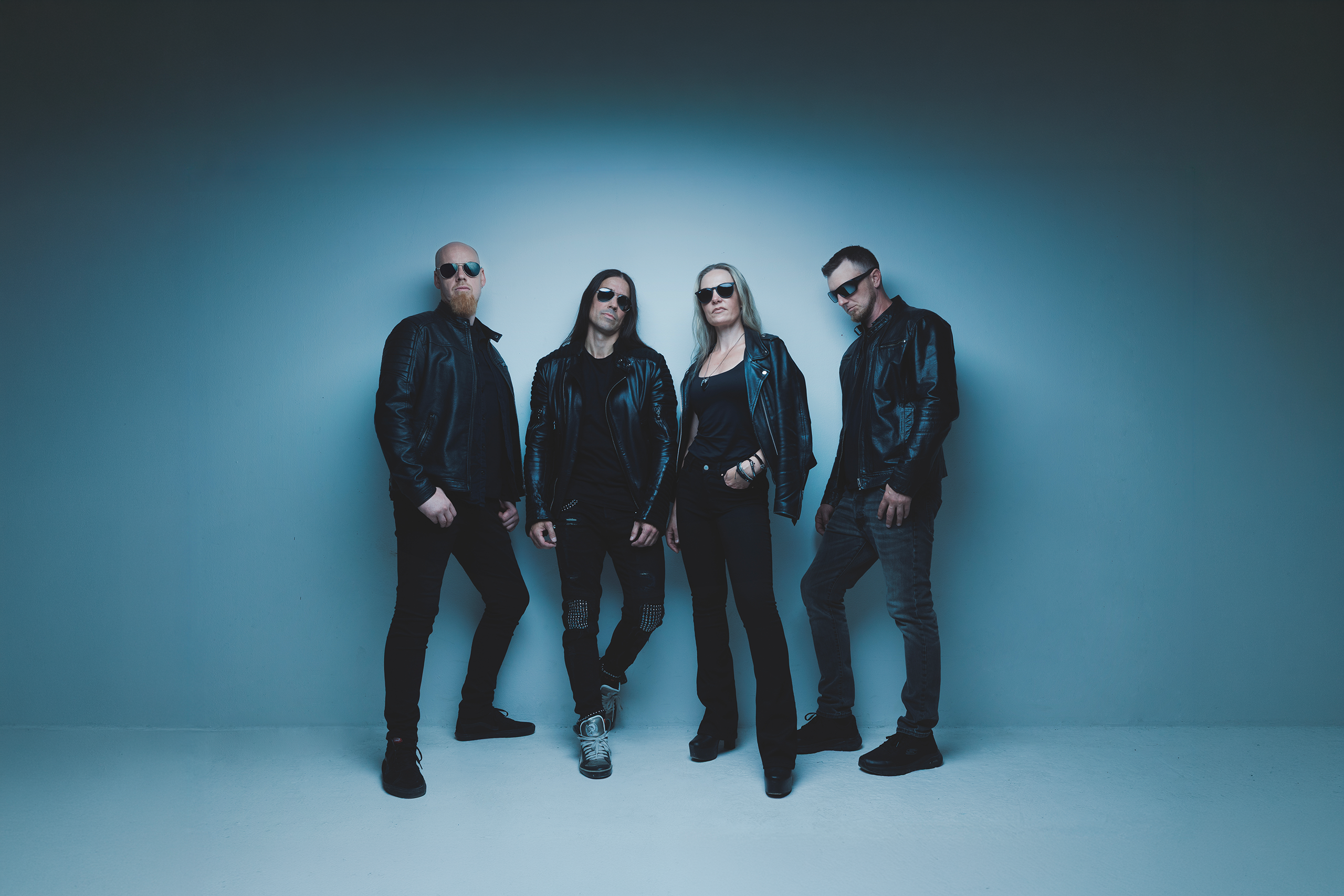
Two major releases spill onto our laps on the same day, from bands who have taken wildly different roads in their career in Norway’s progressive stalwarts Triosphere, and the multinational Kamelot, a power metal institution in their own right. Lets consider that Dark Asylum is Kamelot’s fourteenth album to date, and their fourth since the last time Triosphere released their last album The Heart of the Matter in 2014, that year’s Metal Pigeon Album of the Year list topper no less. While Kamelot has made this endeavor their full time career, finding themselves on the road more often than not, Triosphere has been a part time proposition for it’s members, the band finding time for scattered gigs in the intervening years while they slowly worked on a follow up album. We’ve had reason to bitch about both bands to be honest. Kamelot have gotten a good kicking for what many feel is a noticeable sameness to their Karevik era recorded output, and deservedly so for their stagnant live setlists which have kept more than a handful of us away from attending some of their recent treks near our neck of the woods. Triosphere on the other hand have produced a more desperate and frustrating venting from fans such as myself, namely, why the hell has it taken so long to finish a new album? Twelve years is approaching Guns N’ Roses and Heavenly territory, and its particularly agonizing when their last album was so insanely great. For me, my expectations for both bands were polar opposites, because I felt everything in expectation for Triosphere and next to nothing for Kamelot other than mild curiosity (more on this later).

So lets talk about Triosphere’s Oceans Above, Stars Below first because twelve years was enough of a wait, and I’ll just say first that I find this album simultaneously thrilling and exasperating. I include the latter because goddamit, this is such an incredible album from a band that doesn’t seem to understand how to do wrong, and yet here I’m thinking that maybe had things worked out differently for the band, we could’ve gotten perhaps two albums or maybe three in the time span that it took to produce this singular one? It was pointed out to me that hey, maybe this new album wouldn’t be so spectacular if they only had a handful of years to work on it, that more albums leading up to it would’ve diluted their work and they simply focused on making this the best collection of songs they could — in other words, that it had to take this long. I’m eager to read interviews with these guys to find out what the exact reasons were for the lengthy gestation period (I know they have day jobs, I get that), but I’m not entirely sold on that rationale. But it is what it is.
In the meantime however, I can sit here and gush about brilliant songs such as “Of Tyrants”, “Monster’s Ball”, “Through the Phantom Wall”, “Shorelines”, and the title track. Hang on, that’s like the entire first half of the album right? Yes, and the scary thing is that the second half of the album doesn’t let up either — much like its predecessor, Oceans Above… threatens us with being a nigh perfect album. The striking aspect of this result is that the band haven’t strayed far at all from the sound they seemed to perfect on The Heart of the Matter and earlier on 2010’s The Road Less Travelled. These songs are still largely high octane, speed infused progressive metal with a sugary sweet hard rock center all wrapped up in vocalist Ida Haukland’s rich velvety vocal tone. She hasn’t lost a single step, her voice still capable of enormous depth and range at once, with a subtle sandpapery grit that underscores her vocal lines at just the right moments. As I write this I’m listening to “Cadence of Chaos” which has my favorite vocal moment of hers of many on the album, as she channels Ann Wilson with dramatic gusto during the opening verse. When I praised the band’s last album as that year’s best, I heaped tons of adulation on Haukland’s vocal abilities, and at the time, she was genuinely a breath of fresh air in a metal scene that largely relegated women vocalists to the symphonic metal side of things. Since that time, we’ve had some pretty incredible singers who have similar voices doing really great work, ex-Battle Beast’s Noora Louhimo springs to mind immediately for example, but despite similarities, Haukland really does stand on her own. Her approach to vocal melodies is rooted in AOR hard rock stylings for sure, but she is willing to put her vocal chords under fire and belt in a way that competes with the aggression of the music the band is dishing out.
To that end, in an effort not to just go on about her status as one of my favorite vocalists in metal, well, period, lets talk about the musicianship here to round things out. Haukland’s work on bass will get overlooked by many, but her tight, in groove lock step with “new” drummer Kenneth Tårneby is more than just standard rhythm section stuff. I found myself paying as much attention to it as I did on previous Triosphere albums, she’s an incredible talent on that instrument and I always love hearing good bass done in a way that isn’t showy or obviously bass-y. Tårneby himself is a wrecking ball, his percussion a signature element on all these songs, often as splashy as the guitars for all his unorthodox fills and patterns. Then there’s the stellar guitar tandem of Marius Silver Bergesen and Tor Ole Byberg, where if Metallum is to be believed, the band has a strict division of labor in lead and rhythm respectively, something that seems far more amorphous in other bands (no pun intended, or maybe it is). These guys are riff machines, and that’s really where the guitarwork blows me away throughout as on past Triosphere albums, in the rhythmic assault that’s laid on. Even though there are moments where Bergesen does go off in solo passages, his lead melodies for the most part feel anchored to what’s going on rhythmically both with Byberg and Haukland. It’s why I feel like Triosphere has this mechanized tinge to their music, that kind of Judas Priest-ian precision that makes you think of a mechanized vehicle rolling over your face, only much like Halford’s impassioned howling, Haukland’s very human vocals balance things out. I’ll be honest, I thought this album would be good at the very least, but I didn’t expect an album of the year candidate. Consider me shocked.

And much like Jackie Chiles, I’m chagrined as well, because I had very low expectations for Kamelot, I would even dare to say I wasn’t looking forward to Dark Asylum at all beyond a mere curiosity. The eye roll inducing cover art being similar to their past handful of albums was enough of an enthusiasm dampener for me to make me suspect this was just going to be more of the same. It’s telling that I had to be reminded that this was not indeed the follow up to 2018’s The Shadow Theory, that there was an album in between in 2023 that I just essentially erased from my mind in The Awakening. It was that forgettable (should I revisit that one? Am I wrong?). So imagine my legitimately surprised delight that dawned on me when I spun this album the first time around, when midway through I even voiced aloud to myself, “I’m actually enjoying this?”. The question was implicit, because while its not implausible for a veteran band to turn things around, there was nothing in Kamelot’s recent history that suggested this was going to be the case, but straight up, this is a very good album, easily their best work since 2015’s Haven. The primary reason for this I suspect, is that for whatever reason, vocalist Tommy Karevik finally sounds completely comfortable here, allowed to sing in his own style entirely and not chase the elusive Khan intonation and tone that he’d sometimes be cornered into on previous albums. Maybe this is just my own perception and I’m getting it wrong, but Karevik sounds way more like Seventh Wonder Karevik here, particularly in the way he structures his vocal phrasing and melody crafting.
The evidence of this can be heard on the opening track proper “Ashen World”, which passes for a Seventh Wonder tune to my ears, with Karevik soulfully sitting in a higher register nearly throughout, his nimble vocal melody deft with its sudden twists and turns. Similarly on the title track, that chorus is classic Karevik ala The Great Escape or Mercy Falls, and I love that I can really hear his stamp all over these songs, with the band following suit and keeping things a little more effervescent and bright sounding rather than forcefully heavy and dour like they have been in the past. He sounds brilliant on “Sanctuary” paired alongside Visions of Atlantis vocalist Clementine Delauney, the two of them complementing each other despite having similar registers, something about it just hits perfectly. A great chorus on this one, expansive and soaring, what I have often referred to as an arcing chorus, you can draw its trajectory on a whiteboard and it would look like 180°. Equally impressive as a guest turn is one Tobias Sammet, him returning the favor as Karevik ably guested on the last Avantasia album (and did a tremendous job) on “One Last Masquerade”, this tune a bit more anchored in traditional Kamelot-ian tropes, but skillfully written and tailored for Sammet’s distinct tone. Not sure if it was written with him in mind (usually that’s not the way it goes), but regardless, the band chose well in what song to feature him on. I gotta say, most of the time the guest vocalists have teetered on becoming a schtick for Kamelot, but they nailed it this time, although its not hard to decipher why Ignacia Fernandez was chosen for the harsh vocals despite a plethora of other vocalists who could do that better. She’s fine if a bit muted, screaming vocals aren’t a necessity for modern Kamelot songs, they’re so pushed back into the mix that they’re just a textural note anyway… I would wonder why they bother but then again she was Miss World Chile so, yeah.

Although this album is still far from classic Kamelot sound of the Khan era, I did find that shades of the old days made their way to the ballad “Ivy, My Dear”, something that sounded like it was a close cousin to ballads from the Karma era. I think the prominence of Oliver Palotai’s keys and the woodwind and string flourishes bring up that association, because this sounds more folky, more “renaissance festival” than the band have approached in years, maybe not since “Don’t You Cry” or even “A Sailorman’s Hymn”. The same goes for the strange but delightful folk ballad “Beneath the Moon (Tunglið)” which is a short two minute ditty that is lovely to behold, though I’ll admit I was caught off guard by it being sung in Icelandic apparently(!). It features guests Lea-Sophie Fischer of Eluveitie on violin, and vocalists Rannveig Sif Sigurðardóttir and Sólveig Sara Leupold, and its worth noting that Sigurðardóttir did the lead harmony vocal on the aforementioned “A Sailorman’s Hymn” on The Fourth Legacy way back in the day, making this a cool little full circle moment. Maybe my feeling of it being a knowing nod to the past wasn’t such a wild idea after all. I appreciate the band diversifying a bit with stuff like this, even if its not particularly groundbreaking for them, it helps to distinguish Dark Asylum from its immediate predecessors.
I think Karevik’s larger presence in the writing of vocal melodies here is crucial to Dark Asylum’s artistic success, and its not a coincidence that its conceptual, storyline driven nature hearkens to his work in Seventh Wonder as well… he’s got valuable experience. The lyrics are sharper here, more memorable in their diction and smoother in their delivery than albums past, and maybe that’s a side effect of him not having to shoehorn everything in between riffs already provided by Youngblood. Karevik is the undoubted MVP of this album and that’s been a long, long time coming. When Kamelot was cooking on parts of Haven, it was seemingly (and the songwriting credits supported this) because Karevik was brought onboard to help craft the songs from the ground up whereas on Silverthorn he was brought in when Youngblood and Palotai had already written most of them. I love Youngblood, he was the Chris DeGarmo to Khan’s Geoff Tate in their golden era, but he needs a vocalist to make the best of his riff progression ideas, to pair them against great vocal melodies that simply put, aren’t Youngblood’s strong suit. I’ll conclude by saying this, as a longtime fan since the early Khan days, Kamelot did something genuinely good here, its an album worth checking out. They still falter on some things, the lame cover art, the transparent focus on appearance for their guest vocalist choices (not all, but some for sure), the pointless intro and outro tracks, the terrible setlists (even on the current tour they’re still including the worst of the “heavy” tunes from the Karevik era, perhaps thinking this makes them sound more metal live, I don’t know the reasoning honestly). But that’s a discussion for another time perhaps, for now, I just want to appreciate that Kamelot released a damn good album in 2026, that’s astonishing in itself.


September 7, 2026
I haven’t commented on your site in quite awhile, but a kamelot review certainly drags me out of the woodpile. Thank you for putting up your thoughts on their new CD so soon after the release.
I can’t say I share your thoughts on this kamelot album. I did share the initial apprehensive attitude about what this one would be like. I also do agree that Karevik does sound pretty good overall, and perhaps more like his past Seventh Wonder self.
But I have tried to listen to and like this album. Other than 2 or 3 songs I just find it boring and unimaginative in sound. I have had a harder and harder time enjoying their work as the Karevik era has continued. I know this is described as a concept album, but I just don’t find much of a storyline across the album.
Kamelot’s musical style these days is just so very generic and the writing hasn’t significantly changed or improved over time for my ears. I wish I liked their newer releases better. But I also wished they wrote and recorded music that I would enjoy more. There certainly has been a bit of an evolution of their sound over the years and unfortunately it leaves people like me on the outside looking in, so to speak. I want them to do well, as this is how they make a living. I also have no reason to wish for them to fail in their endeavors, but they have sadly lost me as a fan quite awhile ago. I still hope with every new release that this will be one I enjoy. But they only manage 2 or 3 songs at best per album that I actually can say I like.
Their setlists are atrocious, unless you magically like some of those heavily repetitive featured songs, which I certainly do not. At this point I wouldn’t even go see them for free because I wouldn’t enjoy anything about it.
I don’t wish for a return to the Khan era, he’s perfectly fine where he is and I am glad he is still performing and recording.
Ultimately I just feel zero emotion from their songs, and it just feels very indistinguishable from album to album. All of their Karevik releases after Silverthorn have run together for me to such a degree that I can’t begin to know which album the songs are actually from as they all just sound so generically the same to me. I swear they have a checklist of things they think they have to include in each album, and it reeks of sameness to me. The album covers themselves drive me nuts as a basic description of the cover art would be basically identical every time. I know they aren’t literally identical, but they look so much the same it boggles my mind. Nothing but recycling everything everywhere on these albums.
I still read your site regularly and I am very glad you are still adding new posts!! Even if I haven’t commented in some time, I am still an avid reader of your work. I appreciate what you do in your writing.