
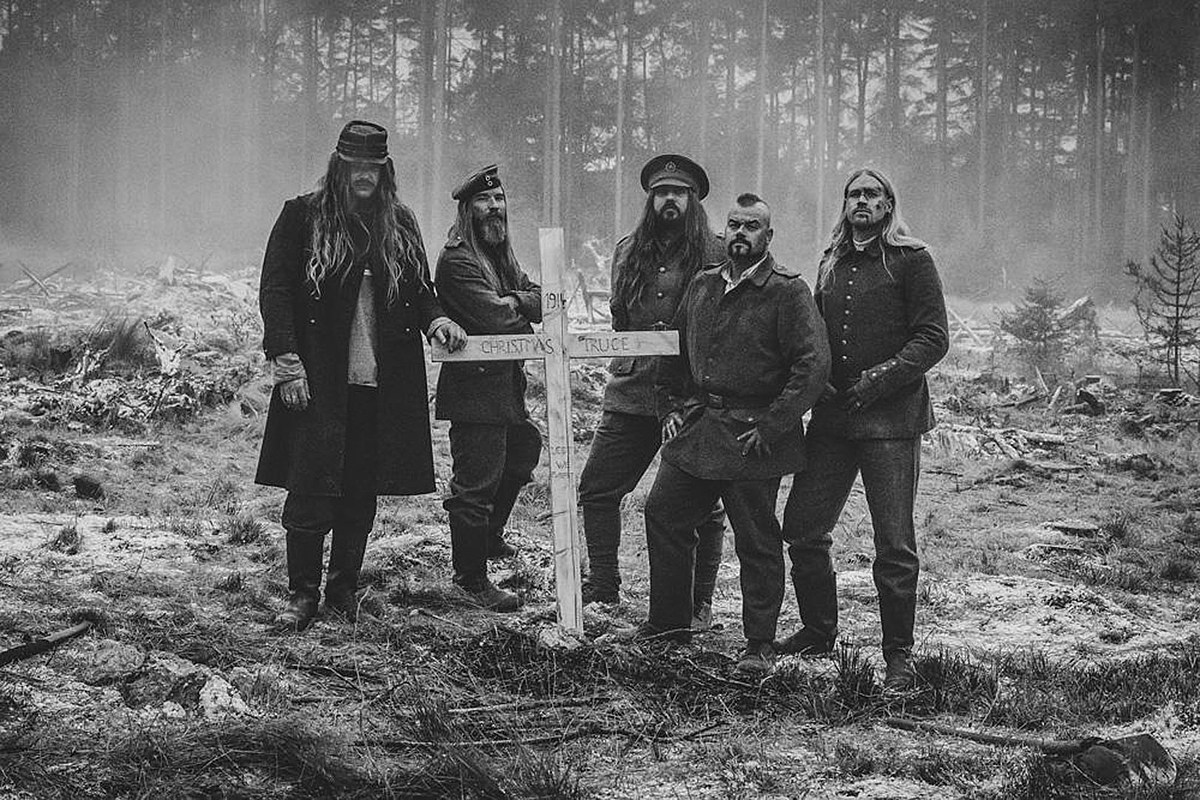
The past few weeks have been rather interesting in terms of big name releases on the metal landscape, with Ghost and Sabaton grabbing the headlines but not overshadowing new music from Hammerfall and Scorpions. There were a few more things I’ve been listening to that occurred in the past two weeks that I’ll have to get to next time around, although I suspect I’ll be writing about the upcoming Hell’s Heroes festival in Houston long before I can get to them (so stay plugged into the MSRcast to hear more new music talk in the interim!). Can hardly believe its April, but with a quarter of the year having gone by I’m more encouraged by what’s been released this year than in 2021, and there’s going to be some notable things coming out in the months to come. I’ve also been encouraged by listening to some other metal podcasts such as our friend David’s That Metal Podcast to make good on my promise to myself to do more writing on this blog that’s kinda selfish, those ideas I’ve kept meaning to get back to that always get shelved because of new music reviews. I started on this late last year with my Metal Pigeon Essential Ten: Power Metal write up, which I’m aiming to keep expanding on, but I also am hoping to get The Metal Pigeon Recommends feature relaunched too (David’s “The Northernmost Killers” episode on Sentenced got me thinking about it because they were last band I covered in that series as well). So yeah, there’s a lot on the agenda hopefully that will become reality soon enough.
Sabaton – The War To End All Wars:

So the first thought that came to my mind way back whenever I first heard that Sabaton was doing yet another World War I themed album was that they were committing a major faux pas… because rarely, and I mean friggin’ rarely does a band continue the same concept for two releases in a row. Even sequels tend to be separated by intervals of time, no matter how detrimental that gap in time can be (ask a Queensryche fan how they feel about Mindcrime II sometime). Sabaton’s reason for doing this is because they felt they simply had too many ideas that they couldn’t fit into The Great War due to the depth and wide reaching breadth of the subject matter at hand, and needed a continuation album. Shrewdly enough, they really did make an effort to tie the two records in together; from having cover artist Péter Sallai utilize nearly the same palette for the artwork, to ensuring similar stylization of the album titles, to even once again offering a narration boosted “history edition” of this album (which is what I’ve been listening to by the way) just like they did for The Great War. But the risk they run here is the unspoken elephant in the room tromping through their fans minds with the echoing message that these songs weren’t good enough to make the first one of these WWI albums, so here they are as leftovers. Hey its a fair enough thought, and I suspect there is a morsel of truth to it as well, but I’ve come to feel after many listens that The War To End All Wars succeeds more often than not and even shows glimpses of the band at their best.
Lets start with the highlights, and of course the first thing anyone should be singling out here is “The Christmas Truce”, which is in the running for being the one of the band’s most spectacular songs ever penned to date, certainly their best “epic”. Gorgeous, tinkling piano snowfall, setting the scene Joakim Broden paints out in some genuinely excellent lyrical diction, set to a melody that at once invokes the sounds of Christmas yet cuts them with an undercurrent of darkness and despair. This is a litmus test song for me, one of those cuts where I might start to side-eye question someone’s musical taste if they can’t even cop to this being a well wrought piece of music. Broden’s vocals dig deep here, full of passion, the kind of performance that required him to throw himself entirely into a different character, and if you’ve seen the incredibly well done music video you might know exactly what I’m alluding to. Another favorite is the grinding, stomping “Soldier Of Heaven”, where the prechorus features that classic Broden hammer drop (“A force of nature too strong, sent from above!”). It’s preceded on the album by the gloriously urgent spiritual cousin to Sabaton classic “Ghost Division” in “Stormtroopers”, not a song about the Empire’s fashionably iconic shock troops but the WWI era German troops of the same name. The Bulgarian Battle of Doiran anthem “Valley of Death” is old school swinging Sabaton action, all glorious triumphant major keys in that chorus and a truly memorable vocal hook. Nothing groundbreaking, but classic Sabaton when its on the mark satisfies that basic heavy metal need to fist pump and sing along. I also wanna point out “Hellfighters” for getting back to the darker, more grind it out sludgefest that The Great War often delved into, something I appreciated for the soundscape it gave to subject matter that needed a hefty dose of it to really give credence to the reality of WWI. The few other tracks I haven’t singled out here do however feel a little like the table scraps from this enormous WWI songwriting session, and they’re not bad songs per say, but their unremarkable nature makes this sequel a little less enthralling than part one.
Hammerfall – Hammer of Dawn:

If you didn’t remember, and you’d be forgiven for not doing so, I really enjoyed the heck out of Hammerfall’s Dominion in the before times back in 2019. Time really flies when you’re heeding the call as Joacim Cans reminds us on the door kicking opener “Brotherhood” (and lets face it, if you’re not heeding the call, why are you reading a Hammerfall review?). Is this classic medieval imagery as a metaphor for Hammerfall concert attendance anthem also hinting at the reality of our collective concert yearning during the pandemic? I normally wouldn’t try to read too much into Hammerfall’s lyrics for obvious reasons but I detect a note of… gratitude, hopefulness, or yearning present in Cans’ words here, and I have to think these songs were written sometime last year when we still didn’t know if shows would be happening in 2022. I last saw Hammerfall in 2018 when they were touring with Flotsam and Jetsam as openers in tow, it was a spectacular time, and they were supposed to be back in fall of 2020 with Beast In Black and Edge of Paradise. I’m incredibly eager to see them return not only for the classic material they’ll be playing, but also because with Hammer of Dawn, they now have two recent albums that I’ve been incredibly fired up about hearing cuts from live.
This is a far more conventional Hammerfall listening experience than Dominion, where the band was not so much experimenting as they were stretching their reach towards more creative songwriting approaches that really worked well. By no means does that make Hammer of Dawn boring though, this is a strong album with relatively few weak moments, but nothing as stellar as “Sweden Rock”, “Chain of Command”, or “Second to One”. The sure fire bangers here are the throwback Renegade-era invoking title track, the cheeky lyrical play of “Too Old to Die Young”, the complex tempo shifting “Reveries”, and the King Diamond assisted “Venerate Me” (although it’s hard to detect the King’s presence at first… maybe they can be knocked for under utilizing him). It’d be easy to think that simply being a Hammerfall fan means you’ll receive each new album fairly well, but that’s not always the case — I’m still not that wild on Infected and (r)Evolution, and there are tangible and intangible aspects I look for when it comes to new material from the group. What they’ve managed to grab ahold of on these past two albums I think is largely an awareness of who they are and what they’re best at tackling on a musical level. I’ve accepted that the raw, melodeath-ian influenced guitar attack they had on the first two albums is likely gone forever, replaced by the post millennium sense of Priest-like precision and the far less dense, looser chugging approach to their riffs. At its core of course, it boils down to the very simple question of whether the songwriting is on point or not, and lately it has been. This is a trend that I hope continues.
Allegaeon – Damnum:

The name Allegaeon has been floating around my metal circle for awhile now, and although I have been introduced and exposed to their past few records via the podcast and just earnest recommendations that have come my way, it’s only on this new album Damnum that I’m really paying attention of my own accord. I’ll have to revisit the others to see if this record is just the beginning of them really landing on something truly inspired, or just the latest entry among a really impressive body of work that I’ve been spacing out on. I have listened to Damnum probably as much as I’ve been listening to any other metal record in the entirety of these past four months of 2022, and it speaks volumes that any record can command that kind of firm, long lasting grip on my attention span these days. And while there’s plenty of bands trying to do to death metal what Allegaeon is succeeding in doing here, namely, reimagining it through a progressive metal filter and embracing melody without turning into a melodic death metal band (a subtle distinction, but certainly a valid one). Their greatest asset in accomplishing this is vocalist Riley McShane, who is capable of some convincingly ferocious growls, fantastically blackened shrieking vox, and a full, almost warm sounding clean vocal tone that he can switch back and forth without warning. It allows the band to be adventurous in their songwriting, to pull some head spinning shifts in tempo and aggression one way or another, and to utilize unconventional rhythms and space as textures and soundscapes for more introspective, moodier moments. Take “Called Home”, which boasts some of the album’s most violent passages, but also has McShane leading us in an emotively sung clean vocal passage over drifting, isolated lead figures and some echoing, off-beat proggy drum fills.
McShane’s clean vocals are at once familiar and also hard to find a direct comparison to, he’s more of an amalgamation of a handful of vocalists you might already know than a doppelganger of one other singer or another. His work towards the end of the impressive album opener “Bastards of the Earth” kinda recalled hints of Haken’s Ross Jennings crossed with Countless Skies’ Phil Romeo (or you know, insert your own point of reference here). Perhaps even more impressive however is his razor sharp enunciation that cuts through in his harsh and growling vocal techniques. Even in uber dense cuts like “Into Embers”, where the band’s more tech death side surfaces, setting aside most melodic indulgences, you can actually discern the lyrics or at least most of the syllabic structure that he’s barking out. I feel like this is an incredibly underrated talent in extreme metal, its one thing for harsh or growling vocals to serve as more of a textural element, we’re all used to that by now. But actually combining that with understandable lyrics is something that can elevate a band’s songwriting, particularly when you have a lyricist with talent at work (Rivers of Nihil should get credit for this as well). Guitarists Greg Burgess and Michael Stancel also deserve mention for their work here, having crafted a wildly diverse tapesty of straightforward yet satisfying tech-death meets tremolo riffs and creative lead breaks and pattern changes. The amount of crazy changeups in a song like “Vermin” was headspinning, yet always felt perfectly timed and never something that was just done because it could be, everything felt of a purpose. This was one of those albums that sat at the crossroads of being familiar enough to be comforting, and yet full of surprises at the same time, a hard place to get to.
Scorpions – Rock Believer:

I’ve had a hard time evaluating this new and possibly final Scoprions album. When I’m actively listening to it I find that its a suitably rockin’ experience for the most part, there are certainly no glaring flaws to be heard. Yet unlike 2010’s now seemingly very strong Sting In the Tail, there aren’t that many moments that are lingering in my mind afterwards (something that characterized damn near all of 2015’s Return to Forever). And you know, I get that maybe expecting too much from a Scorpions record at this stage in their career is a bit rich, that I should just be happy to accept any new music from the legends (and I am). But here’s the thing: Klaus and company got my hopes up with this cover art many months back. It screamed a purposeful throwback to perhaps a late 70s/early 80s sound and spirit, and in somewhere in the very naïve portion of my mind I was hopeful that there could even be a reach back into the band’s more psychedelia infused days with Uli Jon Roth. Of course when I finally got to hear the album in full, it immediately dawned on me that an important aspect of achieving that wish would be, you know, Uli Jon Roth being in the lineup… so shifting back to the more realistic hope of an 80s throwback sound, how well did the Scorpions live up to this kinda sorta promise? Actually they did alright, Rock Believer has a distinctly older school feel that’s built on the band’s fundamental building blocks of straight ahead hard rocking riffs, and Klaus spitting out verses with more attitude filled swagger than he’s done in ages. Of course its still got the sheen of modern production on it, despite the deliberate attempt to conjure up an analog warmth (I could be wrong about this of course but I think at this point I’d be able to suss out a true analog record).
Okay I’m rambling. Here’s what rocked me on this record, first thing to mention being the title track itself, a song that is musically a bridge between modern Scorpions more mellower bent crossed with some Savage Amusement era style riffs and cowbell. If you haven’t seen the music video for this song, you owe it to yourself to check it out because the song is solid enough on it’s own as a slice of bittersweet nostalgia, but the visual dichotomy of the Scorp’s rocking out today intercut with classic footage of their previous eras elevates the entire thing to something that’s truly poignant and kinda hit me right in the emotional gut. It’s followed on the album by the classic 80s “Holiday” vibes invoking “Shining Of Your Soul”, Klaus’ vocals here incredibly emotive and that minor key dip on the prechorus just devastatingly effective at recreating a very specific sound that rings of classic Scorpions. I also love the wildly fast paced rocker “When I Lay My Bones To Rest”, Rudolf Schenker and Mathias Jabs trading off attitude spitting riffs like they’re Slash and Izzy. Klaus sounds in his element there as much as he does on the gorgeous melancholic power ballad “When You Know (Where You Come From)”, which reminds me of previous soul searching balladry classics such as “Send Me An Angel” or more recently, “Lorelei”. And of course “Peacemaker” and “Seventh Son” were absolute jams, culling from that tap of old school spirit that informs so much of this album. I’m realizing now that I’ve coincidentally picked all of the official singles as my favorite cuts from the album, which wasn’t intentional really, but perhaps telling. The rest of the album is decent to good, there’s some weird stuff on here such as the few songs relegated to the “bonus disc” (like the odd but kinda likable “When Tomorrow Comes”) which I’d agree to being wisely left off the main album tracklisting… but really a solid outing by the Scorpions in delivering as good of a throwback record they could muster for a possible final sting. My wish is that they actually would tap Uli to cowrite for another album that revisits their classic psychedelia 70s era, but maybe that’s asking a lot of a band in their 70s. I’m happy they didn’t end things with Return To Forever, this is a worthy swan song if it is indeed that.
Ghost – IMPERA:

I don’t believe I’ve ever reviewed a Ghost record before, and I figured I never would because there’s likely enough written out there about this band and rightly so. They’re a big deal like it or not, and generally speaking, I’m in favor of bands with loud guitars and riffs getting to arena levels because it’s good for the entire metal/hard rock ecosystem. We have talked about Ghost on the podcast before and I did make mention of how I enjoyed their turn towards Scorpions-esque 80s hard rock on 2018’s Prequelle, with “Dance Macabre” being the most convincing Klaus Meine impression anyone’s ever delivered this side of the Rhine (I don’t know what that means it just feels right to say it). Despite that however, I’ve been fairly ambivalent about their music itself, finding it enjoyable enough in the moment (I even thought they were pretty solid live opening for Maiden) but never really having an urge to seek it out on my own all that often. That might change with IMPERA however, because I’m genuinely surprised by how much I’ve been enjoying this record as a whole. The draw here is that Tobias Forge is sticking with further exploring the hard rock avenue he was careening onto on the last album, and its continuing to yield inspiring results. There’s Night Flight Orchestra esque late 70s/early 80s vibes happening on “Spillways” with as smartly crafted a pre-chorus/chorus combo as Forge has ever penned. Equally as compelling is “Call Me Little Sunshine” with its call back to the doomier tempos of their early career albums sans the Blue Oyster Cult sound.
What I really enjoy about Forge as both a songwriter and a vocalist is his indulgence of lush, layered vocal harmony, be it his own vocals multitracked again and again or better still, via backing vocals from some of the nameless ghouls that make up the rest of the lineup (at some point, it would be great to know who he’s playing with). There’s a choir being used on the gorgeously dramatic “Darkness At The Heart Of My Love” to glorious effect, at one point taking over lead vocals for Forge towards the end of the song in a bittersweet finale. And its worth mentioning that the album closer is the closest thing Ghost has come to an “epic” and its really, really well constructed, mini-hooks abound and the major refrain is vintage Forge with an emotive vocal melody. I even dug the harder, more aggressive cuts here (they were outnumbered for sure by midtempo and slower songs) such as “Hunter’s Moon” and “Watcher In The Sky” with their metallic bite and even the truly bizarre “Twenties” was hooky in its own quirky and comedic way. Metal, hard rock or whatever you wanna label it, IMPERA really is one of the strongest albums of the year, and I’m okay with admitting that.
 Its been a little under five years since the Scorpions released Sting In The Tail, the album that they decided halfway through its production would be their last. And in some respects it was, as far as being a truly fresh, organic batch of songs purposefully written for its release. It was a fine album as well, perhaps their strongest overall in twenty years, featuring a handful of gems that for me at least were comparable to their 80s/early 90s classics (check
  The good stuff first then, which is found as early as the album’s lead off single “We Built This House”, which is not a PBS program but instead a paean to the durability of the band’s fifty year career. I say this based on my viewing of the promotional EPK the band made where they spoke a little about each song on the album —- despite the lyrics clearly referring to a significant other known as “baby”. How they reconcile both perspectives is beyond me… maybe the verses are meant for the ladies (or the lads, whatever) and the chorus is just about the Scorpions themselves? I’m being pedantic, the Scorpions have earned the right to bend metaphors however they’d like, and the most important things here are the melody and the hooks. Its built on the classic Scorpions pattern of quiet/loud dynamics, a hushed verse that explodes into an arena ready chorus, but it does seem to be one of the few entirely new songs, its music penned by the band’s longtime Swedish producers (and MTV Unplugged musicians) Mikael Andersson and Martin Hansen. The other haus-titled song, “House of Cards”, is actually built on the back of a resurrected melody, its acoustic balladry reminiscent of the band’s early 90s Crazy World / Face the Heat era.
 There’s a handful of other good songs; “Rollin’ Home, a laid back rocker with a Def Leppard-ish stomp; the ridiculously titled “Hard Rockin’ the Place”, built on a riff from the Blackout era; a handful of decent ballads in “Gypsy Life”, “Eye of the Storm” (being the newest of the ressurected song ideas, from the Humanity Hour 1 era in 2007); a Meine solo-penned lonely sounding number in “Who We Are”; and the panoramic “When the Truth is a Lie” —- again, all above average in quality, but nothing you’d hate yourself for missing. Where things get murky is with the vanilla alternative rock styled guitar rock of “The World We Used to Know”, a song that sounds like it came from the Eye II Eye sessions; as well as the blandness of the album opener “Going Out With a Bang” where chest thumping bravado fails to move me like the more emotional reflections on calling it quits found on Sting In the Tail. Its also unfortunate that “Dancing With the Moonlight” doesn’t seem to live up to its title, especially when you consider songs by the same title by other artists (Thin Lizzy comes to mind immediately). It has a cool backstory about the turbulence laden flight endured by the Scorpions, Alice Cooper and others that happened to also double as Meine’s birthday celebration. The song is somewhat paint by numbers however, with boring verses and a chorus that never seems to take off (heyo!).


 Longtime readers of the blog will have by now taken note of just how much the seasons tend to shift my listening habits around, and they’ll also note just how much I dislike summer in general. If you think that’s an unusual attitude to have, I’ll remind you that I live in Houston, Texas —- but there are silver linings to the oppressive heat and humidity of a Texan summer. One of which is just how well wild, classic styled hard rock pairs with the rising mercury, case in point being the timely arrival of You Are Here, a new album by the Chicago based rock band High Spirits. Okay, they’re in a band in that they play live, but in reality High Spirits is the work of one highly motivated musician in Chris Black. You may have heard his other work before as well —- he moonlights as the drummer for Pharaoh, whose 2012 album Bury the Light came in second on that year’s
  Whats utterly bananas about Chris Black and his work in High Spirits is that he is everything that you hear on the albums: All instruments, all vocals (including harmonies and overdubs). As I mentioned above, he has a band that he takes out live for small runs of select dates, but on album High Spirits is an entirely one man show. It doesn’t sound like it, and that’s testament to Black’s songwriting skills and overall artistry in understanding band dynamics in aspects of rock music —- as in the interplay between rhythm and lead guitars. Take the album opener “When the Lights Go Down”, with its loose yet tight riffing complemented by scorching lead fragments at the tail end of choruses. The songwriting here is razor sharp, Black has a wonderful and rare ability to pen adrenaline soaked, speedy choruses that outpace their verse section anchors (for further proof, check out “Full Power” on the band’s debut album). These are the kinds of songs that cause speeding tickets. Black slows down the tempo a touch on the next track, “I Need Your Love”, where the swinging rhythm guitar and the amped up speed in the pre-chorus bridge just smacks of the classic riffing of Rudolf Schenker. Black’s vocals are unusual for this type of music, while he’s skilled enough to carry melodies and hold notes, his tone is raw, punky even, and his delivery is borderline laid back. If I can provide some adequate frame of reference, its basically the exact opposite of Sebastian Bach’s histrionics —- Black’s approach to singing is workmanlike in serving the song only (I mean that in a positive way).