
More reviews from the dog days of summer, although the season is waning rapidly and good riddance I say, it was a pretty good time for metal releases. I was glad for the slow down that seemed to occur in August, it let me get around to listening to older albums and also to work on non-reviews features that I hope to have out soon for the fun of it. One of the older albums that I dug into listening to was Beast In Black’s 2017’s debut Berserker, and I’d be lying if I wasn’t a little miffed that no one sent me a message asking me why I hadn’t bothered reviewing one of the more outlandish, Euro-swagger filled power metal albums of that year. Its such a fun album, and their Greek vocalist Yannis Papadopoulos is a dynamo, one of the more promising talents in a burgeoning field of new, exciting singers coming up within power metal as a whole. I know that Beast In Black is an offshoot of Battle Beast, but their debut is yet another piece of ammo for my theory that power metal is enjoying a quiet renaissance as of the past two-three years. Anyway, here’s a handful of reviews to round out the summer months, and hopefully I’ll have some non-reviews stuff coming up ahead to give myself and you a break from the treadmill.
 Powerwolf – The Sacrament of Sin:
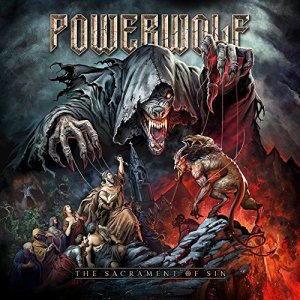
There’s a few ways you can attempt to analyze a new Powerwolf album, and although I’ve only done that once before (for 2015’s Blessed and Possessed) I feel like the best way is to simply compare it to its immediate predecessor. This is because there is no lock on what is the band’s all time best album, even among their sizable fan base. In this Powerwolf share the same dilemma that Sabaton had over time, that the fan favorite songs were spread rather randomly across the entirety of their discography. In the well over half a dozen Sabaton shows I’ve seen, fans went just as nuts for “Ghost Division”, “40:1”, and “Cliffs of Galipoli” as they did for the encore “Primo Victoria”. Now in Sabaton’s case, there has been a recent consensus building/realization that their 2008 album The Art of War has risen in the esteem of the greater metal community at large as one of the best front to back power metal albums of the last decade, as well as one of the most impactful (something that I’d agree with even though I think Carolus Rex and Heroes are more interesting and rich albums). Its natural to compare both these bands, they started out in the same year with their debuts (2005) and have taken a similar career trek to headline status in the European festival scene with a poppy sensibility to their keyboard driven songwriting, a baritone-ish vocalist, and a distinct “shtick” to their image and subject matter. But where Sabaton have at times attempted to innovate, albeit slowly and subtly, Powerwolf might be on the verge of repeating themselves into a Manowar-ish corner.
I will say that I’ve enjoyed this particular album a great deal more than Blessed and Possessed, and though that wasn’t a difficult hurdle to clear, its encouraging to see the songwriting bounce back. The obvious single here is “Demons Are A Girl’s Best Friend”, and at least in its verses they try some new things here and there, but in the chorus its strikingly close to “We Are The Wild” off the last album, which itself was a watered down version of “Sacred and Wild” off 2013’s Preachers Of The Night. Its a strong song, though not exactly compelling stuff beyond the candy coated vocal hook, and honestly it was on the border for me with its lyrics, skirting the edge of good taste in keeping with the lycanthropic theme. If you’re going to commit to this concept, as you could honestly say they have been for years, then don’t muck it up by getting cute in your imagery (then again this is the band that once penned “Resurrection By Erection” so maybe I shouldn’t be so surprised or annoyed). I actually enjoyed “Incense & Iron” more, with Attila’s commanding vocal during the verses going in an unexpectedly epic, Blind Guardian-ish place. The chorus may be standard swashbuckling power metal fare, but the Celtic sounds, the martial stomp and swing of the rhythmic approach combine to craft a stirring anthem. I also thought “Where The Wild Wolves Have Gone” was an interesting ballad from a band that isn’t really suited to attempting them, with its Orden Ogan channeling in style and even Attila’s vocals sounding similar to Sebastian Levermann’s.
I get why Powerwolf are so beloved over in Europe, but it shouldn’t be a mystery why so many of us stateside power metal fans are a little more detached from the band. Unlike Sabaton who’ve made it their mission to establish a fan base in the States through years and years of relentless touring here both as support and headliners, Powerwolf hasn’t even bothered with us (and according to Glenn Harveston, promoter of ProgPower, they won’t even entertain offers to come over). I get it, why go through the massive expense of even trying when you’re kings in your home turf and are scoring number one albums in Germany? It does however result in some distance in just how much I can find myself invested in the band, because while I personally find Sabaton very interesting as someone who enjoys history, even I can admit that their music is very pop-laden for metal. Powerwolf is just as pop, but the werewolf thing doesn’t do anything for me at all in terms of deepening my interest beyond a surface level of is this catchy or not? Without the benefit of seeing them live, I haven’t had the chance to form a personal connection with the band in lieu of being unable to forge any kind of connection to them as artists. I’ve never seen Therion either, but I love their music so deeply that it can override that absence. Powerwolf doesn’t have the kind of music that can really inspire that level of devotion, and sadly this absence of both the live experience and passion for their music will keep them a distant memory in the minds of most American fans.
 Omnium Gatherum – The Burning Cold:
I think I’ve learned to be a little wary of album previews in general, whether its those atrocious 3 minute spliced together montages of every song on an album to “whet” fans appetites, or even just the actual lyric/music video released ahead of the album’s street date. This is because even if its a full song from the album, its not enough to get an impression about the album’s quality one way or another. Its often counterproductive actually, an easy way to overreact to enthusiasm or get dismissive because of a negative opinion on one song. Recently with the Immortal album, I somewhat duped myself into believing that Demonaz and company had simply gone back to their early era roots, which although partially true was nowhere near a complete rendering of what that album really was. It took almost a solid month of listening to it for me to suss out a far more nuanced take, and I suspect that had I simply never heard the pre-release single of “Northern Chaos Gods” ahead of the album in full, I might not have come to that premature, judgment clouding take. With Omnium Gatherum, I saw the music video for “Gods Go First” way back in early July, and for whatever reason came away feeling rather “meh” about what I heard. That honestly dampened my enthusiasm for this album and although I still managed to keep my curiosity piqued come release day just for sheer reviewing purposes, it was hard to shake the bad taste I still had. I get that not everyone will have this problem, but I might be making a decision to stay away from most of these kind of early previews in the near future (case in point is the new Wolfheart track, haven’t listened to it yet).
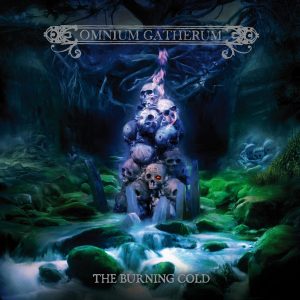
Fortunately in this case, my early negative impression wasn’t nearly strong enough to work against the very obvious excellence that is Omnium’s eighth album in The Burning Cold. This is a continuation of the crackling artistry heard on 2016’s Grey Heavens, an album that I credited with the band finally finding the right way to manage the density of their musical elements. Vocalist Jukka Pelkonen started to time his vocal passages more effectively to complement the dual lead guitar melodies, to work around them and fill in gaps of sound rather than try to compete with them directly. Keyboardist Aapo Koivisto began to be a more foundational force within the structure of the songs, and as founding guitarist Markus Vanhala is usually the primary songwriter, its a credit to him in knowing that this strategy worked last time and to keep it going. A microcosm of this is heard on “Refining Fire”, where all of those elements come together to ensure that one of the more aggressive moments on the album is also its smartest songwriting wise. I particularly love the spacing around Pelkonen’s vocals during the chorus and the mid-song bridge where an awesome dual lead solo dances over Koivisto’s dreamy, lush soundscapes. Speaking of soundscapes, they’re just getting better and better, take a listen to the mid-song dip in “The Fearless Entity” for proof, with its own divergent melody and sense of melancholy and ache.
My previous disliking of “Gods Go First” has largely subsided, its a solid enough track, but it should have never been the single in the first place, that honor should’ve gone to “The Frontline”, as majestic a song Omnium Gatherum have ever written. Its up there with “The Unknowing” from Beyond and “New World Shadows” from well, New World Shadows. This is a gorgeous, thrilling song, built on a Gothenburg inspired sense of swinging melodic motifs ala Whoracle era In Flames, complete with a beautiful acoustic guitar framework keeping things rustic and enchanting underneath. The rhythm guitar attack here is measured and percussive even, aware of itself enough to keep out of the way of the lovely lead melodies, just smart, focused songwriting on display. The emotional outpouring occurs at the 3:22 mark, where Koivisto’s keyboards and the lead guitar join together to cry out a melody that’s simultaneously exulting and heartbreaking. This is why we listen to melodic death metal, because we want shimmering moments of major key goodness here to counterbalance the aggression and intensity —- they both work to make each other more potent. I’ll take stuff like this every day over non-stop blast beats and a never ending tremolo riff. I know I know, everything has its place, but straight up brutality has never produced a song that provokes the kind of emotional response that this song has. I didn’t think it was likely that Omnium would top Grey Heavens, but they’ve eclipsed it, and that’s something to cheer about.
 Cauldron – New Gods:
I first caught onto Cauldron when their vocalist/bassist Jason Decay did a guest spot on BangerTV’s Lock Horns Power Metal episode. He wasn’t exactly the right guy for the gig, it should’ve gone to Martin Popoff (who later hosted the Essential Power Metal albums Lock Horns ep and delivered) but I figured anyone willing to stand up and talk about power metal on camera earned the few minutes in checking out his band. I became an immediate fan of their 2016 album In Ruin, a wild, semi lo-fi blast of old school, early 80’s hard rock meets early NWOBHM influenced metal. Sure they were one of the legion of bands that were doing deliberately retro sounding music, and that stuff could have a tendency to get a little too blatantly worshipful at times (Municipal Waste and the like), but like Sweden’s Enforcer and Chicago’s High Spirits, Cauldron found a way to express something vibrant and endearing (if not exactly new) in their music. There was an immaturity running through that album that was a boon, not a drawback, and through it a connection to the bands of that distant era they were pulling their influences from. I hate to get cliched, but this was metal that sounded great in a buddies garage from the stereo in the corner, while beers got drunk and bands and albums got argued over.
So when Cauldron leans into that aspect of their personality and sound on their newest, New Gods, I’m all in and enjoying every second of the trio’s still meat and potatoes sound. But this is also the band’s fifth album, and if its vague, amorphous artwork wasn’t a clue, the relatively scaled back accessibility factor is a signal that these guys are interested in maturing their approach a bit (actually if artwork is a guide, then they’ve been eyeing this path on their previous two albums as well, devoid of the Spinal Tap-ian ladies that adorned their first two). The most instantaneous stuff here is excellent, the best of the bunch being “Letting Go”, a slow burning juxtaposition of intense, biting mid-tempo riffage and Decay’s best vocal performance to date. His laid back tone has always reminded me of Chris Black but with a little more heft and roundness, and here he unleashes a memorable major key vocal hook, bright and full of energy. And then there’s “Together As None”, the most unorthodox song in Cauldron’s history to date, coming across as a slice of Dokken meets Def Leppard meets Weezer into some weird timeless pop-metal amalgam. I know its gotten its fair share of flack, but I love it and wish the band would extend further in this direction in the future (or in other strange, unexpected directions).
While those two songs were instantaneous and still hold up after countless listens, it took multiple efforts to crack into some of the other stuff here, and I’m not sure if that’s a good or bad thing. I actively disliked “Save the Truth – Syracuse” at first, but came around to it over time, and perhaps its because its such a slow burner (I’m that guy who took forever to love “Holiday” by the Scorpions, it was too slow and repetitive for the longest time, but one day it just smacked me in the face). Its still just a solid, not great song however, with a refrain that is subtly pleasant and reminds me of 80’s hard rock’s penchant for taking itself deathly seriously (that’s a good thing here). I haven’t really made heads or tails of the lyrics here, but it all fits the tone and general vibe of the music, and that’s kind of what I want from Cauldron —- the title of the song suggests a possible storyline or backstory here, but I’m a little hesitant to commit that much mental energy to this band (its not implausible for the future, but c’mon, I’m not listening to Operation: Mindcrime here). Similarly, “Never Be Found” took its time growing on me, but I can’t understand why, its one of the best cuts on the album, a confident rocker with the tastiest (yes!) dual harmony guitar solo I’ve heard this band pull off. But its listless cuts like “Prisoner of the Past”, “Drown”, and the pointless instrumental “Isolation” that throw this album off balance and prevent it from being as fun as In Ruin. Its still a worthwhile listen with some awesome moments, but Cauldron took a step back here, and that’s concerning.
 Beyond the Black – Heart of the Hurricane:
Beyond the Black is the brainchild of vocalist Jennifer Haben, who made her debut (to most of us not in Germany) on Kamelot’s newest album in April on “In Twilight Hours”, a song I deemed the best on the album and a contender for the Song of the Year list. Her vocals on that track in a spiraling duet with Tommy Karevik played a big role in its success, particularly during its dramatic peak towards the end where she delivered an impressive display of range and emotive resonance. It was enough to make me pay attention to news regarding her own band to give them a fair shot, and its interesting enough to point out that Beyond the Black is kind of a growing big deal in Germany already, their previous albums charting quite high there (both this new album and its predecessor were top five on the national chart). They are a German born band with German band members, and its also worth noting that barring Haben the lineup is entirely new for Heart of the Hurricane. I’m not exactly up to date on why the entire band parted ways with Haben after their 2016 album Lost In Forever, but its impressive that Haben was able to cobble together a new lineup in such a short amount of time in the interim. Just as impressive is that this is genuinely a really excellent slice of symphonic pop-metal in the vein of Within Temptation and to a certain extent, the sugary sweetness of Amaranthe sans the electro-beat influences. Let that be your warning, if you enjoy most things about those two bands, feel free to proceed —- everyone else, don’t say I didn’t warn you.
The ironic thing is that I’m writing this right as Within Temptation have released their new single with Jacoby Shaddix (yeah that guy) “The Reckoning”, and its as dicey as you’d expect, a transparent attempt at edginess for edginess sake. The band’s roots were in symphonic metal (gothic metal at first for you nitpickers), but as Therion’s own Christofer Johnson has pointed out in recent interviews, there is nothing so unfashionable these days as symphonic metal. With the genre’s bigger names and veterans having moved away from the sound, its left a vacuum for its fans wanting someone to deliver the kind of stuff that they loved on albums like Century Child and The Silent Force. I’d be willing to bet that they’d really love the bulk of the fifteen (!) tracks on Heart of the Hurricane, because Haben and company make no attempt to deviate from the symphonic metal playbook, even excelling at moments due to their dedication to its tropes and cliches. Take album highlight “Song For the Godless”, with its unabashed Eluvietie invoking Celtic/folky motifs, or “Fairytale of Doom” with its almost children’s sing-songy melody that Haben unexpectedly sings right along to. When you’d expect things to get too clever by half and do something different in order to not sound overly cheerful or happy… nope, its full steam straight ahead without a second thought. Call it refreshingly oblivious.
Its also worth pointing out that Haben is the perfect vocalist to serve as the vehicle for this stylistic approach, her vocals reminiscent enough of Sharon Den Adel’s nationality neutral delivery to soak up pop hooks and dish out radio-rock appeal. Even the beauty and the beast tropes seem to work just on the pure strength of the songwriting and her skill at delivering compelling melodies, as on “My God Is Dead” where the vocals of I’m assuming the guitarist Chris Hermsdörfer work as a foil, Haben manages to keep us entranced enough to avoid thinking about just how close to hammy his presence made things for a second. So with all this genuine praise about what I’m listening to as the carrot, here’s the sharp, pointy stick: This is not a genuine band in the traditional sense, and is almost certainly a studio project in practice if not in conception as well. I had wondered just how it was possible for Haben to lose her entire band and somehow get a new lineup together within a year and collectively work on new material in such a short time span —- was she the songwriter and just dictated to everyone else? Certainly possible. But no such luck, as a little digging has unearthed a trio of German producers as the songwriters at work here (with Miro Rodenberg working on the album as mastering engineer to boot). I’m not against this in principle, Frontiers Records has developed a cottage industry around these types of releases, but the “band” has certainly loses a little appeal to me as a result. Even Amaranthe is writing their own stuff, for better or worse. Make of this knowledge what you will symphonic metal fans.

 Immortal – Northern Chaos Gods:
 Necrophobic – Mark of the Necrogram:
 Kalmah – Palo:
 Elvenstorm – The Conjuring:
 Dee Snider – For The Love Of Metal:
 Exlibris – Innertia:
 Kobra and the Lotus – Prevail II:
 Thaurorod – Coast of Gold:
 The Night Flight Orchestra – Sometimes The World Ain’t Enough:
 Uada – Cult of a Dying Sun:
 Khemmis – Desolation:
 Frozen Crown – The Fallen King:
 Hoth – Astral Necromancy:
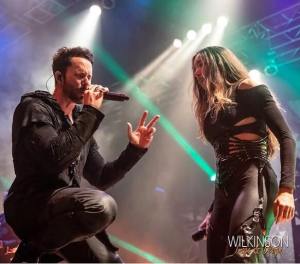 But a band making a bad impression due to a combo of performance issues and aesthetic choices is admittedly an extreme outlier, and they certainly weren’t the problem when I left the House of Blues in Houston over a month ago on May 9th one song before Kamelot finished their headlining set. This is a band that can rightfully be called one of my favorite metal bands of the past decade plus, power metal stalwarts who towered mighty during their Roy Khan era, stumbled a bit after he left in 2011 but recovered with 2015’s excellent Haven album. I’ll say this, the band played well that night, Tommy Karevik was in as fine form of voice as he was on the past two times I’ve seen him, and they played to an appreciative audience. But I was a little unenthusiastic about the experience, mainly because I had taken a peek at the setlist ahead of time and noticed just how nearly identical it was to the last time I saw them in 2015. Nine songs were the same, and of the only four Khan era songs they played (down from seven the last time) all were cuts they had already played last time (and honestly on the tour before that back supporting Silverthorn in 2012 when I saw them in Austin). Now I get that three albums into the Karevik era, they’d naturally trim the Roy songs down a bit, but a little swapping in and out of classic Kamelot cuts would be preferable. Particularly for fans who’ve been around for awhile like myself. I was essentially seeing the same show from three years ago, with the exception of the new songs they added in from April’s The Shadow Theory.
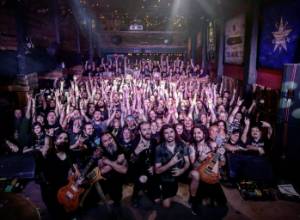 Seeing Orphaned Land take the stage made me feel a little like being eighteen again. It was surreal to finally see this band that I had been a massive fan of for such a long time since 2004 (more on that history
 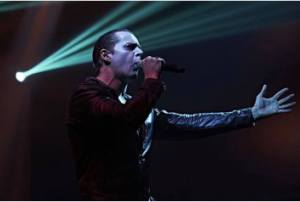 Four days later I was heading out to Satyricon at a venue north of downtown Houston I’d never been to before. With me were three friends, two of whom had just gotten officially married earlier that day. Yes they were going to a black metal concert on their wedding night, and the groom was fired up in particular about seeing the band for the first time (he is a big, big fan). We all had a good idea of the setlist ahead of time, my only quibble being that it seemed like they were skipping playing “Now Diabolical” on this tour. Its been said by the band no less that this would be their likely last North American tour, for reasons that they’ve not gone deeply into but I think are largely business oriented at heart. They don’t get big crowds in the US, not like those in Europe, and its understandable that this late in their career they’d want to avoid spending a lot of time and money for little reward. Whatever the reason, we knew this was the last chance we’d have to see them. I’d seen the band twice before, but was still left feeling that this was going to be a momentous, memorable show just for the magnitude of its finality for us. But sometimes the best part about a show is everything else around it not related to the band or the performance —- it was fun to experience a new (and cool) venue, hang out at the nice patio bar built right next to it before and after the show picking craft beers off a gaudy flatscreen TV menu. It was an altogether different kind of celebratory feel to see my newly married friends rockin’ out right up front and center in front of Satyr in a state of near delirium. I was happy that they were that ecstatic. The bonus was that the band did throw some surprises our way in the setlist (they played “Now Diabolical” for one), and Frost came out from behind his drum kit to lead us in some strange, foot stomping crowd chant while Satyr politely tried to hide his amused grin.
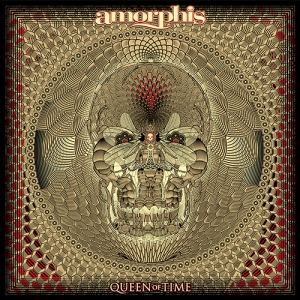 Amorphis – Queen of Time:
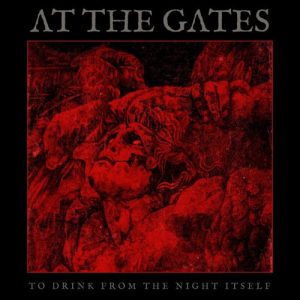 At The Gates – To Drink From The Night Itself:
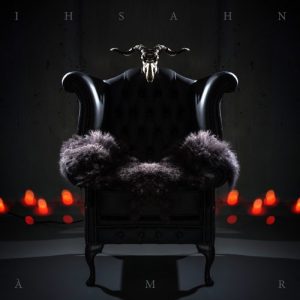
 Judicator – The Last Emperor:
 Barren Earth – A Complex of Cages:
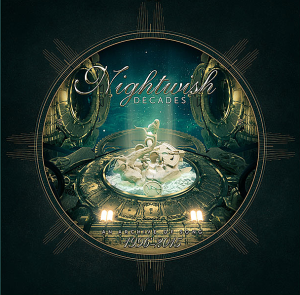 Nightwish – Decades:
 Primordial – Exile Amongst The Ruins:
 Oceans of Slumber – The Banished Heart:
 Panopticon – The Scars of Man on the Once Nameless Wilderness I and II:
 One of the year’s biggest releases, at least in the prog/power metal world, The Shadow Theory is Kamelot’s third album in the Tommy Karevik era, and their twelfth overall. It was on their third album Siége Perilous where they first introduced the much loved Roy Khan as their vocalist, but it wasn’t until its follow-up (The aptly named The Fourth Legacy) where Khan’s inclusion as a co-songwriter finally created the Kamelot magic we all love. The Khan/Thomas Youngblood songwriting duo wouldn’t suffer the expected sophomore slump either, delivering in succession albums that ranged from excellent (Karma, Ghost Opera) to downright masterful (Epica, The Black Halo). Similarly, Karevik’s first album with the band mirrored Khan’s nearly non-existent songwriting presence on Siége Perilous, as Silverthorn was an awkward, clunky affair that really could’ve used more of the new guy’s input. But just like Khan’s true unveiling on The Fourth Legacy, Karevik’s ground floor role in crafting the songs for his sophomore effort in Haven resulted in the band’s strongest album in a decade. I mention this emergent symmetry not only to point out just how much time I have on my hands to think about such things, but also to sketch out just where my expectation level was for The Shadow Theory.
 What I’m realizing after the umpteenth listen through this new album is that Karevik’s mighty vocal power and ability to sing sustained vocals in a higher register weren’t quite enough to completely shake those darker tendencies from Kamelot’s songwriting approach. Not only does The Shadow Theory not hit the same major key heights as Haven, but it doesn’t hit the same sustained emotional heights either as a result. My theory last time around was based around the possibility that Youngblood and Palotai were in the process of breaking out of songwriting tendencies that were built up over time that naturally resulted in darker albums —- their way of adjusting to Khan’s increasing preference (and controversial speculation here, his declining range) for a lower to middle register vocal approach. But I think I may have overlooked something else entirely that smacked me in the face when I went back recently to read/watch a bunch of interviews with Youngblood. He said in response to several questions over those interviews that the band moved away from their more mythological/fantastical lyrical imagery because they found it limiting over time. In interviews for the new album, he was keen to discuss the Carl Jung based conceptual angle behind The Shadow Theory, relating it to the state of the world at present and how we relate to it (ie social media, etc). In one interview he even defended the band’s name, acknowledging the Arthurian mythology influence, but effectively brushing past it by suggesting the band had moved on topically (and that basically its just a brand name).
 Thematically and to a certain degree lyrically, The Shadow Theory sees the band attempting to try something entirely new by framing the album in a very modern, nearly science-fiction setting. In some sense its their music catching up to the visual style we’ve seen in some of their recent music videos, and its certainly reflected heavily in the dystopian drenched
  Perhaps nowhere does the sunlight breakthrough more than on the glorious duet sung ballad “In Twilight Hours”, one that should be in serious consideration for our hypothetical top five Kamelot ballads discussion. Karevik delivers an impassioned vocal, and he’s matched in kind by Beyond The Black’s Jennifer Haben whose own vocals are the perfect balance of ethereal and earthy, resulting in a crystalline quality to her phrasing. Its a majestic song, centered around a cinematic, fully-arcing chorus crafted almost solely around their conjoined vocal melody —- but the emotional build up in the verses is perhaps more impressive, utilizing Palotai’s understated, sombre piano fragments and a sense of quiet, hushed dynamics that Kamelot have made a history of owning (recalling immediately classic ballads “Wander” and “On The Coldest Winter Night”). When Youngblood finally crashes in with his vocal melody echoing guitar solo, its almost cathartic in its emotional weight, the guitarist proving once again that his understanding of restraint and release is central to Kamelot’s musical power. I also really enjoyed “Stories Unheard”, a unique track that while not as magnetic as its peers described above, certainly has something charming working for it, a combination of its many disparate elements —- the music box emulating intro is immediately intriguing, keeping our attention long enough for the chorus to wallop us.
 I really wanted to enjoy “The Proud and the Broken”, and in brief flashes I do, but overall it fails to move me as the apparent epic of the album. I’m not sure what the problem is here beyond the lack of a more definable vocal melody, because it has an interesting intro and fine middle instrumental passage (just one of those songs that doesn’t quite gel perhaps). I did notice the thematic similarities between it and Orphaned Land’s “Take My Hand” off their recent Unsung Prophets and Dead Messiahs album, not in exact diction, but in the spirit of what its lyrics are trying to say. Entirely coincidental of course, but its interesting how one song works so well and the other falls flat due to not making all the requisite emotional connections (lyrical and musical). We’ll skip the pointless closing instrumental “Ministrium (Shadow Key)”, only pausing to wonder why anyone felt that this was a better inclusion than the relatively decent bonus track “The Last Day of Sunlight” (which is noteworthy for its utterly bizarre musical hook during the verses and a chorus boasting a really nice Karevik moment). The other lackluster cuts were “Amnesiac” and “Burns to Embrace”; the former ruined by an anemic chorus and a wash of industrial sound effect nonsense, the latter by a lack of an actual melody of any kind in the verses (what the hell guys?).
 But hey, Iced Earth is a trad/power metal band, and Houston and Texas in general is pretty solidly death metal country right? Something like this was perhaps bound to happen. In fact I remember the days when the very idea that a power metal band of any stripe would play in Houston seemed like a cruel joke —- indeed, the first major one to really entice us was Blind Guardian on their 2002 trek supporting A Night At the Opera, but sadly forces conspired to
  It didn’t exactly work out that way. Oh we had some big shows through the years —- Dragonforce in 2006 at the Meridian drew almost as many as Iced Earth (pre – “Through the Fire and Flames” blowing up even), where somehow my friends and I wound up in the lounge backstage watching ZP Theart and Herman Li trying to lure all too witting women back to their tour bus (it was more amusing than impressive, like Motley Crue without the roadies to do their corralling for them). They had a nascent but buzz worthy Between the Buried and Me with them, who won over the crowd easily. Kamelot with Roy Khan would storm that same venue one year later with Leaves Eyes in tow (hot off the success of the Vinland Saga) and drew an eye raising amount of people for an unforgettable show, the band at the peak of their powers and riding high off the momentum of The Black Halo and Ghost Opera. Nightwish post-Tarja also landed a month later with Paradise Lost and sold the place out with a ton of fans arriving from Mexico for a chance to see the band in a small club setting. But largely speaking, power metal avoided Houston like the plague for most of that decade, the European bands often skipping North America altogether or having disappointing debut tours (Therion and Edguy come to mind immediately here).
 Sabaton ceased touring the States by themselves or with under powered touring partners, and in following up their 2014 trek supporting Iced Earth, they paired up with Nightwish a year later with Delain as support. It was three bands that would draw a fair amount of fans on their own pulling in a huge crowd together at a spacious downtown venue. When Sabaton returned a year later as a headliner, they brought along Delain and Battle Beast as support, and according my MSRcast co-host Cary it was so packed as to be downright uncomfortable, with no space to move among the biggest crowd that could possibly fit in the Scout Bar. They repeated the formula on last year’s tour as well, this time pairing up with Kreator for a co-headlining run with newcomers Cyhra as support —- the former coming off the success of sharing a headlining slot with Obituary and the latter drawing a few fans who were interested in what Jesper Stromblad was doing these days. I’m focusing a lot on Sabaton here for what I think should be an obvious reason: They’re the most successful power metal band in the United States since Dragonforce in the mid-aughts. Their success should be the model for other bands (particularly power metal bands) to follow when touring the United States, but clearly that isn’t happening. I’m at a loss as to why.
 Booking agencies are failing their clients, and bands need to start taking matters into their own hands via direct communication with their peers to make sure their tours are attractive enough to get fans out of their houses on a weeknight. I knew a few people who went to the Iced Earth show (MSRcast Cary was one of them), but I know a handful of friends who decided to pass on it, and when asked why they replied with a litany of reasons —- they’d already seen the band before, the lineup wasn’t exciting, and there were too many other shows coming up to pay for. When I asked them if they’d have showed up to an Iced Earth / Hammerfall billing, the answer was a definitive yes. What more market research do you need? I myself passed on the Iced Earth show, and I’ll be honest, I felt a little guilty about it at first. I consider myself a champion of power metal in the States, particularly in a place like Texas where its not exactly beloved, but its increasingly harder to do everything a good fan does. You want to support bands by buying the albums, buying tickets to shows and even buying a t-shirt or a hoodie, sometimes you can’t do all three so you pick one and try to make good. But there’s only so much of a paycheck that can’t be diverted from bills and groceries, and bands need to realize that and begin attempting to make it easier on their fan bases.
 There’s so many moments on Judas Priest’s Firepower that caused me to break into gleeful cackling, my surprise at what I was hearing having no other reasonable way to manifest itself when listening to the album alone in my car. In lieu of grabbing someone by the arm and shaking them profusely, or shouting a variety of expletives as adjectives to verbalize my bubbling thoughts, my growing enthusiasm manifested itself in absurd ways. My first time listening to it was when driving one evening to the MSRcast recording studio, and the moment that really set me off was “Guardians”, whose epic, isolated piano intro was harmonized by multi-tracked guitars in a wave of epic euphoria building majesty. Its pure, heroic melody recurs in the song it immediately feeds into, the soaring eagle that is “Rising From Ruins”, together the two songs forming as glorious a one-two punch as anything in the Priest catalog, recalling instantly the storied “Electric Eye/Hellion” pairing. I throw around the term inspired a lot on this blog (among many other adjectives I’m sure), but on the “Guardians/Rising From Ruins” duo, Priest tapped into that rare magic that exemplifies the unique ability of metal to convey emotions that are wholly foreign to other styles of music —- feelings of urgency, desperation, and conviction channeled through a funnel of raw power. Upon first hearing the pair, my mind was blown, and I spent the long drive-thru wait in the ritual pre-podcast-recording Starbucks run playing them on repeat. It took every bit of maturity and calm not to babble incoherently about it when I arrived at the studio, but if you heard the last MSRcast, you’ll hear bits of that leaking through.
 It stuns me to say this, but Firepower may be a better album in terms of songwriting and production combined than any post-reunion Maiden album has been. Regarding production alone, perhaps Brave New World is its only near match, but I wonder if that’s due to how vibrant and lively it sounded relative to the dire thud of Virtual XI and The X Factor? Throughout their career arcs, its been natural for many to compare the two bands, and I’ve tried to avoid doing that myself, but with Firepower the comparison screams for examination: Maybe Maiden need to rattle their own cage with a shake up at the producer spot —- and although the first name I’d advise would be Andy Sneap himself, its could be a variety of people (Roy Z for instance…). Of course we wouldn’t even be discussing this if Ritchie Faulkner hadn’t worked out as a talented songwriter in replacing KK Downing, terrific production job or not. We’re paying attention because these new Priest songs have been sharper, hook-ier, meatier, and downright more Priest-ish than ever before because of his outsider perspective and his innate ability to use that to direct the band’s focus. I know they’ve been saying in interviews that Glenn had a lot to do with this album, and I do believe them, but in regarding the difference between Nostradamus’ two pretty decent songs and Redeemer of Souls being such a terrific front to back album, Faulkner was the not so secret weapon.
 I see no weak tracks here, not in the middle when things could naturally get toned down a bit (they’ve wisely placed the “Guardians”/”Rising From Ruins” combo in the center of the tracklisting), and certainly not towards the end where one of the most vicious cuts Priest has written in decades is unleashed in “Traitors Gate”. I love the tempo acceleration in Halford’s vocal delivery during the opening of the chorus (“…out of the dark / into the light…”), and the major key melodicism of the instrumental section towards the end, which is as unexpected here as it was during the break in “Ram It Down”. Halford has rarely sounded this fierce, so absolutely brutal and withering —- its a little crazy to think he’s sounding this awesome this late in the game. While the bulk of the credit goes to the metal god himself, you’ve got to again look to the Allom/Sneap production team in finding a way to make Halford sound younger than he’s sounded, well… maybe ever. And then there’s the haunting, doomy ballad “Sea of Red”, speaking about the carnage of war with the gravity it demands, almost hearkening to Maiden’s relatively recent “For the Greater Good of God” with its acoustic strummed intro bed. Its old school in spirit though, bringing up memories of Coverdale era Purple’s “Soldier of Fortune”, while simultaneously mirroring the album closing duty and spirit of “Beginning of the End” from Redeemer, another Sabbathy ballad.
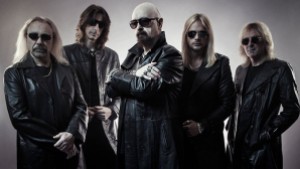 Its by now been a week or two since this album was released, and while the press has properly conveyed just how earthshaking a release this is and the band seems to know it too, I wonder if we’re still some months or years away from truly defining its impact on the band’s ultimate legacy. No longer can it be written that Painkiller was the last high point, that the band limped on through the Ripper years and when Halford rejoined, they staggered on with some semi-decent records before calling it a day. I’ll hammer this point again and again, that Ritchie Faulkner rejuvenated the Judas Priest songwriting machine and with his tenure in the lineup, they’ve released two knock out albums back to back including this one which is downright intimidating in its blistering attack. Its a case not only for the greatest concluding chapter a legacy metal (or rock) band has ever had on a creative level (Maiden’s post-reunion commercial success is hard to match), but also for the argument that new blood in long running bands can work to maximize the potential of a legacy sound. Fellow Brits Cradle of Filth enjoyed similar creative renewal with their past two efforts with new six stringers in the band, and its been a marvel to behold. Draw whatever conclusions you may from this, but its been a revelation as a fan of so many bands that have changed members and lost certain core songwriting teams. It begs the question: Who’s next up?