
 Sunday, September 22nd, marked the official Autumnal equinox, and even though the temperatures here in Houston will still reach the 90s this week, there were signs in the air that the seasons had truly changed. It was in the sounds of an NFL Sunday escaping from the television, the outdoor smells of burning wood and grilling meats, the sights of a grey, overcast sky, and of course, the feel of much cooler breezes. In case you haven’t noticed, I’m pretty big on this time of the year, and of course I tend to gravitate to listening to those bands that tend to provide a suitable Fall soundtrack. One of these bands is Insomnium, whom I began to get into heavily last year around this same time after years of seeing their name pop-up repeatedly. This surging interest perfectly coincided with the chance to see them live in November supporting their One For Sorrow album, and I still remember the anticipation of the drive to the venue, the electricity of one of the most intense performances I’ve ever seen, and the shaking exuberance of the drive back home in the chilly late night air.
So perhaps my perception of time is distorted a bit, in terms of gauging my stunned surprise to the fact that four days ago on Thursday, September 19th the band released their new single “Ephemeral”. Seeing that One For Sorrow was released in 2011, a full year prior to my becoming a die hard fan, I might be projecting my personal timeline with the band over their working, reality based timeline. But it seems to have come as a welcome surprise to most of their fans, as the band had been recently posting cryptic Facebook posts for awhile hinting at something coming down the pike, only for it to end up being the release of a rather absorbing documentary on the making of One For Sorrow. So when another of these cryptic hint posts showed up on my Facebook feed, I figured it would be another retrospective based release, certainly not new music. That it actually ended up being so capped off what was the best week of the year for metal releases. And I can’t think of a better way to usher in the Fall than with new Insomnium music.
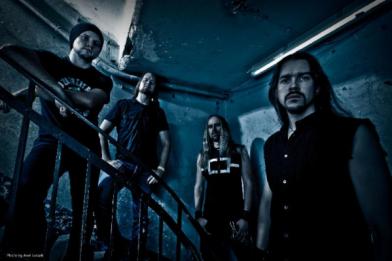 This single release is actually an EP to be precise, a collection of four tracks, the aforementioned “Ephemeral” and three acoustic based instrumental tracks. The title track kicks us off; a just under four minute slice of tempered Insomnium styled melo-death and its our first taste of the band’s slightly different take on their sound. Noticeably there is a lack of the band’s usual penchant for a slower, lengthy musical intro —- before we know it we’re launching headlong into a twice repeating up tempo verse section that accelerates into a nicely worked bridge, before exploding with a gush of ultra melodic guitars in the chorus. Whats striking here is the interesting tempo progression, a rhythmically uptempo verse to be sure, followed by an even faster bridge, and finally the guitars take the lead in the chorus to push the song to the speed limit. As usual for a band of their songwriting talent, Insomnium’s keen ear at layer separation between instruments is the key attribute at work here —- notice that the vocals continue from section to section at their own pace, never feeling the need to match the rhythm section or guitar leads. This song is catchy as hell. Probably more than any other melo-death band, Insomnium seems to have a never ending supply of ear worms that they liberally sprinkle all throughout their songwriting.
I want to point out the exceptional lyrics here as well. As lyricists, Insomnium have tended to lean towards the bleak, morose, and often flat out depressing —- but they always temper that approach with an underlying layer of optimism, or for lack of a better term, hope. On “Ephemeral”, verse lyrics speak to us of the grimness of living: “For this life will break you / Years will wear you down / And every day you die a little / Until the shadows will take you”, a plainly laid out sentiment that no one has managed to express as well since Sentenced. But the refrain that follows in the chorus is one of Insomnium’s best moments lyrically, a Norse mythological ethos steeped expression of sheer will: “Dying doesn’t make this world dead to us / Breathing doesn’t keep the flame alive in us / Dreaming doesn’t make time less real for us / One life, one chance, all ephemeral”. In my experience with Insomnium, its the melodies that draw me in first, but vocalist Niilo Sevänen’s perfect blend of harsh vocals with clear enunciation prevent these lyrics from just melting into the background. This song’s been on a regular rotation for the past few days and will probably stay there for weeks more at least.
 There are three other cuts on this EP, as mentioned before, they are short atmospheric, acoustic instrumentals that actually served as the soundtrack to their One For Sorrow documentary. And before you yawn, let me assure you that they work within the context of this release. I suppose the obvious thing would be to say they were soothing, and at times they were, but “The Swarm” kicks off with a Jester Race sounding acoustic strum that is almost waltz-like in its tempo, bringing to mind the best era of that famed Gothenburg sound. They’re all good pieces, and nice to have in addition to the main attraction, but I think it would have been far more interesting had they re-recorded a few tracks from their back catalog in an acoustic format, perhaps with clean vocals over them? Ah can’t win them all. Regarding the documentary, I loved every minute of it, and its starkness in tone matched the band’s musical qualities, right down to the directorial decisions —- its worth checking out on YouTube. That coupled with the new single has me more anticipatory than ever, could a new album possibly arrive before year’s end? If not at least Autumn is finally here.
[youtube=http://www.youtube.com/watch?v=5DjmQXtZUx4&w=480&h=360]
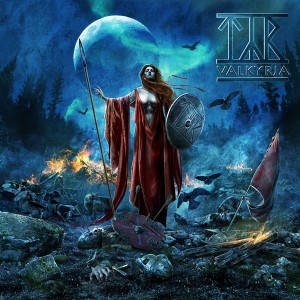 Some of you may already know that I’ve been pretty big on Týr, they are a rarity in metal —- a band with a sound that is truly all their own. I once overheard a conversation on the floor of a Nightwish/Kamelot show where someone was trying to describe Týr to his friend by comparing them to other bands. If I recall correctly, he name dropped Korpiklanni somewhere in the conversation. No… just, no. There are your bog standard, numerous, often copycat folk and “Viking” metal bands, and then there are artists like Týr who elevate the entire subgenre to a level of literary and musical excellence. Even their cover art is goddamned jaw dropping (look at that picture over there and tell me you don’t want a framed poster of that on your wall). In a way the artwork is a microcosm for the band’s sound; punishing yet harmonious, epic yet understated in the most elegant way.
 My favorite of these surprises came in the form of Týr’s first collaboration with a well known metal vocalist, namely Leaves Eyes’ own Liv Kristine, who shines on the stormy power (and I mean POWER) ballad “The Lay of our Love”. This will make the best songs of the year list without a doubt, its one of those rare songs that made me stop what I was doing while listening and really pay attention, and when it was over, I replayed it again and again. Týr hit me right in my metal guilty pleasure wheel house here, a delicate ballad with an acoustic intro, set to tempo by distantly thundering bass lines with a guitar solo might rank among the most memorable the band has ever composed. Kristine’s vocals are well renowned for her ability to match ethereal tone with sheer vocal heft and power, and when she begins to soar in the chorus alongside Joensen’s rough hewn voice, the theme of the album comes alive. They made a great choice selecting Kristine to handle the guest spot, and it makes me wish I could enjoy her main band more.
 Well its finally here. Years after I first saw Carcass in 2007 at a dingy downtown Houston club playing the headlining slot of a godawful Texas Death Metal Fest and wondered if they were going to attempt to follow up… erm, Swansong, they have returned with a new album at last. And the thing is, my anticipation for it all those years ago when I relished the opportunity to hear “No Love Lost” live has gradually diminished over the years —- I think in part because I wondered what was taking them so long, and that maybe their return was really just about unleashing the classics night after night and making a living off it. Hey, that’s fair enough, they’d have all right to do so if its all they were content with. But noise was made by both Bill Steer and Jeff Walker that they were interested in the idea of doing a new record. So for years we’d read this stuff, doled out in Blabbermouth-sized bites with hopes raised that it could be soon, only to have soon pass by with nothing to show for it. I think that if many of us are totally honest, we all probably stopped caring after awhile.
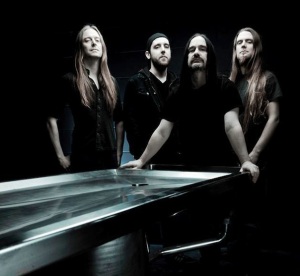 Highlights abound, the much praised “Captive Bolt Pistol” turns in one of Steers more memorable series of solos —- strings of tornadic like fret patterns over a bed of thrash riffing that recalls Megadeth’s Rust In Peace era. Speaking of which, I get a Deth like vibe on the album closer “Mount of Execution”, which starts off with a memorable slow melodic bend before it launches into a midtempo-ed gallop for the majority of the track, Walker spitting out Mustaine laden vocals that actually do approximate melodic singing at various points. It sorta feels like 1992. “A Congealed Clot of Blood” storms along until the end of the song where we’re treated to a classic tri-tone laden symphony of guitars, capped off by an amazing middle solo… its a rare moment of quiet in an album that is 95% blistering attack. I love “The Master Butcher’s Apron” which is about exactly what the title suggests —- this might feature the best riff on the album, a slow, almost Metallica “Sad But True” echo to the tempo and rhythm guitar pattern (anyone else hearing that?). Wilding’s fills are incredibly complex, the kind of satisfying metal drumming that seems to be all too rare. My favorite moment on the record comes at the end of the best song on offer here, “316 L Grade Surgical Steel”, a perfect Carcass song in every way: Tremendously catchy main riff, Walker’s strategically paced vocals with lyrics turned dark and reflective —- the awesome ending section is worth pointing out alone, Walker barks against stop-start fire of riffs and percussion: “Don’t tell me that you want / Don’t tell me that you need / Don’t tell me that you love / Don’t tell me that you care / Don’t fool yourself”.
 Its highly unlikely that any of us would have been able to predict that the quietly touted new sound of Satyricon would sound exactly like what we’re hearing on their newly released eighth album. When the band announced a lengthy hiatus after completing the touring cycle for 2008’s “The Age of Nero”, they walked away saying that a comeback would have to include a revamp of their sound, which was essentially a silent way of saying that they had taken their straight ahead, black n’ roll style of the past decade as far as it could go. Upon reading that statement I found myself wondering, well, where could they take their sound? Its either go back to their roots by bringing back the symphonic elements of the Nemesis Divina era and perhaps mix it with slight touches of black n’ roll, or go off into some totally random avant-garde offshoot ala Ihsahn and perhaps “treat” us to bewildering saxophone laden weirdness. The thing with black metal is that when you really boil it down to its component parts to attempt to merge it with other non-black metal elements, there’s not a lot left out there that hasn’t been done. And maybe I’m just reading into something that was never there, but I felt that when Satyricon made that pre-hiatus declaration, they were speaking in reference to black metal as a whole, and not just the sound of Satyricon.
 And when I describe the album with a term like that, I suppose I had better really explain what I mean. This is proving to be the most difficult album I’ve ever had to write a review for, because I believe I understand what Satyricon are trying to attempt to capture here, but I’m finding it difficult to spell it out in words. I’ll give it a shot here: If you can look at older Satyricon as symphonic driven black metal, and recent Satyricon as a raw, unadorned, black n’ roll reaction against that, then new Satyricon exists not in between those polarities, but outside of it —- looking in. Their musical shift from their earlier sound to their recent sound was a process of addition by subtraction. Their new sound then, is born not from further addition or subtraction of black metal musical elements, but by simply rewriting the equation with new elements altogether, some black metal, and some just plain musical. The most distinct element is a noticeable sense of softness that comes not only from an organic, warm analog production, but from the liberal manipulations of space in relation to instrumentation.